€240,000. That is how much money is at stake when you sign a ten-year commercial lease with a monthly rent of €2,000. With a rent of €3,000, it is €360,000. This is not an abstract scenario, but the everyday reality for restaurateurs, retailers, doctors, agencies and craft businesses.
Even so, many business owners sign the lease presented to them by the landlord without having it checked. That is understandable: the premises are suitable, time is pressing, and the landlord has other interested parties. But it is a mistake that is difficult to correct later – because in commercial tenancy law, you are not protected by the statute, but only by the contract.
Note: This article is for general information and does not replace individual legal advice. Commercial lease agreements are complex, and every contractual situation is different. Have your specific agreement checked by a lawyer before signing.
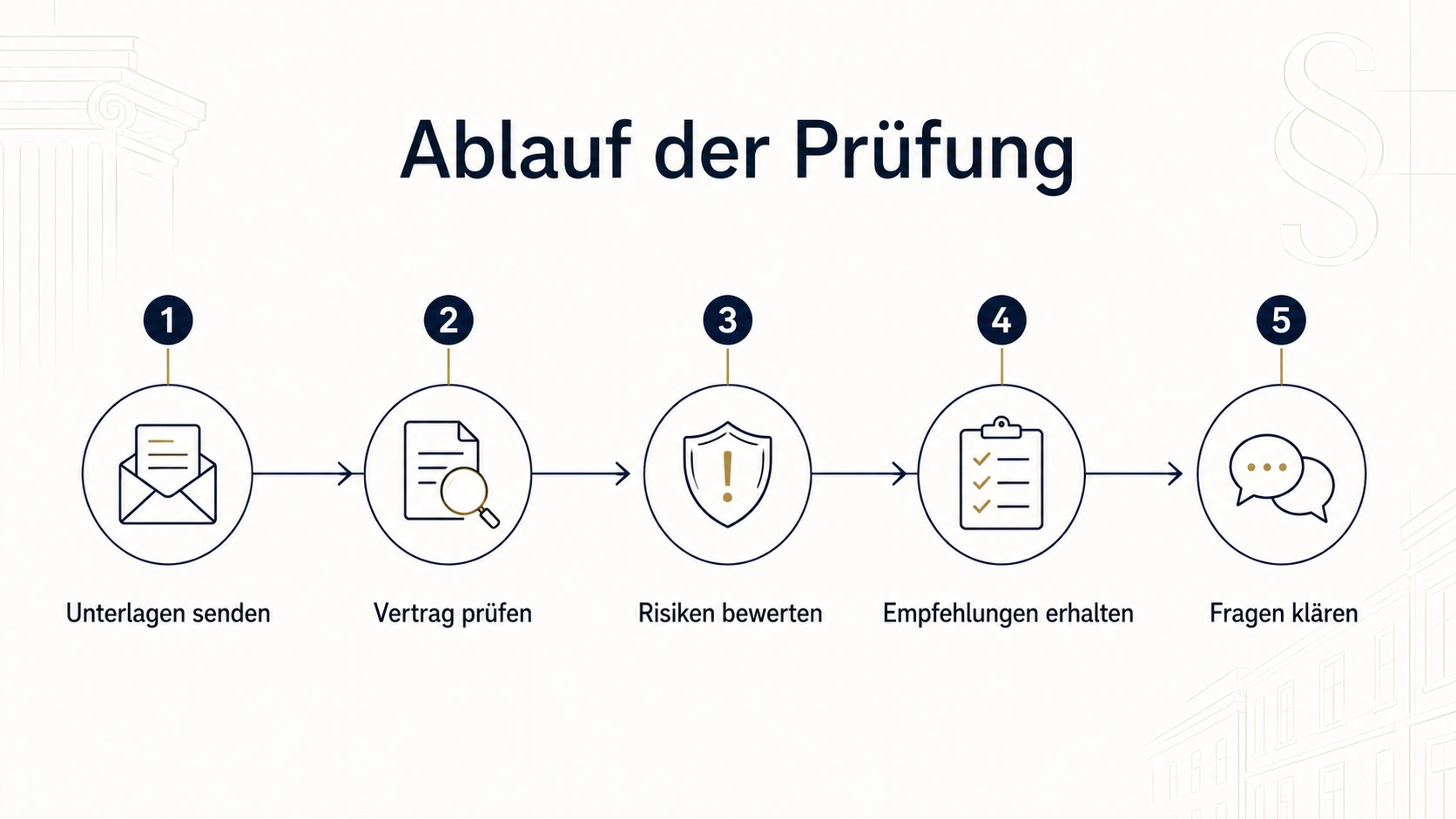
Contract review process
- Initial contact and initial assessment. You briefly describe the situation to us: type of rooms, planned usage, duration, time pressure. We will tell you whether and to what extent an inspection is advisable. This initial assessment is free of charge.
- Submission of documents. You will send us the draft contract and the corresponding attachments by email.
- Exam. We are analysing the draft clause by clause and comparing it with current case law and the market standard.
- Report and meeting. You will receive a written evaluation and discuss the priorities for the renegotiation with us.
- Subject to agreement: Negotiable. We formulate proposed amendments and, upon request, handle the correspondence with the landlord.
What documents do we need?
- The complete draft contract, including all annexes
- Floor plan or layout, if available
- For existing contracts: the original contract and all amendments
- Previous service charge statements, if the tenancy is currently in force
- Relevant correspondence with the landlord, including emails – since the form reform, these can already constitute contract amendments
What you’ll get from us
An analysis of the draft contract, covering all critical clauses; specific wording suggestions for renegotiation; and an assessment of which clauses are standard practice in the industry and where the draft deviates from market standards to your disadvantage. The cost of a review is generally disproportionate to the sums involved in a long-term commercial lease.
What we look out for during the audit
The following ten points are the areas where commercial tenancy agreements most frequently prove to the tenant’s disadvantage in practice. They also form the framework for our review.
Unclear operating costs regulation
Under residential tenancy law, the Service Charges Regulation sets out an exhaustive list of costs that may be passed on to tenants. This does not apply under commercial tenancy law: the landlord may pass on almost any type of cost, provided that the agreement is transparent and specific.
Many draft agreements exploit this. Wording such as „operating costs in accordance with Section 2 of the BetrKV and other operating costs“ leaves it unclear what these „other costs“ are supposed to be. The bill then includes centre management fees, administration charges or maintenance levies that nobody was expecting. Courts have ruled that clauses listing the term ‘administration costs’ without providing a definition are non-transparent and invalid – for more on this, see our article on Clauses relating to ancillary costs and the requirement for transparency.
Please note: Insist on a final breakdown of all apportionable cost categories. You cannot be charged for anything that is not expressly stated in the contract. And do not rely on the twelve-month period familiar from residential tenancy law: Section 556 of the German Civil Code (BGB) does not apply to commercial premises.
2. Unlimited maintenance obligation
According to the case law of the Federal Court of Justice (BGH), a standardised clause transferring all maintenance and repair costs to the tenant without any limit on the amount is invalid; it contravenes Section 307 of the German Civil Code (BGB). Nevertheless, such clauses are found in many draft tenancy agreements: „The tenant shall be responsible for all maintenance and repair work on the let property.“ It sounds unambiguous, but in this form it is generally invalid.
Effective maintenance clauses must limit the tenant’s liability to damage attributable to the use of the property and specify a cost ceiling – on a case-by-case basis and per year. In particular, the tenant must not be held liable for pre-existing damage dating from before the tenancy began.
3. Lack of protection against competition
Every commercial tenant is afforded protection against competition as an inherent part of the contract, even in the absence of an express agreement: the landlord may not let premises to direct competitors on the same site or on an immediately adjacent site.
Many landlords exclude this protection by contract. That is generally permissible – but the Federal Court of Justice (BGH), in its judgment of 26/02/2020 (XII ZR 51/19), drew a line: the standard-form exclusion of competition protection in a shopping centre while simultaneously imposing an operating obligation with a range-of-goods restriction unreasonably disadvantages the tenant and is invalid. Details in our article on Protection against competition and the obligation to operate.
Please note: Request an explicit non-competition clause with clearly defined scope in terms of both business activities and geographical area. If the landlord refuses, the obligation to operate the business should at least be waived, or it should be possible to adjust the product range.
4. Index-linked rent without a cap
A basic rent of 3,000 euros, an indexation clause with no cap, and eight per cent inflation: a rent increase of 240 euros per month, or 2,880 euros per year. This increase is permanent and forms the basis for all future adjustments. The inflation spikes of 2022 and 2023 have shown many commercial tenants just how quickly an indexation clause can become a burden.
Please note: A pro-rata adjustment – for example, 70 per cent of the rise in the index – or an annual cap are negotiable. Both are common practice, but are rarely offered of their own accord. Value protection clauses are also subject to the Price Clauses Act and, in standard form contracts, to the review of general terms and conditions.
5. Fixed runtime without exit
Five years, ten years, sometimes longer. This provides certainty regarding the location, but also ties you in financially – even if you have long since vacated the premises. Three clauses limit the risk: a break option after 24 or 36 months, a contractually guaranteed right to re-let the property under objective conditions, and clear rules on subletting. Our guide covers the notice periods and grounds for termination Termination of the Commercial Lease Agreement.
6. Area deviation without tolerance limit
If the floor area is ten per cent smaller than stated in the contract, you will end up paying around 48,000 euros too much over ten years, based on a monthly rent of 4,000 euros. Unlike residential tenancy law, commercial tenancy law does not have a statutory materiality threshold; some contracts even expressly exclude adjustments for deviations of up to ten per cent.
Please note: Agree on a narrow tolerance, have the area measured independently before signing the contract, and specify the measurement standard – DIN 277 and the gif guidelines are the commonly used standards. Our article on Determining the lettable area.
7. The formal trap following the reform
Since 1 January 2025, commercial tenancy agreements with a term of more than one year need only be in writing (Section 578(1), second sentence, of the German Civil Code (BGB) in conjunction with Section 126b BGB). A handwritten signature is no longer required. A transitional period applied to existing contracts; this ended on 1 January 2026, and since 2 January 2026, the written form has also applied to them.
Important: Written termination has thus lost a great deal of significance, but is not ruled out in every case. A prior formal defect is only remedied to the extent that the currently relevant text form is actually observed. If the agreement in question – such as an oral collateral agreement – does not exist in text form either, the defect persists.
This simplified approach also has a downside: if an email can constitute a contractual amendment, there is an increased risk of inadvertently agreeing to something. Even a quick message to the landlord can be legally binding. For more details, see our article on Written form and text form in commercial lease agreements.
8. Decommissioning and Conversion Costs
A restaurant owner spends 80,000 euros on fitting out his rented premises – kitchen, ventilation system and dining area. When the lease expires, the landlord demands that the premises be restored to their original condition: another 40,000 euros.
Please note: Before the tenancy begins, clarify which alterations require planning permission and who bears the risk of non-approval; whether, and to what extent, there is an obligation to restore the property to its original condition; whether fixtures may be removed; and whether compensation is payable for improvements that increase the property’s value. An inspection report at the start of the tenancy is essential. For further reading: our article on tenant's obligation to return the property.
9. Termination clauses to the detriment of the tenant
Under Section 543( 2(3) of the German Civil Code (BGB), the landlord may terminate the tenancy without notice if the tenant is in arrears with the rent, either in full or to a not insignificant extent, for two consecutive payment dates, or if arrears amounting to two months’ rent have accumulated over a longer period. Contracts often contain different, stricter provisions; these are subject to scrutiny under the law governing standard terms and conditions and may be invalid.
Important – a common misconception: In the event of termination for arrears of rent pursuant to Section 543(2)(3) of the German Civil Code (BGB), a prior Warning letter statutory not required. And the grace period payment known from residential tenancy law does not apply in commercial tenancy law: anyone who pays the arrears after receipt of the termination does not cure them thereby.
Conversely, the tenant also has rights of termination that are often overlooked. The Federal Court of Justice (BGH) confirmed in a ruling dated 06.10.2021 (XII ZR 11/20): If the landlord deliberately draws up incorrect service charge statements and persists in doing so despite justified objections, the tenant may terminate the tenancy without notice.
10. Lack of Regulation on Subletting
Relocation, restructuring, merger: there are many reasons for wanting to transfer or sublet a tenancy agreement. Without a contractual provision, you need the landlord's consent. Clauses that leave a transfer to their absolute discretion leave you unable to act in a difficult situation.
Please note: Agree on objective approval criteria – creditworthiness of the new tenant, compatibility of the business sector, suitable usage concept. The landlord may then only refuse for factual reasons.
Why commercial rent is not residential rent
The central difference in one sentence: In Residential tenancy law protects the legislature protects the tenant, whereas in commercial tenancy law only the contract protects them.
| Subject | Residential rent | Commercial rent |
|---|---|---|
| Protection against dismissal | Comprehensive legal protection (§ 573 BGB) | None; purely contractual arrangement |
| Rental price | rent cap, rent increase limit | No legal limit |
| Operating costs | Catalogue of the BetrKV, settlement period twelve months | Freely negotiable; no statutory billing deadline |
| Maintenance | Landlord obligation; only minor repairs transferable | Largely transferable, in standard form contracts only with a cost ceiling |
| Grace period payment | Yes (§ 569 para. 3 BGB) | No |
| legal form for over a year | Written form (§ 550, § 126 BGB) | Form (§ 578 para. 1 sentence 2, § 126b BGB) |
| Freedom of contract | Severely restricted by mandatory law | Almost unlimited |
The draft contract almost always comes from the landlord and is designed in such a way that the economic risk is shifted as far as possible onto the tenant. That is legal – and precisely why checking it is worthwhile. Our provides a complete overview of the structure and content of a commercial lease agreement Guide to commercial lease agreements.
Already signed? What is still possible now
- Identify ineffective clauses. Many of the clauses described above are invalid as standard terms and conditions and do not have to be followed, even if they are in the contract.
- Negotiate a contract modification. An existing tenancy agreement can be amended by means of an addendum. Landlords often have a vested interest in a clean-up, for example in the event of a change of ownership or refinancing.
- Check utility bills. Incorrect bills can also be disputed retrospectively; the limits arise from limitation periods and forfeiture.
- Check for rights of extraordinary termination. Formal defects, a breach of non-competition protection or significant defects in the rental property can be grounds for extraordinary termination.
Pre-signature checklist
- Operating costs – final list of all cost categories? Contractual billing period agreed?
- Area – independently measured? Tolerance limit agreed? Uniform scale?
- Rent increase – Index clause capped? Adjustment intervals clear?
- runtime – Fixed term appropriate? Break clause included? Automatic renewal checked?
- Protection against competition – agreed or excluded? If an obligation to operate exists: combination of clauses checked?
- Purpose of use – wide enough for future adjustments? Who bears the approval risk?
- Conversion and dismantling – Authorisation procedures regulated? Decommissioning obligation defined? Acceptance protocol agreed?
- Legal advice on tenancy bonds and rent increases – Are the extension and cancellation deadlines realistic? Are special termination rights available?
- Subletting – objective approval criteria agreed?
- Security deposit – Height and form appropriate? Settlement arrangements at the end of the tenancy sorted?
- Form – Text form maintained? All authorised representatives named? Old written form clauses updated?
- Cosmetic repairs – Scope defined? Condition upon handover documented?
Frequently asked questions
How much does a contract review cost?
That depends on the scope of the contract. In the initial assessment, which is free of charge, we will tell you what effort to expect before you decide.
How long is the exam?
Usually a few days. If there is time pressure because the landlord has set a deadline, let us know during your initial contact – urgent reviews are possible.
Can I terminate my commercial lease agreement early?
As a general rule, not with fixed-term contracts. Possible options include a contractual break clause, a statutory ground for extraordinary termination pursuant to Section 543 of the German Civil Code (BGB), or a mutual agreement Cancellation agreement.
As a commercial tenant, do I have to bear maintenance costs?
Only if this is agreed in the contract; without such a provision, the landlord remains responsible (§ 535 para. 1 German Civil Code (BGB)). Standard contract clauses that impose all maintenance costs on the tenant without an upper limit are invalid according to the case law of the Federal Court of Justice (BGH).
What has applied to the form since the reform?
Since 1 January 2025, text form is sufficient for new contracts, and from 2 January 2026 also for existing contracts. However, a past formal defect is only cured to the extent that the agreement currently exists in text form.
Do I have protection from competition as a commercial tenant?
Yes, even without an express agreement, there is inherent protection against competition arising from the contract. This can be excluded by contract, but in a shopping centre not in combination with an obligation to trade with range-of-goods restrictions.
What is the maximum security deposit for commercial premises?
There is no statutory upper limit as there is for residential property. In practice, three to six months' rent is customary. The form – cash deposit, guarantee or a combination – is freely negotiable; make sure you pay attention to a clear settlement deadline after the end of the tenancy.
Can a summary dismissal due to default in payment be averted by subsequent payment?
No. The grace period payment under Section 569 (3) of the German Civil Code (BGB) only applies to residential property. In commercial tenancy law, the termination remains valid.
Important Note: The content of this article has been prepared to the best of our knowledge and belief. However, due to the complexity and constant evolution of the subject matter, we must exclude liability and warranty. The content of this post has been created to the best of our knowledge and belief. However, the complexity and constant evolution of the subject matter make it necessary to exclude liability and warranties. If you require legal advice, please call us without obligation on 0221 – 80187670 or write to info@mth-partner.de.