In short: A material description is misleading when an average customer interprets it differently than the product actually is (§ 5, Para. 2, Sentence 1, No. 1 UWG). Terms such as „pure“ or „100%“ must be consistent across the entire specified component. For textiles and footwear, additional statutory labeling requirements apply, already before purchase in the online shop. Violations can be fined by competitors, registered associations, and chambers.
„Pure wool upper material“, „100% cotton“, „vegan leather“: Material information is among the product information that customers pay attention to when buying – and among the information that is most often criticized. This article explains when a material claim is misleading, what labeling is required for textiles and shoes, how courts have judged individual terms, and how to respond to a warning.
Note: This article serves general information purposes and does not replace legal advice in individual cases. Whether a statement is misleading depends on the specific wording, structure, and target audience. If you have any questions, please contact us. Warning letter received, Have them examined before you sign a settlement agreement.
When is a material statement misleading?
After Section 5, paragraph 1 of the UWG It is unfair for someone to engage in misleading business activity that is likely to cause consumers or other market participants to make a business decision that they would not have made otherwise. A statement is misleading if, among other things, it contains false or deceptive information about the essential characteristics of a product. The law explicitly mentions the following: Composition and the Quality (Section 5, paragraph 2, sentence 1, no. 1 UWG).
What „misleading“ means in competition law
A statement does not have to be false to be misleading. It is sufficient that an average informed, attentive, and understanding customer understands it differently from the facts. Whether the advertiser wanted to deceive does not matter. What matters is the impression the statement creates in the public.
For material specifications, there are three rules:
- Absolute terms are taken literally. Anyone who writes „purely“, „100%“ or „completely natural“ promises that no other material is included.
- Collective terms encompass the entire component. By „upper material“, the customer understands everything that is located above the sole – not just the largest part of it.
- The first impression counts. A reference to a hidden place usually does not correct a misleading main statement. The extent to which courts base their understanding of the public on advertising is also shown by the advertisements with New recordings as „Number 1 Hits“.
One example is a judgment of the Düsseldorf Higher Regional Court of Appeal of October 5, 2010 (I-20 U 180/09): A retailer advertised children’s hiking shoes with „upper made of pure wool – cuddly knit fabric“; however, the knit cuffs consisted of polyacrylic. The court found the advertisement misleading because consumers understood „upper“ to mean the entire shoe, including the knit cuffs. The basic principle remains valid to this day: Anyone who advertises with a material designation must be accurate with that designation for the entire component in question.
How have courts assessed individual material terms?
The following overview summarizes decisions regarding frequently used material designations. It also shows how strongly the result depends on the wording and design of the offer.
| Term | Court | Outcome |
|---|---|---|
| „Outer material pure virgin wool“ (wristband made of polyacrylate) | Higher Regional Court of Düsseldorf, 05.10.2010 – I-20 U 180/09 | Misleading: „Upper material“ also includes the cuffs. |
| „Merino wool“ as a fiber designation | Higher Regional Court of Hamm, 02.08.2018 – 4 U 18/18 | Not permissible: no fiber designation in the Textile Identification Regulation. |
| „Cotton“ instead of „cotton“ | Supreme Court of the Federal Republic of Germany, 31.10.2018 – I ZR 73/17 | Violation of the regulation, but not noticeable: Customers understand „Cotton“ as cotton. |
| „Acrylic“ instead of „Polyacrylic“ | Higher Regional Court of Munich, 20.10.2016 – 6 U 2046/16 / Higher Regional Court of Frankfurt, 14.01.2021 – 6 U 256/19 | Ununiform: The Munich Higher Regional Court considered the violation to be significant; the Frankfurt Higher Regional Court denied it, because customers understand „acrylic“ as polyacrylic. |
| „Textile leather“ (without leather component) | Higher Regional Court of Hamm, 08.03.2012 – I-4 U 174/11; Higher Regional Court of Bamberg, 21.03.2012 – 3 U 219/11 | Misleading: Customers expect a leather component. |
| „Apple leather“ / „vegan leather“ | LG Hannover, 2019 / OLG Celle; OLG Cologne, 04.07.2025 – 6 U 51/25 | Depending on the design: permissible where „vegan“ was prominently featured in the product name (Hanover/Celle); inadmissible where the indication only appeared in the expanded product description (Cologne). |
Individual decisions do not bind other courts. The overview shows trends, but does not replace the examination of one's own wording.
Which marking applies to textiles in the online shop?
The same applies to clothing and other textile products. Textile marking regulation (EU) No. 1007/2011, supplemented by the German Textile Labeling Act. It stipulates how the fiber composition must be indicated:
- Only approved fiber designations. The designations are listed exhaustively in Annex I to the regulation. Terms of their own, such as „merino wool“, or English designations such as „cotton“, do not correspond to them.
- Weight percentages in mixed tissues. For several fibers, all fibers with their weight percentage are to be listed in descending order.
- „Pure“, „entirely“ and „100%“ Only products that consist exclusively of a fiber may be labeled with these additives. These additives are not mandatory (ECJ, judgment of 05.07.2018 – C-339/17).
- Indication before purchase. The fiber composition must be visible in the online shop before the customer places an order. The obligation begins as soon as the product is offered for order (BGH, judgment of 24.03.2016 – I ZR 7/15).
If the required fiber information is missing in the online offer, a significant piece of information is withheld from the customer: Information obligations under EU law are considered essential (Sections 5a, 5b Paragraph 4 UWG). However, not every labeling error is actionable. Whether a violation is noticeable depends on the individual case; for example, the BGH did not object to the use of „Cotton“ instead of „Cotton“.
What material information is required for shoes?
The same applies to shoes Section 10a Requirements for the object of the contract, With this, Germany has implemented the EU directive 94/11/EG. The material of three components must be specified:
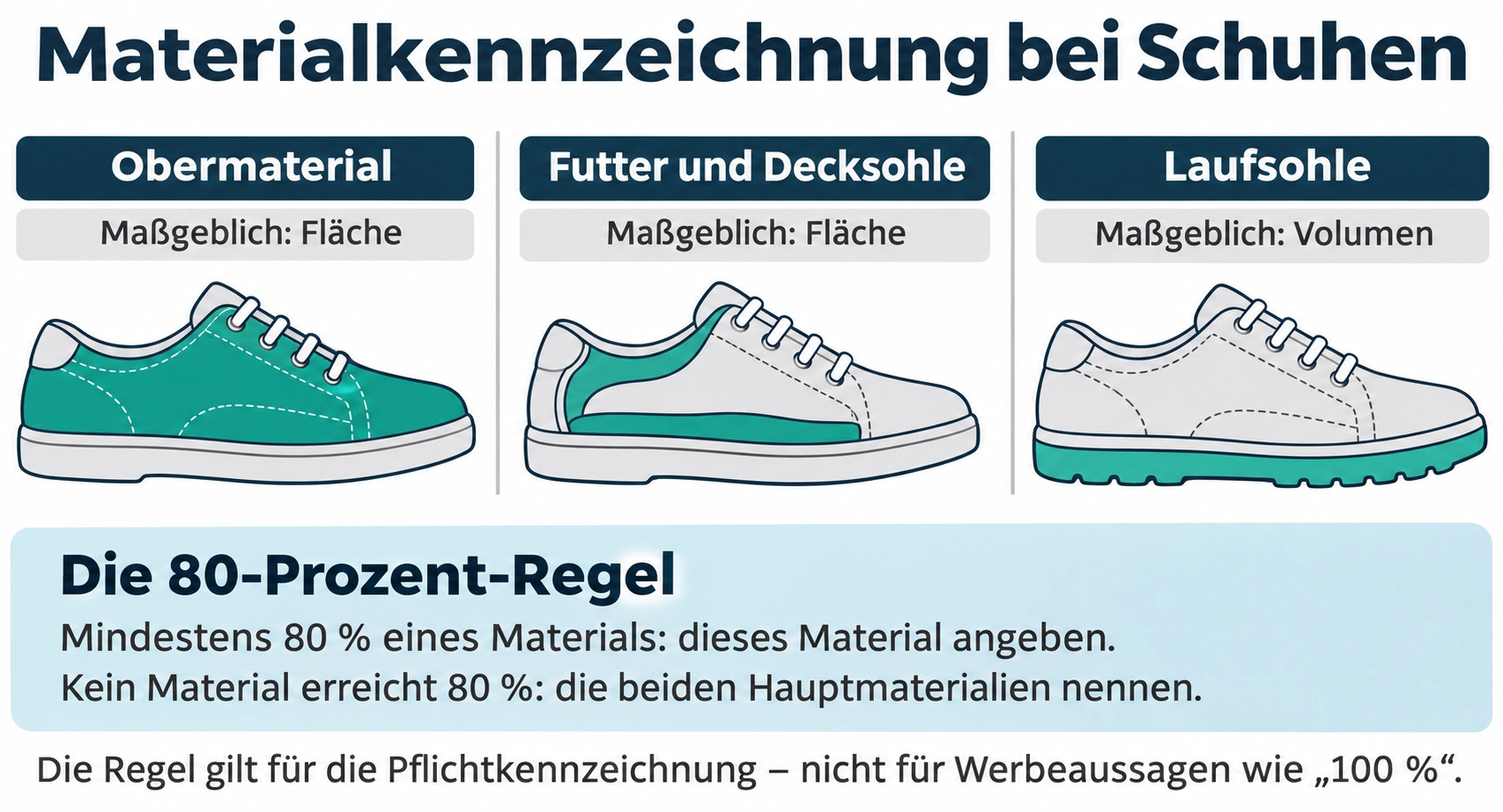
- Upper material – the area is crucial.
- Feed and sole – the area is also crucial.
- Running sole – the volume is crucial.
If a material makes up at least 80% of the component, the mention of that material is sufficient. Otherwise, the two main materials must be mentioned. The mention can be made using the standardized pictograms or in writing. Accessories such as buckles or eyelets are not considered part of the main material.
The 80 percent rule simplifies the mandatory labeling requirement. It does not apply to advertising: Anyone who explicitly advertises with „pure“ sheep wool or „100 percent“ leather is making an additional statement that must be consistent with the entire product. This is exactly what the advertising in the Düsseldorf case failed to achieve.
Is it allowed to write „vegan leather“ or „apple leather“?
There is no specific legal regulation for leather. The guiding principle is the prohibition of misleading advertising. When referring to „leather“, customers mean a material made from tanned animal skin. Whether an additional term such as „vegan“ or „apple“ clearly indicates that no leather is present depends on what the customer actually sees:
- In the proceedings before the LG Hannover (2019) and the Higher Regional Court of Celle It was about bags from a manufacturer where „vegan“ was already prominently featured in the product name. The association of the German leather industry’s lawsuit remained unsuccessful; „vegan leather“ and „apple leather“ were allowed to be used.
- The Higher Regional Court of Cologne However, in 2025 it banned „apple leather“ for dog collars made from apple leftovers (judgment of 04.07.2025 – 6 U 51/25). There, „apple leather“ was prominently featured in the product overview and on the detail page. The customer only noticed the „vegan“ label when he opened the product description. The addition „apple“ alone did not make it clear enough that no leather was used. The decision was made in an expedited procedure.
- „Textile leather“ The OLG Hamm and the OLG Bamberg have judged this to be misleading. „Artificial leather“ The Bamberg Regional Court held that this was not problematic, because the addition „Kunst-“ clearly indicates an artificial material.
The decisions therefore do not contradict each other in principle; the decisive factor was always the specific design of the offering. Those who want to be sure use „synthetic leather“ or mention the actual material, for example „polyurethane“ or „material based on apple residues“.
What applies to environmental statements from 27.09.2026 onwards?
With the implementation of EU Directive 2024/825 („Empowering Consumers“), stricter rules for environmental claims have been in effect since September 27, 2026. This is relevant for material claims because advertising often relies on the material to convey „recycled,“ „sustainable,“ or „environmentally friendly“ claims:
- General environmental statements What is considered „environmentally friendly“ or „green“ is only allowed if an acknowledged outstanding environmental performance can be demonstrated, for example through the EU Ecolabel or the Blue Angel.
- Sustainability seal They are only permitted if they are based on a certification system with independent control or are established by the state. Even custom-designed seals are not sufficient.
- Specific material information What remains permissible is „70% recycled polyester“, if it is verifiable and proven.
- Transitional rule: For goods that were put into circulation before September 27, 2026, the determination of whether their enforcement is proportionate must be examined on a case-by-case basis for the claims referred to in § 15b of the UWG. The special regulation applies until September 26, 2028 inclusive.
Receiving a warning letter: What is at stake and what should be done?
Accusations may be made after Section 8(3) of the UWG:
- Competitors, who sell similar goods to a considerable extent and not just occasionally.
- Business associations, But only if they are registered in the list of qualified business associations with the Federal Office of Justice (§ 8b UWG).
- Consumer associations, if they are registered as qualified institutions with the Federal Office of Justice.
- Industrial and Commercial Chambers as well as chambers of commerce.
Whether the sender may be fined is therefore the first question to be examined. The lists of the Federal Office of Justice are publicly accessible.
The possible consequences of a legitimate warning letter:
- Failure to comply: The statement must be removed. As a rule, the person suing for a reprimand demands a criminal penalty for failure to comply. Those who submit it are liable to a contractual penalty for each future violation. Exception: In the case of a first-time reprimand for a violation of information and labeling obligations in online commerce (§ 13, paragraph 4 UWG), a competitor cannot agree to a contractual penalty if the reprimanded party generally employs fewer than 100 employees (Section 13a, paragraph 2 of the UWG).
- Fines for infringements: If the warning is justified and formally correct, the necessary expenses can be claimed (Section 13, paragraph 3 of the UWG). Competitors are not entitled to compensation for violations of legal information and labeling obligations in electronic business transactions (§ 13, paragraph 4, no. 1 UWG). This applies, for example, to a lack of textile labeling in the shop, but not to actively false advertising. This exclusion does not apply to associations.
- Damages: Intentional or negligent acts can result in competitors claiming damages. Since May 28, 2022, consumers have their own rights as well when they were induced to purchase through unfair practices (§ 9, paragraph 2 UWG).
- Penalty: In cases of widespread violations of consumer interests, authorities can impose fines (§ 19 UWG).
Claims for damages and claims for compensation from competitors expire after six months; the consumer’s claim for compensation under § 9(2) UWG expires after one year (Section 11, paragraph 1 of the UWG). The period of limitation begins as soon as the person entitled to a claim has learned of the violation and the responsible party, or without gross negligence on their part, would have had to have learned of it. In the case of a continuous violation, such as a misleading offer that remains online, the limitation period for the claim for damages usually only begins when the violation has ended.
The first steps after a warning
- Make a note of the deadline, but don't sign anything without checking it first. Reprimands usually impose a deadline of a few days. Do not let them expire; otherwise, an injunction with additional costs threatens.
- Check the information immediately and, if necessary, change it. Compare the product description with the actual material. If the discrepancy is found, correct it in the shop, on marketplaces, and in product data feeds.
- Have the warning letter itself reviewed. Is the sender entitled? Does the warning letter contain the statutory mandatory information (§ 13, paragraph 2 of the UWG)? Are there signs of legal abuse, such as mass warnings with inflated value amounts (§ 8c of the UWG)?
- Customize the disclaimer. Pre-formulated statements are often broader than necessary and include fixed, high contractual penalties. A customized statement eliminates the risk of repetition without tying you in more than necessary.
- Involve the suppliers. If the material information comes from the manufacturer, you are still liable as the provider yourself in the event of claims for damages.
How can material information be formulated in a legally sound manner?
- Name the components individually. Instead of „outer material: pure virgin wool“: better: „woolen fabric, knit cuffs made of polyacrylic“.
- Absolute concepts only at 100%. „Use “pure„, “entirely„ and “100%” only when only one material is present.
- Use prescribed designations. For textiles, only the fiber designations from the regulation, in German and with weight percentages.
- Do not assume manufacturer's claims without verification. Request material proofs, especially for private labels and imported products.
- Check the offers on the marketplace. The same rules apply on Amazon, eBay or Otto, including for offers generated automatically from data feeds.
Material information is not the only mandatory information in the online shop. Our guide explains which information should be included in the legal notice. Impressum erstellen and our contribution to Legal notice obligations under the Digital Services Act. Advertising with guarantees must also take the customer's understanding into account, see our contribution on Warranty promises in advertising.
Frequently asked questions
Is every false material statement misleading advertising?
No. The information must be suitable to prompt customers to make a purchase decision that they would not have made otherwise (§ 5, paragraph 1, UWG). In the case of material information, this is often the case, because the material determines price, quality, and maintenance. Minor deviations can be insignificant: the BGH considered „cotton“ instead of „cotton“ to be negligible (judgment of 31.10.2018 – I ZR 73/17).
Can I write „100% cotton“ when a seam is made of polyester?
If the fabric is made of cotton, ordinary polyester sewing threads may be ignored when specifying the fiber content, provided they do not replace chain or shuttle threads.
May I use „vegan leather“?
It depends on what the customer sees. If „vegan“ was prominently featured in the product name, the leather industry had no success before the LG Hannover and the OLG Celle. If the mention appeared only in the unfolded product description, the OLG Cologne banned „apple leather“ in 2025. „Artificial leather“ or the mention of the actual material are safer.
Do I have to pay the legal fees?
In a justified and formally correct notice of infringement, the costs are usually borne by the competitor (§ 13, paragraph 3 UWG). Competitors do not incur costs if the infringement concerns violations of information and labeling obligations in online trade (§ 13, paragraph 4, no. 1 UWG). In these cases, they cannot agree on a contractual penalty in the first instance if the infringer usually employs fewer than 100 employees (§ 13a, paragraph 2 UWG).
How long can a violation be reprimanded for?
Claims for damages are time-barred six months after knowledge of the violation and from the responsible party; consumer claims for damages under § 9(2) UWG are time-barred after one year (§ 11(1) UWG). If a misleading offer remains online, the period for claiming damages usually only begins when the violation has ended.
Received a warning letter regarding a product claim?
Send us the warning letter and the link to the offending offer. We will check whether the sender is entitled, whether the complaint is valid, whether the costs are due and how the cease and desist notice should be formulated – before the deadline expires. More about our advisory service Internet and competition law.
Telephone: 0221 - 80187670
E-Mail: info@mth-partner.de
Author: Lawyer Helmer Tieben, MIntTax (University of Melbourne); admitted to the Bar of Cologne since 2005. Office address: Sachsenring 34, 50677 Cologne.
Jurisdiction: November 2026, including the UWG amendments to environmental statements of September 27, 2026.
Important Note: The content of this article has been prepared to the best of our knowledge and belief. However, due to the complexity and constant evolution of the subject matter, we must exclude liability and warranty. Important Notice: The content of this article has been created to the best of our knowledge and understanding. However, due to the complexity and constant changes in the subject matter, we must exclude any liability and warranty.