
Objective and principles of skilled labour immigration
The German Residence Act (AufenthG) aims to control immigration to Germany, taking into account the economic and labour market policy interests of the Federal Republic. In particular, the targeted promotion of immigration highly qualified specialists a central role. This policy aims to strengthen the competitiveness of the German economy and counteract the shortage of skilled labour. Through a Sustainable integration The aim is to strengthen social security by integrating qualified workers into the labour market and society.
Within the legal framework, the Residence Act distinguishes between different Types of residence permits for the purpose of gainful employment, each of which includes specific requirements and authorisations. In principle, there are temporary Residence permits (e.g. for specialists or researchers), special forms such as the EU Blue Card for highly qualified employees with above-average salaries and permanent Establishment licences for skilled workers under certain conditions. The type of title that is considered in each individual case depends on qualifications, employment offer and other criteria.
Development of the regulations: EU Blue Card and skilled labour immigration reforms
A significant innovation in German residence law was the Introduction of the EU Blue Card The background to this was the EU Council's Highly Qualified Directive 2009/50/EC of 25 May 2009, which harmonised the conditions for entry and residence of third-country nationals for the purpose of highly qualified employment. The EU Blue Card represents a Temporary residence permit (usually up to four years), which enables highly qualified specialists from third countries to stay in Germany for employment. With the EU Blue Card, foreign academics can work in Germany if they fulfil certain salary and qualification requirements and later receive a settlement permit under simplified conditions. The purpose of this measure was to attract internationally sought-after skilled workers to Germany and offer them long-term prospects.
With the entry into force of the Skilled Labour Immigration Act On 1 March 2020, the provisions of Section 4 of the Residence Act were comprehensively revised and expanded. This reform brought considerable relief and new opportunities for labour migration. For example, the group of Specialists The right of residence has been extended beyond academic specialists to include people with qualified vocational training (Sections 18a, 18b AufenthG). The previous bottleneck reference (i.e. the restriction to shortage occupations) and the priority review were largely abolished, so that skilled workers with recognised qualifications in each qualified profession in Germany. New paths have also been created, such as a Residence permit for training and for the recognition of foreign professional qualifications, as well as facilitating the transition from the asylum procedure to training or employment. Overall, the Skilled Immigration Act 2020 aimed to make the immigration of skilled workers more attractive and practical and to better align it with the needs of the German labour market.
The provisions were modernised again in the following years. In particular, the German legislator 2023 - as part of the implementation of Directive (EU) 2021/1883 (revised version of the Highly Qualified Persons/Blue Card Directive) - the Residence Act was amended and extended once again. Most of these recent changes came into force on 18 November 2023 and 1 March 2024 will come into force (some parts on 1 June 2024) and aim to further facilitate access to the German labour market for foreign skilled workers. A key point of the 2023 reform is the introduction of a points-based „opportunity map“ for qualified job and training seekers from abroad, which enables a residence permit to search for a job in Germany even without a concrete job offer. In addition, the salary thresholds for the EU Blue Card have been lowered and the group of authorised persons expanded (e.g. certain experienced professionals without a university degree can now receive a Blue Card, provided they have comparable qualifications and a sufficient salary). Other changes include the simplified recognition of foreign professional qualifications (which now also includes Domestically can take place) and the cancellation of the Western Balkans regulation in the Employment Ordinance.
The constant adjustments and extensions to the statutory provisions emphasise the importance of a flexible and future-oriented immigration policy, which fulfils both the needs of the German economy and the legitimate interests of immigrants. Germany is continuously developing its right of residence for skilled workers and labour in order to remain attractive in the global competition for talent.
Residence permit for the purpose of gainful employment - overview
The following Possibilities The Residence Act (Chapter 2, Section 4 AufenthG) provides that foreign nationals may Residence in Germany for the purpose of gainful employment to make it possible. Here is an overview of the most important categories and respective residence permits:
Residence titles for skilled workers with vocational training - This includes persons who have a Domestic or recognised foreign qualified vocational training have concluded. In Germany you can as a specialist work, in principle in any qualified employment. Example:
-
Residence permit for a skilled worker with vocational training, § Section 18a AufenthG - Issues a residence permit to a professionally qualified skilled worker to pursue an occupation corresponding to their qualifications (without any professional restrictions).
Residence permit for skilled workers with academic training (studies) - These titles are aimed at University graduates and other academically qualified specialists. In addition to temporary residence permits, this group also has the option of permanent residence if they have special qualifications. These include
-
Residence permit for a skilled worker with an academic qualification, § Section 18b AufenthG - Residence permit for foreign academics to pursue qualified employment in Germany (corresponding to their university education).
-
Settlement permit for skilled workers, § Section 18c (1) AufenthG - One indefinite Settlement permit, which is issued to a skilled worker if they have held a residence permit as a skilled worker for at least three years (e.g. in accordance with § 18a, 18b or 18d) and fulfil other integration criteria (e.g. pension contributions, language skills).
-
Settlement permit for holders of an EU Blue Card, § Section 18c (2) AufenthG - An unlimited settlement permit that can be issued to EU Blue Card holders after just 33 months (or 21 months if they can prove German language skills at B1 level). The prerequisite is that the Blue Card holder has been in qualified employment without interruption during this time and has paid into the pension insurance scheme.
-
Settlement permit for highly qualified specialists, § Section 18c (3) AufenthG - In special cases shall highly qualified specialists with an academic education should be granted a settlement permit immediately. This applies in particular to Scientists with special expertise or Teachers in a prominent position, as long as their integration and livelihood appear to be secure. This exception enables top talents to obtain permanent status directly without having to stay for several years beforehand (although the state authorities may require approval).
Residence titles for research purposes - There are special residence permits for scientists and researchers that reflect the transposition of the EU Researchers Directive 2016/801 into national law. These titles make it easier for research projects and academic staff to stay in Germany and to be mobile within the EU. These include
-
Residence permit for the purpose of research, § Section 18d (1) AufenthG - Issued to foreigners who have a Research project at a recognised research institution in Germany (prerequisite is, among other things, a hosting agreement with the institution). This residence permit is usually accelerated and also permits teaching activities.
-
Residence permit for the purpose of research for a beneficiary of international protection in the EU, § Section 18d (6) AufenthG - Special regulation that enables recognised beneficiaries of protection (persons entitled to asylum or refugees) from other EU countries to come to Germany for a research project.
-
Residence permit for short-term mobility for researchers, § Section 18e Residence Act - Applies to researchers who already hold a residence permit from another EU Member State and for Short research stays (up to 180 days) want to come to Germany. The Short-term mobility allows them to stay in Germany without a new lengthy visa procedure (a notification from the other EU country is sufficient).
-
Residence permit for mobile researchers (stay over 180 days), § Section 18f (1) AufenthG - For longer research stays (more than 180 days, max. 1 year) by researchers with a residence permit from another EU country. A German residence permit is issued if certain requirements are met (including a valid passport and submission of the hosting agreement with the German research institution). This regulation allows Long-term mobility of researchers within the EU without having to go through the full visa procedure from scratch.
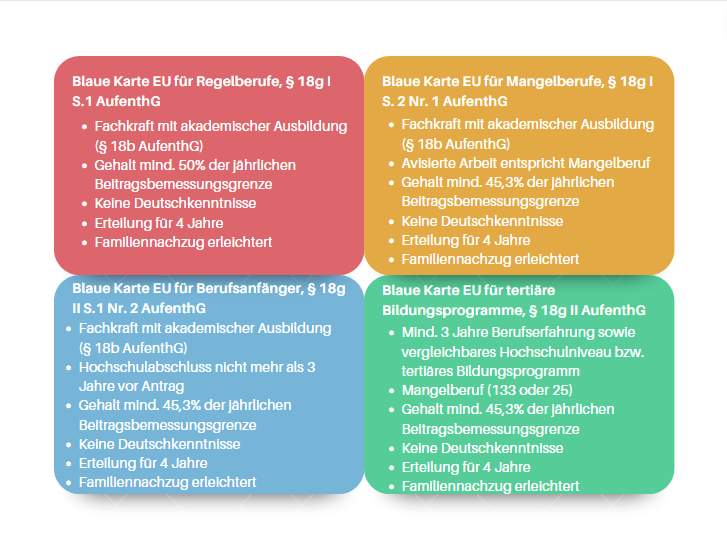
EU Blue Card - The EU Blue Card is a central residence permit for highly qualified skilled workers with a university degree. As mentioned above, it was introduced to attract academic specialists from non-EU countries to the German labour market. The EU Blue Card generally requires an above-average salary and a university degree (or comparable proof of qualification). It is initially issued for a limited period and entitles the holder to employment commensurate with qualifications and can lead to an early settlement permit if employment continues (Section 18c (2) AufenthG). The Residence Act now differentiates between several types of EU Blue Card cases, particularly with regard to salary thresholds and qualifications:
-
EU Blue Card for Standard occupations, § Section 18g (1) sentence 1 AufenthG - The standard blue card for professions that do not fall under a special shortage definition. An employment contract is required with an annual gross salary of at least 50 % of the annual contribution assessment ceiling in the general pension insurance scheme (the exact salary limit is set annually, e.g. approx. ≈58,000 € per year, depending on the current assessment limit). In these cases, no approval from the Federal Employment Agency is required as long as there are no grounds for refusal in accordance with § 19f AufenthG.
-
EU Blue Card for Shortage occupations, § Section 18g (1) sentence 2 no. 1 AufenthG - For specialists who work in Shortage occupations defined areas (e.g. doctors, engineers, IT specialists or other professions for which there is a particular need in Germany). Here, the salary threshold is reduced to 45.3 % of the contribution assessment ceiling (i.e. significantly lower than for standard occupations), however approval from the Federal Employment Agency is required in these cases. The lower salary requirement is intended to facilitate recruitment in urgently needed professions.
-
EU Blue Card for Career starters, § Section 18g (1) sentence 2 no. 2 AufenthG - For foreign university graduates whose degree is no longer than three years ago. The reduced salary threshold of 45.3 % of the contribution assessment ceiling also applies here (with the approval of the employment agency). This takes account of the fact that career starters often have a lower starting salary, but are nevertheless to be recruited as highly qualified specialists.
-
EU Blue Card for Graduates of tertiary education programmes, § Section 18g (2) AufenthG - This variant also enables an EU Blue Card for people who do not have a traditional university degree, but do have a Equivalent tertiary education programme have successfully completed at least three years of training at level 6 of the European Qualifications Framework, e.g. a qualification equivalent to a Bachelor's degree from a vocational academy or a master craftsman/technician qualification). In addition, in certain cases extensive Professional experience can be taken into account instead of a formal qualification. For example, an IT specialist without a degree, but with several years of relevant professional experience and a salary above the specified threshold, can be issued an EU Blue Card. This opening up of the Blue Card reflects the extended requirements of the new EU directive and is intended to give talented specialists without a university degree a chance if their qualifications are practically equivalent to a university degree.
-
Short-term mobility for holders of an EU Blue Card, § Section 18h AufenthG - Holders of an EU Blue Card issued by another EU country are authorised to use the EU Blue Card for Short stays up to 90 days come to Germany within 180 days and work here without having to apply for a German residence permit in advance (registration procedure is sufficient). This regulation facilitates business trips or project-related short stays by Blue Card holders within the EU.
-
Long-term mobility for holders of an EU Blue Card, § Section 18i AufenthG - For longer stays (over 90 days) by holders of an EU Blue Card issued in another EU country. In this case, the foreigner can obtain a German EU Blue Card if they wish to move to Germany for a longer period of time (e.g. change of employer within the EU). The requirements are based on the general criteria for the Blue Card, but applicants benefit from the fact that they are already Blue Card holders (e.g. the qualification is generally deemed to be proven if recognised in the other EU country).
Residence permit for intra-corporate transferees (ICT) - These titles serve to implement the EU ICT Directive 2014/66/EU. They make it easier for international companies to temporarily post employees to Germany. A distinction is made according to the duration and type of transfer:
-
ICT card for internally transferred Managers or specialists, § Section 19 (2) AufenthG - A temporary residence permit issued to employees of an internationally active company who are travelling for a Longer secondment (as a rule over 90 days) to a German branch office. The prerequisite is an employment contract or secondment agreement with details of the manager/specialist function.
-
ICT card for trainees, § Section 19 (3) AufenthG - Similar to the ICT card above, but specifically for trainees/interns in an internal exchange programme within the Group. It enables junior employees of a company to gain professional experience in Germany.
-
Short-term mobility for ICT employees, § Section 19a AufenthG - Holders of an ICT card issued in another EU country can use the Short-term mobility work in Germany for up to 90 days in a 180-day period, without to apply for a German residence permit (an official notification is also sufficient here). This facilitates short assignments in German branches.
-
Mobile ICT card, § Section 19b (2) AufenthG - Is an internal transfer to Germany possible? longer than 90 days planned and the employee already has an ICT card from another EU country, Germany can issue an Mobile ICT card issue. This acts as a German residence permit for the period of the longer transfer (over 90 days). The requirements are similar to those for § 19 (manager, specialist or trainee, valid employment contract for the duration of the transfer, etc.). The mobile ICT card ensures that the employee is legally protected in the event of a longer intra-EU transfer in Germany without losing the original ICT card.
Residence permit for other employment purposes; civil servants - The law also offers opportunities for gainful employment that regardless of qualification as a specialist or are located in special areas, as well as for persons in public service:
-
Residence permit for employment on the basis of the Employment Regulation or intergovernmental agreement, § Section 19c (1) AufenthG - This title authorises employment in Germany if a legal regulation (e.g. the Employment Ordinance) or a bilateral agreement provides for this. This includes, for example, labour quotas for certain countries or groups of people. A prominent example is the so-called Western Balkans regulation, which was originally limited in time and has now been cancelled: It allows nationals of certain Western Balkan states to work in Germany regardless of formal qualifications, provided they have an employment contract and the Federal Employment Agency agrees.
-
Residence permit for employment for foreigners with strong practical professional knowledge, § Section 19c (2) AufenthG - A residence permit for qualified employment can be issued here if the Employment Ordinance provides for this for people with extensive professional experience (but perhaps without a formal qualification as a specialist). This regulation is aimed, for example, at IT specialists or other experts who do not have a recognised qualification but have skills that are in demand due to several years of practical experience. The specific requirements (such as minimum salary or occupational fields) are set out in the regulation.
-
Residence permit in justified cases Individual cases of public interest, § Section 19c (3) AufenthG - A residence permit may be issued in exceptional cases, if there is a public interest in the employment of the foreigner exists - in particular a regional, economic or labour market interest. This „public interest“ clause gives the authorities discretionary powers, e.g. to allow a foreign entrepreneur, investor or specialist to take up employment, even if the person does not fulfil all the usual criteria, provided their involvement would be of considerable benefit to the general public.
-
Residence permit for foreigners in Germany Civil servant status, § Section 19c (4) AufenthG - If a foreigner is in a Civil servant relationship with a German employer (e.g. university professor with civil servant status or civil servant scientist), he or she receives a residence permit to fulfil his or her official duties without the approval of the employment agency. After three years, this group of people can even be granted a settlement permit directly, even if the usual requirements (such as 5 years of residence) have not yet been fully met. This special rule recognises the special status of civil servants in the civil service.
Residence titles for qualified tolerated individuals for employment purposes - Under the keyword „Lane change“ there is the possibility for tolerated foreigners (i.e. persons who are obliged to leave the country with a tolerated stay) to obtain a regular residence permit, if they are well integrated and qualified. This regulation in Section 19d AufenthG is intended to motivate people to accept skilled workers who are already tolerated in the country but have been integrated into the labour market in the long term instead of deporting them. The requirements are graded according to qualifications and professional experience:
-
Residence permit for qualified tolerated persons with German vocational training or German university degree, § Section 19d (1) no. 1a AufenthG - Tolerated persons who have completed qualified training or studies in Germany, should receive a residence permit for employment, provided a suitable job is available. This enables, for example, foreigners who come from the asylum system and have successfully completed an apprenticeship or course of study here to remain as skilled workers.
-
Residence permit for qualified tolerated persons with recognised foreign university degree and 2 years of employment, § Section 19d (1) no. 1b AufenthG - Tolerated persons with a foreign university degree (equivalent or comparable to a German university degree) who have already for at least two years without interruption who are in qualified employment in Germany can also receive a residence permit. This benefits, for example, rejected asylum seekers who are well trained and have proven themselves through work.
-
Residence permit for qualified tolerated persons with three years of uninterrupted qualified employment, § Section 19d (1) no. 1c AufenthG - This variant is aimed at tolerated persons who may not be able to prove that they have an academic qualification, but who continuously for three years work in a qualified job in Germany. They should also be given the opportunity to obtain a secure residence permit. In addition, it is required that they have recently been able to support themselves (no social benefits in the 12 months prior to the application) and that other integration criteria (housing, knowledge of German, no criminal offences, no abuse of tolerated status, etc.) are met.
In addition to these core requirements, § 19d also stipulates for all cases that sufficient living space must be available, German language skills (usually at least level A2-B1) must be proven and there must be no misconduct such as misrepresentation of identity or criminal offences. If all this is given, shall the foreigners authority will issue the residence permit. After two years of employment with this title, the holder may then each take up employment (full labour market mobility).
Residence titles for participation in European Voluntary Service - Young people from third countries who would like to come to Germany to take part in a programme such as the European Voluntary Service (EVS) There is a corresponding regulation:
-
Residence permit for the purpose of participating in the European Voluntary Service, § Section 19e (1) AufenthG - Issued if the foreign national submits an agreement with a recognised organisation for European Voluntary Service and - if necessary - the Federal Employment Agency has given its approval (many voluntary services are exempt from the approval requirement). The agreement must include details of the activity, supervision, duration, accommodation, meals and pocket money. The residence permit is issued for the duration of the voluntary service, but for a maximum of one year. This provision enables cultural and social exchange and is part of the EU-wide standardised regulations for volunteers.
§ Section 19f Reasons for refusal of certain residence permits - This regulation lists special Reasons for refusal for the granting of some of the above-mentioned residence titles (in particular from the education and research sector, e.g. for students, researchers, volunteers according to §§ 16b, 16c, 16e, 16f, 17, 18d-18g, 19e AufenthG). Section 19f AufenthG regulates the circumstances under which an application for such a title may be submitted. Rejected must be cancelled. Examples: if the host educational institution does not fulfil its obligations, if the research institution is threatened with insolvency, or if the foreigner has exceeded a certain maximum duration of stay. This clarification is intended to prevent abuse and ensure that the facilitated mobility and residence permits are only used if certain quality criteria are met.
Residence titles for job seekers - The Residence Act offers foreign skilled workers who have completed their training in Germany or have carried out research here the opportunity to subsequently for the job search to remain in the country. § Section 20 AufenthG lists several groups of cases in which a temporary residence permit can be issued for the purpose of seeking employment. This gives graduates and qualified skilled workers a Orientation and application phase, to find a job that matches their qualifications:
-
Residence permit to look for a job for foreigners with German university degree, § Section 20 (1) no. 1 AufenthG - Graduates of German universities can apply for up to 18 months stay in Germany to look for a suitable job (the law stipulates a maximum of 18 months; often 6-12 months are initially granted and can be extended).
-
... for foreigners looking for a job after completion of a research activity, § Section 20 (1) no. 2 AufenthG - Foreigners who have worked as researchers in Germany (e.g. with a § 18d residence permit) and whose research project ends can also receive a residence permit for up to 9-12 months in order to seek employment. This is intended to enable highly qualified scientists to remain in industry or science.
-
... for foreigners looking for a job after completing a German vocational training programme, § Section 20 (1) no. 3 AufenthG - Specialists who have a domestic who have successfully completed qualified vocational training can receive a residence permit for up to 12 months in order to find a job that corresponds to their vocational qualification. This right to look for a job after completing an apprenticeship was newly introduced in 2020 in order to keep talented people trained here in the country.
-
... to find a job after recognition of the foreign professional qualification or granting of the licence to practise, § Section 20 (1) no. 4 AufenthG - If a foreigner in the federal territory Recognition procedure After completing the training process for the professional qualification obtained abroad (or obtaining a licence to practise/professional licence in a regulated profession), they can then obtain a residence permit for up to 12 months to look for a job. Example: A nurse or doctor completes the recognition of their qualification in Germany - they are then allowed to stay for one year to find a job.
-
... for finding a job after completing a Assistant or helper training in a state-recognised training occupation in the Health and nursing care, § Section 20 (1) no. 5 AufenthG - Even those who only have a shorter training in the care sector (e.g. a one-year care assistant course) can, under certain circumstances, receive a temporary residence permit to look for a job. This takes account of the high demand in the care sector.
As a rule, all of these variants of Section 20 require that the foreigner's livelihood is secured (no social benefits during the search phase) and they can only be used in the following cases once can be utilised.
Opportunity card (points system) - A completely new option for labour migration is the Opportunity card according to § 20a AufenthG which was created with the 2023 law reform. The opportunity map is a Residence permit for the purpose of seeking employment or after further training and qualification programmes in Germany. It is organised on the basis of a point system awarded: Interested applicants receive points for certain criteria, in particular Qualification, Professional experience, German or English language skills, Age and Reference to Germany (e.g. previous residence or relatives in Germany). If enough points are achieved (the Minimum score is specified in an annex to the law and can be adapted by statutory order), the person can receive an opportunity card.
Important features of the opportunity map: It is initially used for one year and entitles the holder to live in Germany and look for qualified work during this time. During this time Trial work for up to two weeks and part-time jobs of up to 20 hours per week are permitted in order to facilitate arrival. § Section 20b AufenthG regulates the Scoring in detail - the criteria and point values are defined there (for example: a university degree gives points, professional experience gives additional points, young applicants under 35 receive points, language skills are honoured, etc.).
Another new feature is the Follow-up opportunity card (Section 20a (5) sentence 2 AufenthG): If the holder of the opportunity card has not yet received a regular employment contract that fulfils all requirements within the first year, but has already received a concrete job offer in prospect, an extension of up to two further years be issued. This extension is intended to enable the person to complete any missing qualification measures or recognition procedures in Germany, for example, so that they can then switch to a regular residence permit for gainful employment (e.g. Section 18a or Blue Card). The Chancenkarte is therefore a Instrument for controlled immigration without a job offer, which enables potential skilled workers with potential to enter the German labour market. Your introduction to the 1 June 2024 marks a paradigm shift towards a more flexible, point-based management of labour migration.
Residence permit for exercising a self-employed activity - In addition to dependent employment, the Residence Act also promotes the immigration of Entrepreneurs, the self-employed and investors. Section 4 contains § 21 AufenthG, which covers various constellations of self-employment. In general, the following applies: A residence permit for self-employed persons is issued if an economic interest or regional need the activity exists, the activity Positive effects on the economy and the Financing secured (§ 21 Para. 1). In addition, there are special circumstances to make it easier for certain groups to become self-employed:
-
Residence permit for the exercise of a self-employed activity (economic interest), § Section 21 (1) AufenthG - The general basic offence: This includes, for example. Investors, company founders or freelancers, who want to set up a business in Germany. The above criteria (economic interest, viability of the business idea, equity capital or financing) are checked by the immigration authorities, often with the involvement of the relevant chambers of industry and commerce or economic authorities. Persons over the age of 45 must also provide evidence of adequate pension provision.
-
Residence permit for self-employment on the basis of favour under international law, § Section 21 (2) AufenthG - Applies if international agreements provide for special facilitations. An example could be a bilateral agreement that facilitates independent acquisition for nationals of a certain country. In practice, this provision is rarely relevant, but offers the opportunity to reflect Germany's contractual obligations.
-
Residence permit for one Graduates of a German university for the exercise of a self-employed activity, § Section 21 (2a) AufenthG - Former foreign students who have completed their studies in Germany can apply for a residence permit to study in Germany. start-up-related self-employment received, when the planned self-employed activity in a Connection with the knowledge acquired during the study programme stands. This is intended to make it easier for highly qualified graduates to enter the start-up world - for example, if a Master's graduate in computer science wants to set up an IT company. The requirements for capital and economic interest are rated somewhat lower here, as it is assumed that innovative start-ups by university graduates are worthy of support per se.
-
Residence permit for a foreigner who is a skilled worker, to start a business if a scholarship is available, § Section 21 (2b) AufenthG - Newly introduced in 2020/2021: This regulation enables specialists who have a Start-up grant have received a residence permit to implement their business idea in Germany (e.g. from public funding programmes or private foundations for the promotion of start-ups). This assumes that there is already a public interest in the start-up (as a grant has been awarded). In particular, innovative Start-up founders from abroad are to be attracted in this way.
-
Residence permit for the exercise of a freelance work, § Section 21 (5) sentence 1 AufenthG - Freelancers (e.g. artists, doctors, architects, consultants) who are not employed can also obtain a residence permit. The conditions are similar to § 21 para. 1 (economic interest, livelihood secured, etc.), but the special features of liberal professions are taken into account. It is often sufficient if practising the liberal profession is in the public interest (e.g. a foreign doctor who wants to settle in an underserved region).
-
Settlement permit for the exercise of a self-employed activity, § Section 21 (4) sentence 2 AufenthG - After three years successful self-employment can a foreigner can be granted a permanent settlement permit (subject to the usual requirements such as securing a livelihood, no criminal offences, etc.). This period is significantly shorter than the regular 5 years for others, which makes it more attractive for entrepreneurs. Prerequisite: The company continues to exist and the self-employment was economically viable. The law thus honours the creation of jobs and economic added value by foreign entrepreneurs.
In summary, Section 4 AufenthG provides a Wide range of residence permits for all facets of gainful employment: from employees to scientists and trainees to entrepreneurs. Which Residence permit in each individual case depends on the applicant's profile and objective. In view of the complexity of the law and the regular reforms, it is advisable to seek expert advice in the specific case.
Important Note: The content of this article has been prepared to the best of our knowledge and belief. However, due to the complexity and constant evolution of the subject matter, we must exclude liability and warranty. The content of this article has been compiled to the best of our knowledge and according to the current state of knowledge. Nevertheless, changes may occur as the law develops. The complex and constantly changing nature of the subject matter makes this necessary, Liability and warranty for the accuracy and completeness of the information.
If you Legal advice If you have any questions about your residence status or immigration project, please contact us without obligation. You can reach us by telephone at 0221 - 80187670 or by e-mail to info@mth-partner.de. Our law firm is at your side with expertise in immigration and residence law.
Lawyers in Cologne advise and represent you in immigration law.



12 responses
Hello,
A quick question:
I have been in possession of a residence permit for gainful employment § 18 para. 4 sentence 1 AufenthG for two years. When can I apply for a permanent residence permit?
LG
I have also been in possession of a residence permit for gainful employment § 18 para. 4 sentence 1 AufenthG for two years.
Did you get an answer?
Hello Mr Belarbi,
I have just read through your commentary on the mth-partner.de website, which deals with the Residence Act 18 para. 4 sentence 1. I have the same residence 18 para. 4 sentence 1 and wanted to ask you whether you have perhaps already received information on when exactly you can apply for permanent residence.
With kind regards
Xebat Kavak
Hello Mrs Laginova,
I have just read your commentary on the website mth-partner.de, which deals with the Residence Act 18 para. 4 sentence 1. I have the same residence 18 para. 4 sentence. Sentence 1 and wanted to ask you if you have perhaps already received information on when exactly you can apply for permanent residence.
With kind regards
Xebat Kavak
Ladies and Gentlemen,
I have had a Slovakian ID card since 27 May 2016 and have been registered in Bratislava and also in Munich since 27 June 2016. can I set up a BGR in Germany and get a residence permit from Germany?
My Slovakian id card has been renewed annually so far.
I bought a small flat in Bonn in cash and also have a current account with Postbank.
Thank you in advance.
Yours sincerely.
Farhad Shabestari.
Hello,
I have a question,
I have a residence permit for gainful employment § 18 para. 3 AufenthG and have been working for more than 3 years. When can I apply for a permanent residence permit?
Yours sincerely,
Jorego
Hello Jorego, I wanted to ask you, did you get the right answer? I also have the same paragraph as you and I wanted to know when you can apply for a permanent residence permit? LG Nino
I have lived in Germany for 8 years and have electricity here. Now I would like to apply for naturalisation and I am currently working, I currently have Article 18 paragraph 4 S1. Can I apply for naturalisation? If yes, by which paragraph?
Thank you very much.
Boa noite, fui casada por 7 anos na Alemanha tive o visto permanente, mas por que estava muito doente e sozinha voltei ao Brasil para me curar de um câncer.
Agora encontrei uma possibilidade de trabalhar de novo na RFA com meus familiares .
Gostaria de saber se ainda posso viver lá com meu visto!
Grata pelas respostas serias!
Hello,
I have been in possession of a residence permit for gainful employment § 18 para. 4 sentence 1 AufenthG for two years. When can I apply for a permanent residence permit?
LG
The same problem with me
18 Baš. 4 S.1
Hello
In December 2019 I am doing 3years as in Germany and always worked.
I have a residence permit 18 abs 4s1.
I came to Germany with a visa.
I want a residence permit or residence 21 abs to work independently.
Best regards Niko