
Note: This article is for general information only and does not replace individual legal advice. Nationality law is complex and depends on the circumstances of the individual case. Please consult a lawyer for your specific situation.
Every month, the Federal Office of Administration (BVA) in Cologne receives around 1,000 new applications for the confirmation of German citizenship (BVA, as of 2026). The authority processes them in order of receipt. Anyone who submits their application incorrectly or incompletely not only loses time – they risk a request for additional information, which extends the already long process by several months. In the worst-case scenario, an avoidable error can lead to rejection.
Processing time: The BVA itself speaks of at least two years as a realistic processing time (bva.bund.de). In complex cases – missing documents, queries to registry offices, investigations by German authorities – it can take significantly longer. Every error in the application means an additional loop: the BVA requests further information, you gather it, send it again, and the process goes back to the queue.
This article describes the twelve most common mistakes made by applicants from abroad – and explains how to get it right in each case. The mistakes are not abstract. They are based on the specific requirements that the BVA describes in its information sheets and application forms (Form F, Annex V), and on information from the Federal Foreign Office for Germans living abroad.
Basics: How the acquisition of German citizenship by descent works, we explain in our Guide to German citizenship by descent.
Error 1: Incorrect procedure selected
The most fundamental mistake happens before the actual application is even filled out: many applicants confuse the Observation of nationality (§ 30 StAG) with the Naturalisation (§§ 10, 13, 14 StAG). These are fundamentally different procedures.
The determination clarifies whether you already possess German citizenship – for example, because an ancestor passed it on to you. The result is a certificate of citizenship. Naturalisation, on the other hand, newly confers citizenship – on someone who did not previously have it. Those who apply using the wrong form will not simply have their application redirected. It will be sent back.
Please check which procedure applies to your situation before submitting an application. If you believe you have inherited German citizenship from a German ancestor: Declaration (Form F). If you wish to acquire citizenship anew: Naturalisation. If you are claiming entitlement as a descendant of persons persecuted under National Socialism: Naturalisation according to Article 116 (2) of the Basic Law or Section 15 of the Nationality Act.
Art. 116(2) of the Grundgesetz or § 15 of the Nationality Act: Which path leads to naturalisation? — Three Paths to Reparations Compared
Error 2: Application not completed in German
The BVA exclusively accepts applications in German. This applies to form F, to appendix V (which must be completed individually for each ancestor in the lineage) and to the supplementary information. Anyone submitting the application in English, Spanish or any other language will receive it back, unprocessed.
This does not mean that all accompanying documents must be translated. Civil status documents (birth, marriage, death certificates) in English or French are generally accepted without translation. However, divorce decrees, custody agreements and other court documents must be submitted as certified translations. When in doubt, it is better to have it translated than to risk the BVA requesting further information.
Error 3: Annex V forgotten or incompletely filled in
Form V is the heart of the application for establishment. It records the chain of descent – generation by generation, from the applicant back to the ancestor who first possessed German citizenship. The BVA requires a separate Anlage V for each generation: for you, for your mother or father, for the grandparents, and so on, up to an ancestor born before 1914.
Common mistakes: Submitting only one Anlage V for the entire family. Skipping generations. Leaving fields blank because the information is unknown – instead of entering „unknown“ and attaching an explanation as to why the information is missing.
The Foreign Office recommends that US applicants trace Annex V back to an ancestor born in or before 1914. The reason for this is that prior to the First World War, there were no relevant grounds for loss of nationality due to acquiring foreign citizenship (the loss of nationality through emigration was abolished in 1913), meaning that the nationality of this ancestor can generally be considered secure.
Error 4: No certified copies submitted
The BVA requires certified copies of all documents – not the originals, and not simple photocopies. Originals are only accepted upon special request and „only returned upon special request“ (BVA information sheet). Anyone sending uncertified copies will receive a request for additional documents. Anyone sending originals risks losing them in the post.
Certifications can be carried out by the responsible German mission abroad (embassy, consulate general), by a notary, or by the issuing authority itself. For documents from abroad, check whether an apostille or legalisation is required – this depends on whether the country of issue has acceded to the Hague Convention.
Error 5: Chain of custody not conclusively proven
The most common substantive weakness: The applicant may be able to show that a grandfather or great-grandfather was German, but they cannot prove that citizenship was passed down through every intermediate generation. A chain with even one missing link is not a chain – the BVA cannot make a determination.
This means: For each person in the line of descent, you need at least one birth certificate (to prove descent) and ideally proof that this person was still German at the time of the birth of the next descendant. The latter is the difficult part, as nationality can have been lost between two generations – for example, through the acquisition of a foreign nationality before 27 June 2024 (Section 25 (1) StAG old version) or through the marriage of a German woman to a foreigner before 1 April 1953.
We explain where to find archive documents to prove the chain of ancestry in our article Archives as a key to proving German citizenship.
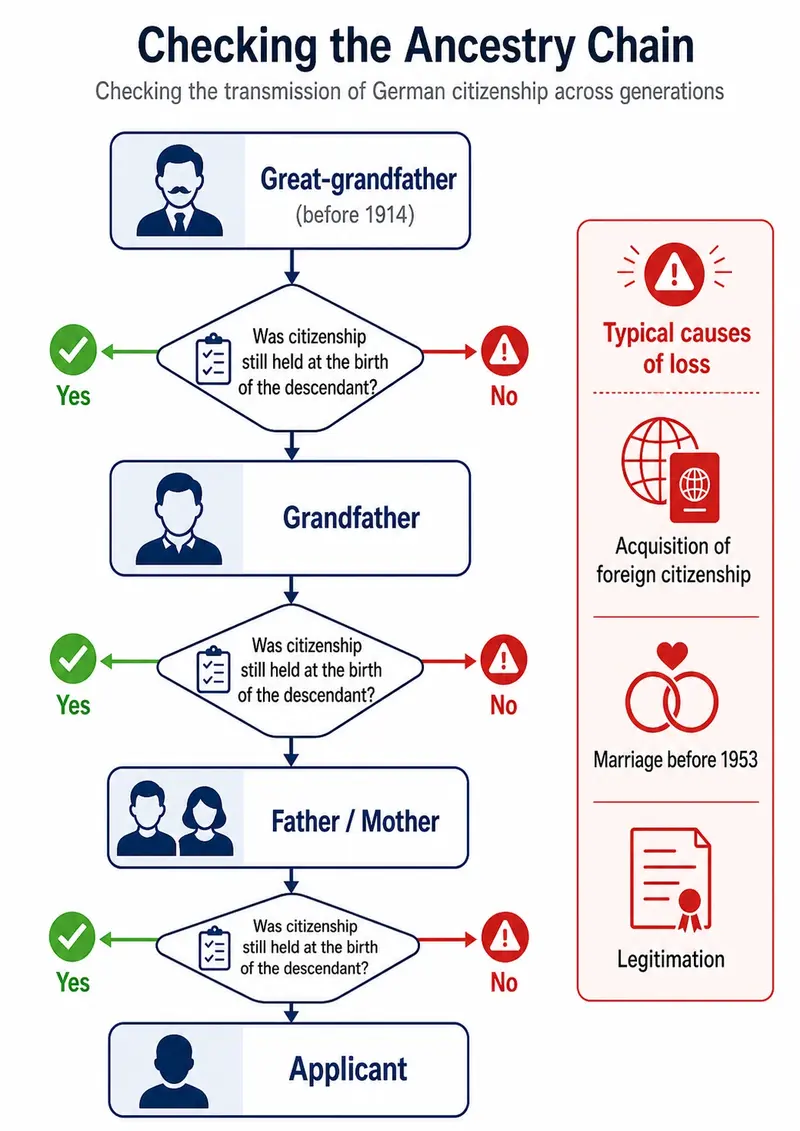
Error 6: Loss of citizenship in the ancestral line overlooked
Many applicants assume that German citizenship passes automatically from generation to generation – without the possibility of it being lost. This is not true. German law knew (and knows) numerous grounds for loss, which varied depending on the period.
| Period | Loss event | Legal basis / Notice |
| Before 1 April 1953 | German woman marries foreigner → automatic loss of German citizenship | § 17 No. 6 RuStAG as amended. Since 2021: Acquisition of nationality by declaration under § 5 StAG possible (deadline until 19.08.2031) |
| 1.1.2000 – 26.6.2024 | Voluntary acquisition of a foreign nationality without a retention permit | § 25(1) StAG as amended. EU/Swiss citizens were exempt. Abolished since 27 June 2024 (StARModG). |
| From 27 June 2024 | Acquiring another nationality no longer leads to its loss | StARModG — applies to all nationalities worldwide. Caution: A loss incurred before 27.6.2024 remains effective (BVA notice) |
| Historical (pre-1914) | Ten years of uninterrupted stay abroad without registration in the consular register (Sec. 21 RuStAG 1870) | Abolished in 1913. This may be relevant for older cases |
The combination is particularly dangerous: an ancestor became a US citizen in the inter-war period – that alone led to the loss of citizenship under the law at the time. If this loss is overlooked in the lineage, the entire application is built on a false foundation.
Error 7: Generation cut-off not observed (§ 4 para. 4 StAG)
Since 1 January 2000, the so-called generation cut-off has been in effect: Children born abroad whose German parent Likewise born abroad acquire German citizenship not automatically (§ 4 para. 4 of the Nationality Act). The chain is broken if the birth is not registered in the German birth register within one year (§ 36 of the Civil Registry Act). This deadline is met if the birth notification is received by the competent German mission abroad within one year.
The generational cut-off affects expats, emigrants, and their descendants equally – regardless of how long they have lived abroad or whether they have lived in Germany in the meantime. Those who have missed the one-year deadline must find another path to citizenship.
Error 8: Application sent to the wrong authority
The BVA is only responsible for individuals who have their Residence abroad In Germany, those wishing to do so must approach their local citizenship authority, which is usually the municipal or district administration. The BVA returns such applications.
Conversely, if you move to Germany while proceedings are ongoing, the BVA will no longer be responsible. The file must be transferred to the local authority. Inform the BVA of any change of address, stating your case reference number, to avoid any delivery issues.
The application can be submitted via the relevant German mission abroad or directly by post to the BVA: Bundesverwaltungsamt, Barbarastr. 1, 50735 Köln, Germany. The BVA advises against submission by fax or email, as the documents must be submitted in original or certified copy.
Error 9: No proof of German ancestor's nationality
Your German ancestor's birth certificate is not sufficient. It proves the place of birth and parents – but not citizenship. The BVA requires a document that directly indicates the ancestor's German citizenship: an old passport, an identity card, a registration office entry with the note „German“, a naturalisation certificate, or a registration card.
If no such document exists, indirect evidence may suffice when viewed as a whole: military records, voter registers, church records with details of origin, emigration lists. However, they are rarely sufficient individually. The proof that citizenship existed is the task that requires the most archival research.
Error 10: Apostille or legalisation forgotten
Foreign documents generally require an apostille for use in Germany if the country of issue is part of the The Hague Convention Abolishing the Requirement of Legalisation for Foreign Public Documents has joined. If the country is not a member, legalization by the competent German mission abroad is required.
This particularly applies to birth certificates, marriage certificates, and divorce decrees issued abroad. If the apostille is missing, the BVA will request it. In some countries, obtaining an apostille can take several weeks – please factor this in.
Note: For US applicants, according to the Federal Foreign Office, the apostille for documents from the USA generally needs to be applied for at the Secretary of State of the respective federal state.
Error 11: Unreachable after application
The BVA processes applications in the order they are received. If there are queries – which is more the rule than the exception – and the applicant does not respond, the proceedings are suspended. There is no automatic reminder. The case remains pending until a response is received.
What you should do: After you receive confirmation of receipt (which will contain a reference number), all correspondence should be conducted using this reference number. Inform us immediately of any change of address. If the BVA requests further documents, respond promptly. The longer you wait, the lower your case will be prioritised internally.
Error 12: No objection lodged upon rejection
If the BVA rejects the application, that is not the end of the matter. An objection can be lodged against the rejection decision within one month of its notification (§ 68 VwGO). Many applicants are unaware of this or miss the deadline because they do not understand the decision or because delivery via the foreign representation causes delays.
An appeal is particularly worthwhile if the BVA assesses the evidence differently to the applicant or if new documents can be submitted that were not taken into account during the initial examination. If the appeal is unsuccessful, the applicant can lodge a claim with the Administrative Court of Cologne. At this point, at the latest, legal assistance is strongly recommended.
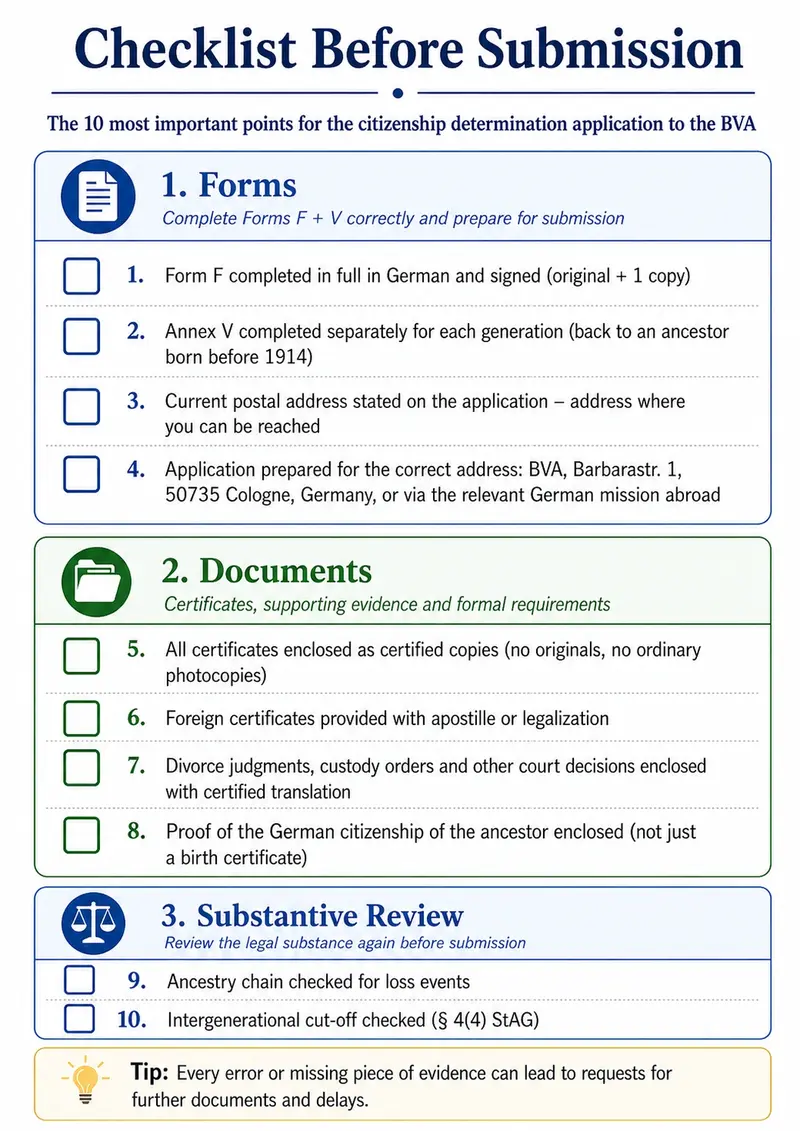
Pre-dispatch checklist
Before you seal the envelope, check:
- Form F fully completed and signed in German (Original + 1 copy)
- Attachment V completed individually for each generation (up to an ancestor born before 1914)
- All certificates enclosed as certified copies (no originals, no simple photocopies)
- To have foreign documents apostilled or legalised
- Divorce decrees, custody orders and other court judgments in certified translation
- Proof of the ancestor's German nationality enclosed (not just a birth certificate)
- Chain of custody checked for loss events (table above for reference)
- Generation test (§ 4 para 4 StAG)
- Current postal address on the application form — Delivery address at which you can be reached
- Application to the correct address: BVA, Barbarastr. 1, 50735 Cologne (if sending from abroad) or via the German representation abroad
When to consult a solicitor
Most declarations of parentage can be submitted yourself with careful preparation. If the chain of descent is simple and well-documented, you won't need a solicitor.
The situation looks different if: the chain of descent could be interrupted by grounds for loss, archives cannot find the requested documents, the BVA has already made additional demands which you cannot understand, a rejection notice has been issued and an appeal or legal action is being considered, or if you are unsure whether registration, naturalisation or declaration of acquisition is the correct procedure.
As a law firm with a focus on nationality law, we examine the chain of descent, identify potential grounds for loss in advance, and assist with compiling the evidence. If the BVA rejects an application, we represent clients in objection and legal proceedings. Please get in touch.
Further articles
German Citizenship by Descent – Guide — Chain of descent, cut-off dates, § 4 StAG
§ 5 StAG: Acquisition of nationality by declaration in cases of gender discrimination Until 19 August 2031
Dual citizenship since 2024 — What the StARModG has changed
Online check: checking German nationality from abroad — Free initial assessment
Frequently asked questions
How long does the recognition procedure at the BVA take?
The BVA states a processing time of at least two years. In complex cases – for example, when documents need to be requested from registry offices or if there are gaps in the chain of descent – it can take considerably longer. Around 1,000 new applications are received every month.
Can I submit the application by email or fax?
The BVA advises against it. As the documents must be submitted in original or as certified copies, the postal route is the only secure method. Alternatively, you can submit the application through the responsible German mission abroad.
What happens if I move to Germany during the proceedings?
The BVA will then no longer be responsible. Your file will be transferred to the local nationality authority (municipal or district administration). Please inform the BVA of your new address, stating your file reference number.
My grandfather became a US citizen. Do I still have German nationality?
That depends on the date. Before 1 January 2000, the rule was: anyone living abroad who acquired a foreign nationality upon application did not lose their German nationality (so-called "Inlandsklausel", § 25 para. 1 RuStAG a. F.). From 1 January 2000 to 26 June 2024, the rule was: loss occurred upon acquisition of a foreign nationality without prior approval, even for those residing abroad. From 27 June 2024 onwards: no more loss. The decisive factor is the date on which your grandfather acquired US citizenship, and whether a ground for loss was applicable at that time.
Sources and further information
- Federal Office of Administration (BVA): Information Sheet on Determining German Nationality, Form F (Application), Annex V (Ancestors). Available at bva.bund.de. As of: 2026.
- Federal Office of Administration: „Processing time“ — „As approximately 1,000 new applications for recognition are received here every month, a processing time of two years is unfortunately not unusual.“ (bva.bund.de).
- Federal Foreign Office: Determination of German nationality (Certificate of Nationality). Information for Germans abroad, application guide, apostille information. germany.info.
- Nationality Act (StAG) as amended on 22 February 2024 (Federal Law Gazette 2024 I No. 60), last amended by the Nationality Law Modernisation Act (StARModG) of 22 March 2024 (Federal Law Gazette 2024 I No. 104), in force since 27 June 2024. In particular, Sections 4, 5, 13, 14, 25, 30 of the StAG.
- Basic Law for the Federal Republic of Germany: Article 116(1) of the Basic Law (Nationality), Article 116(2) of the Basic Law (Re-naturalisation following persecution by the Nazis), Article 16(1) of the Basic Law ( Prohibition of Deprivation).
- Civil Status Act (PStG): § 36 PStG (Birth notification for births abroad, one-year deadline).
- Administrative Court Rules (VwGO): Section 68 VwGO (Objection to Administrative Act).
- § 25 (1) of the Nationality Act (RuStAG/StAG) as amended: Loss by acquiring a foreign nationality upon application. Domestic clause (until 31.12.1999), deletion (from 01.01.2000), abolition of the loss of nationality provision (from 27.06.2024).
Lawyer Helmer Tieben
Tieben Law Firm — MTH Partner
Sachsenring 34, 50677 Cologne | Tel.: +49 221 20426165 | www.mth-partner.de
Areas of focus: Immigration law • Nationality law • Tenancy law • Employment law