
Anyone renting office space, a retail shop or a warehouse is operating within a different legal framework than when renting a residential property. Commercial tenancy law knows neither rent caps nor Protection against dismissal – alongside a freedom of contract that harbours both opportunities and risks in equal measure. This article explains what matters in commercial lease agreements, from the form of the contract and the rent level to termination, and refers to in-depth guides for each individual point.
Note: This post serves as general guidance and does not replace individual legal advice. Commercial property leases are complex documents where the contract drafting can determine six-figure economic consequences. Have your contract reviewed by a lawyer before signing.
What is a Commercial Lease Agreement?
A commercial lease agreement governs the rental of premises that are not used for residential purposes, but rather for business activities. Typical commercial premises include offices, retail shops, medical practices, workshops, catering spaces and warehouses.
There is no independent commercial tenancy law as a closed set of rules in Germany. The legal basis is formed by the general tenancy provisions of Sections 535 et seq. of the German Civil Code (BGB). However, the decisive factor is: the special tenant protection provisions for residential space apply to commercial spaces only to a very limited extent. In practice, this means: no personal use, no rent cap, no rent index, no grace period payment, no notice periods staggered with the duration of the tenancy.
Instead, freedom of contract dominates. The legislature treats commercial tenants and landlords as parties on an equal footing. What is in the contract applies – with a few exceptions.
Whether a tenancy agreement is to be classified as commercial at all does not depend on the title of the contract, but on the agreed purpose of use. In the case of mixed use, the deciding factor is which purpose predominates; for more in-depth information on this, see our article on Demarcation of residential and commercial tenancy law.
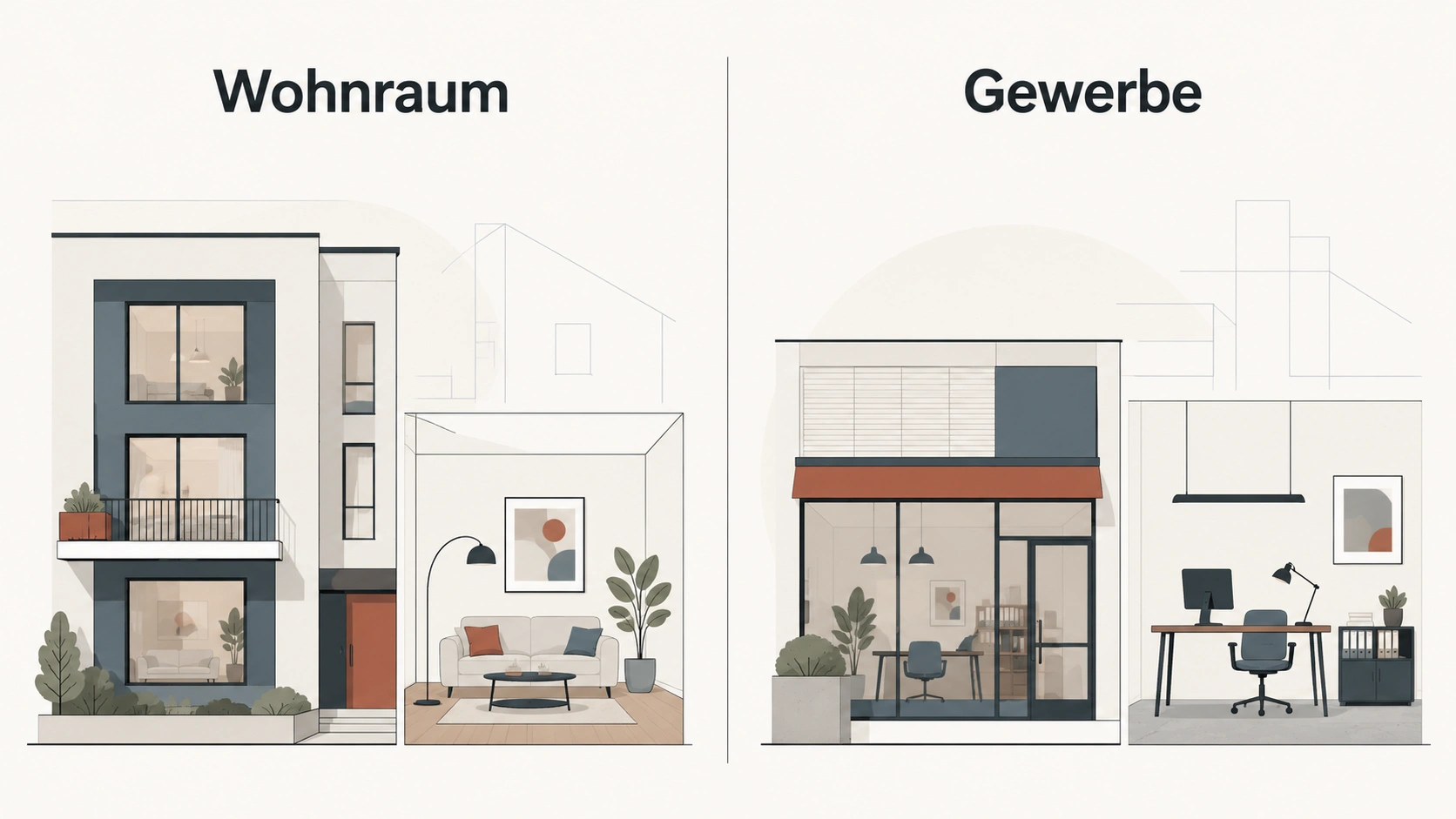
Residential and commercial space compared
| Subject | Residential tenancy agreement | Commercial lease |
|---|---|---|
| Tenant protection | Extensive legal protection | Limited legal protection; freedom of contract |
| Rent amount | Rent Index, Rent Brake, Cap | Open to negotiation; no statutory upper limit |
| Security deposit | A maximum of three net basic rents (§ 551 BGB) | No legal limit |
| Contract duration | Fixed-term contracts only under strict conditions (§ 575 German Civil Code) | Fixed-term contracts are freely possible; after 30 years there is a right to terminate (§ 544 BGB) |
| Notice period (indefinite) | Three to nine months, depending on the rental period | The third working day of a quarter, at the end of the following quarter (Section 580a(2) of the German Civil Code (BGB)) |
| Grounds for termination (landlord) | Only with a legitimate interest (§ 573 BGB) | No reason required |
| Grace period payment for late payment | Yes, summary dismissal can be remedied (§ 569 para. 3 BGB) | No, the termination remains valid |
| Operating costs | Only costs under Section 2 of the Operating Costs Ordinance (BetrKV) are eligible for apportionment. | Freely negotiable, including administrative costs |
| service charge settlement deadline | Twelve months (section 556(3) of the German Civil Code (BGB)) | No statutory deadline; the contract is decisive |
| Maintenance | Landlord's obligation generally | Largely transferable to the tenant |
| Rent reduction | Non-contractually excludable | Contractually limitable or excludable |
| Statutory form for terms exceeding one year | Written form (Section 550 of the German Civil Code (BGB)) | Text form (§ 578 para. 1 sentence 2 BGB) |
| Value Added Tax | Not relevant | Landlords may opt in under Section 9 of the German Value Added Tax Act (UStG) |
The form: text form instead of written form
Until the end of 2024, commercial leases with a term of more than one year had to comply with the written form requirement: handwritten signatures of both parties on a single document. If this form was not observed, the lease was deemed to have been concluded for an indefinite period and was subject to ordinary termination – even in the case of a ten-year fixed term.
The Fourth Bureaucracy Reduction Act changed that. Section 578(1) of the German Civil Code (BGB) was amended by the addition of a sentence stating that Section 550 of the BGB applies to commercial premises with the proviso that the Text form satisfies section 126b of the German Civil Code (BGB). The wording of section 550 BGB itself remained unchanged; only its application to commercial space was amended. Since 1 January 2025, this has applied to new and amended contracts, and since 2 January 2026, it also applies to existing legacy contracts that continue unchanged.
That doesn't mean, however, that old formal defects automatically disappear. A prior lack of written form only loses its significance to the extent that the currently decisive text form is actually complied with. If the agreement in question – such as an oral collateral agreement or an undocumented amendment – does not exist in text form either, the defect persists and the contract remains subject to ordinary termination.
Our [text/document/article] covers the entire subject matter, including the unity of documents, cure by addendum and contractual written form clauses Main article on the written form requirement in commercial tenancy law.
Rent level: what rental models are available?
In commercial tenancy law, there is neither a rent cap nor a rent index. The rent is a matter for negotiation. In practice, four models have become established.
Fixed rent – a fixed monthly amount for the entire term. Budgetary certainty for both sides, but no inflation adjustment for the landlord.
Index rent – The rent is linked to the Consumer Price Index and is adjusted at agreed intervals. During periods of high inflation, this can lead to significant increases. Clauses relating to the protection of value are subject to the Price Clauses Act and, in standard form contracts, to the review of general terms and conditions.
Graduated rent – The increases are set in advance in terms of amount. This provides predictability for both sides.
Turnover rent – the rent depends entirely or partly on the tenant's turnover. Common in retail, particularly in shopping centres, usually as a minimum rent plus a turnover-linked component. That a rent adjustment cannot simply be demanded at will is shown by a Decision of the Cologne Regional Court.
Service charges: what can be passed on?
In residential tenancy law, only the costs listed in Section 2 of the Operating Costs Ordinance (Betriebskostenverordnung) may be passed on. In commercial tenancy law, it is different: here, other types of costs can generally also be transferred to the tenant, such as management costs, costs for a security service or centre management. The prerequisite is that the types of costs are named transparently and concretely in the contract – clauses in practice often fail due to this, as a Decision on the transparency requirement shows.
Important for commercial tenants: The twelve-month period for billing known from residential tenancy law does not apply here. According to established case law, Section 556 of the German Civil Code (BGB) does not apply to commercial property tenancies, not even by analogy. The sole determining factor is what the lease agreement stipulates. For the same reason, the digital inspection of receipts possible since 2025 also does not apply to commercial spaces, according to the prevailing view – the Higher Regional Court of Schleswig rejected an analogy.
Deposit: no statutory upper limit
For residential property, the deposit is limited to three months' net rent without heating (§ 551 BGB). For commercial premises, there is no such limit; three to six months' rent is usual in practice. The form is also freely negotiable: cash deposit, bank guarantee or deposit insurance. Likewise, there is no statutory right to pay in instalments – the landlord can demand the full deposit before the tenancy begins. Negotiating is particularly worthwhile here.
Termination of the Commercial Lease Agreement
Permanent contracts
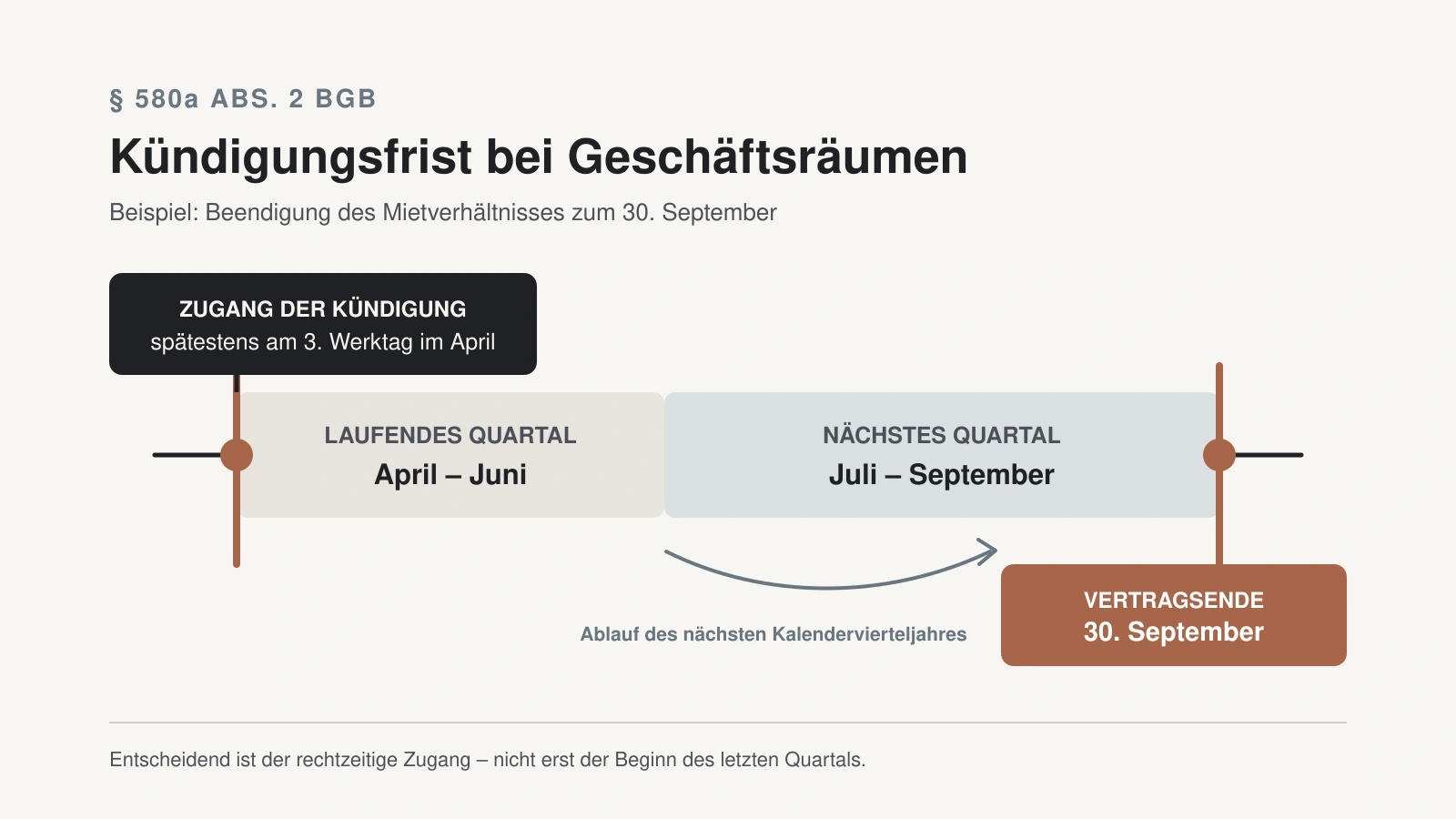
Unless the contract contains a provision to the contrary, Section 580a(2) of the German Civil Code (BGB) applies: Notice of termination must be given no later than on the third working day of a calendar quarter to be effective at the end of the next be explained by the calendar quarter. In practice, this corresponds to a period of around six months.
Example: If the tenancy is to end by 30 September, the notice of termination must be received by the third working day of July at the latest – that is, at the beginning of the quarter at the end of which the tenancy is to be terminated. When calculating this, Saturday is generally counted as a working day; if the last day of the grace period falls on a Saturday, Sunday or public holiday, the deadline is extended to the next working day.
Unlike residential tenancy law, the landlord does not need a reason for termination. They can give notice of termination in the ordinary way without having to prove personal use or a breach of duty.
Fixed-term contracts
Fixed-term commercial lease agreements are the norm; lease periods of five, ten or fifteen years are customary. During the term, the agreement generally cannot be terminated ordinarily – neither by the tenant nor by the landlord. What remains possible are an agreed special right of termination, termination without notice for good cause (§ 543 BGB) and a mutually agreed Cancellation agreement. For contracts with a term of more than 30 years, Section 544 of the German Civil Code (BGB) provides a statutory right of termination after the 30-year period has expired.
Termination without notice – no grace period
In the event of late payment to the extent described in Section 543(2)(3) of the German Civil Code (BGB), the landlord may also terminate the tenancy without notice under commercial tenancy law. The most significant difference from residential tenancy law is that the grace period for payment under Section 569(3)(2) of the German Civil Code (BGB) does not apply to commercial premises. Any payment of arrears made after receipt of the notice of termination does not thereby remedy the breach.
For commercial tenants, this means that anyone running into payment difficulties should talk to their landlord before notice is served. All deadlines, grounds and formal requirements are covered in detail in our guide on Termination of the Commercial Lease Agreement.
Maintenance: Is it all sorted, or is it all down to the tenant?
Under residential tenancy law, the landlord is generally responsible for maintenance. Under commercial tenancy law, the obligation to carry out maintenance can, to a large extent, be transferred to the tenant – for the rented premises themselves and, under certain conditions, also for communal areas and building services.
In practice, a distinction is made between the roof and walls clause, whereby the landlord remains responsible for the roof and load-bearing structural elements, and complete transfer. Limitations are imposed by the judicial review of standard business terms: if a standard form contract is used, maintenance clauses are subject to Sections 305 et seq. of the German Civil Code (BGB). Clauses without a cost ceiling or involving an unreasonable shift of risk can be void.
Protection against competition
Anyone renting commercial premises in a multi-tenant building wants to be sure that the landlord does not let to a direct competitor in the same building. To a certain extent, inherent contractual protection against competition applies even without an express agreement; the Federal Court of Justice (BGH) derives this from the landlord's obligation to grant the contractual use of the premises. In practice, however, this protection is rarely sufficient. Anyone who wants to be certain needs a clause that clearly defines the spatial and material scope. Details on this, including on the obligation to operate and the consequences of a breach, in our article on Protection against competition and the obligation to operate.
option to tax under Section 9 of the German Value Added Tax Act (UStG)
Rental income from commercial properties is generally exempt from VAT. However, the landlord can opt to pay VAT and thereby claim input VAT on construction and maintenance costs.
This has consequences for the tenant. If they are able to deduct input VAT themselves, for example as a retailer or tradesperson, the VAT is economically a pass-through item. If, on the other hand, they use the premises for VAT-exempt services – as a doctor or alternative practitioner, for example – the rent effectively becomes more expensive. The option must be stipulated in the lease agreement. The fact that the tenant can withhold payment until a proper invoice is issued demonstrates a Decision on the display of VAT.
T&C check: not everything in the standard form contract holds up
Freedom of contract ceases to apply where the contract has not been individually negotiated but is provided by the landlord as a standard form contract. In such cases, Sections 305 et seq. of the German Civil Code (BGB) apply. Clauses that are regularly found to be invalid under the rules governing standard terms and conditions:
- Maintenance obligations without a cost ceiling
- Blanket transfer of all decorative repairs without a time schedule clause
- One-sided rent adjustment clauses without limitation
- Complete exclusion of the right to a rent reduction in the standard form contract
- obligation to operate with tied assortments while simultaneously excluding protection against competition
For tenants, this means: even if something is in the contract, it does not have to be legally binding. A review by a solicitor uncovers invalid clauses – often with significant financial implications.
What must definitely be regulated in the commercial lease agreement
- Contracting parties – full name, including company name, authorised signatory and registration number
- Property for rent – Location, floor area, fittings and condition, ideally with a floor plan; for the correct Determining the lettable area See our separate article
- Purpose of use – What use is permitted? Restricting the purpose too narrowly becomes a problem if the business model changes; who bears the risk of a lack of official approvals carries, should be explicitly regulated
- Rental period and option to renew – Term, renewal options, special rights of termination
- Rent level and rent adjustment – Fixed, index-linked, stepped or turnover rent? Which index, which intervals?
- Operating costs – complete and transparent breakdown of recoverable cost types
- Security deposit – Amount, form, payment date
- Maintenance and repair – a clear division of responsibilities, cost ceilings
- Protection against competition – geographical and material scope
- Value Added Tax – Landlord's option to tax, tenant's right to deduct input VAT
- Subletting – Is it permitted, and under what conditions?
- Return – Condition at the end of the contract, Decommissioning obligations, Handover Report
What does that mean for commercial tenants?
It is the contract, not the law, that protects you. There is no provision that allows an unbalanced clause to be rectified retrospectively – apart from the review of standard terms and conditions, and that only applies to standard-form contracts. Experience shows that the three points with the greatest economic impact are the operating costs clause, the allocation of maintenance costs and the term of the contract, including any extension mechanisms. Anyone with limited time for reviewing the contract should start with these.
What does that mean for landlords?
Freedom of contract is only as good as the clauses hold up. In standard form contracts, it is precisely the economically most important provisions that fail particularly often: maintenance without an upper limit, blanket cost-shifting, and the exclusion of rent reductions. An invalid clause is void without replacement – the law steps into its place, and that is usually less favourable for the landlord than a moderate, valid regulation.
Frequently asked questions
Muss ein Gewerbemietvertrag schriftlich abgeschlossen werden?
No. Since 1 January 2025, the text form has been sufficient for new and amended contracts; since 2 January 2026, this has also applied to existing contracts. An email may therefore suffice. However, for reasons of evidence and to ensure the integrity of the document, careful documentation is nevertheless strongly recommended.
What is the notice period for a commercial lease agreement?
Under section 580a(2) of the German Civil Code (BGB), notice of termination must be given by the third working day of a calendar quarter at the latest, taking effect at the end of the next calendar quarter – in practice, around six months. Unlike residential property, the notice period does not extend with the duration of the tenancy, and the landlord does not need a reason for termination.
Is there an upper limit for the security deposit?
No. The three-month limit under Section 551 of the Civil Code (BGB) only applies to residential property. For commercial property, three to six months' rent is customary.
Can the rent be freely agreed upon?
Yes. Neither the rent control cap nor the local rent index apply to commercial rent. Common models are fixed, index-linked, tiered and turnover rent.
Can the tenant reduce the rent due to defects?
Basically yes (§ 536 BGB). Unlike residential property, however, the right to a rent reduction can be restricted or excluded by contract in a commercial lease – though not without limit in standard form contracts.
Does a twelve-month deadline apply to the service charge statement?
No. Section 556(3) of the Civil Code (BGB) applies only to residential space. For commercial space, what is stipulated in the lease agreement is decisive; without a contractual deadline, only limitation periods (statutory limitation) and forfeiture restrict the claim.
Does value added tax need to be paid on commercial rent?
Only if the landlord opts to charge VAT pursuant to Section 9 of the German VAT Act (UStG). For tenants entitled to input VAT deduction, this is economically neutral; for VAT-exempt tenants such as doctors or therapists, it is not.
Can an immediate termination due to payment arrears be rectified by subsequent payment?
No. The grace period payment under § 569 (3) of the German Civil Code (BGB) only applies to residential leases. In commercial lease law, the immediate termination remains valid, even if the arrears are paid afterwards.
Have your commercial tenancy agreement checked – before you sign
A commercial tenancy agreement usually binds you for years, and unlike under residential tenancy law, you cannot rely on tenant protection regulations. A court will not amend the contract in your favour simply because a clause places a financial burden on you. This is precisely why it is worth checking the contract before signing. To find out what needs to be checked and what documents we require, please visit Have a commercial lease checked.
Free initial assessment
Phone: 0221 - 80187670
E-mail: info@mth-partner.de
Solicitor Helmer Tieben · Sachsenring 34 · 50677 Cologne
Further articles on commercial tenancy law
Important Note: The content of this article has been prepared to the best of our knowledge and belief. However, due to the complexity and constant evolution of the subject matter, we must exclude liability and warranty. The content of this post has been prepared to the best of our knowledge and current state of understanding. The complexity and constant evolution of the legal situation make it necessary to exclude liability and warranty. For your specific situation, please contact a lawyer – telephone 0221 – 80187670 or info@mth-partner.de.