
Note: This article is for general information only and does not replace individual legal advice. Nationality law is complex and depends on the specific historical circumstances. Please consult a lawyer for your specific case.
Your grandfather was born in Breslau in 1923. Your mother grew up in Buenos Aires. You yourself have been living in the USA for twenty years. Nevertheless, it is possible that you possess German citizenship – not through naturalisation, but by birth. German nationality law follows the principle of descent (ius sanguinisCitizenship is passed down from generation to generation, regardless of where the person in question is born.
That sounds simple enough at first. In practice, however, many applications fail not because the ancestry is missing, but because it cannot be proven. The Federal Office of Administration (BVA) in Cologne — responsible for determining German nationality for Germans living abroad — requires complete documentation for each generation in the line of descent. And this is precisely where archives come into play.
Foundations: We explain in detail in our how the chain of ancestry works legally and which cut-off dates apply. Guide to German citizenship by descent.
Why a birth certificate alone is not enough
Many applicants assume that a German birth certificate of an ancestor is sufficient proof of their nationality. This is a widespread misconception. A birth certificate proves that a person was born in a specific location. It does not prove that this person possessed German nationality. These are two fundamentally different things.
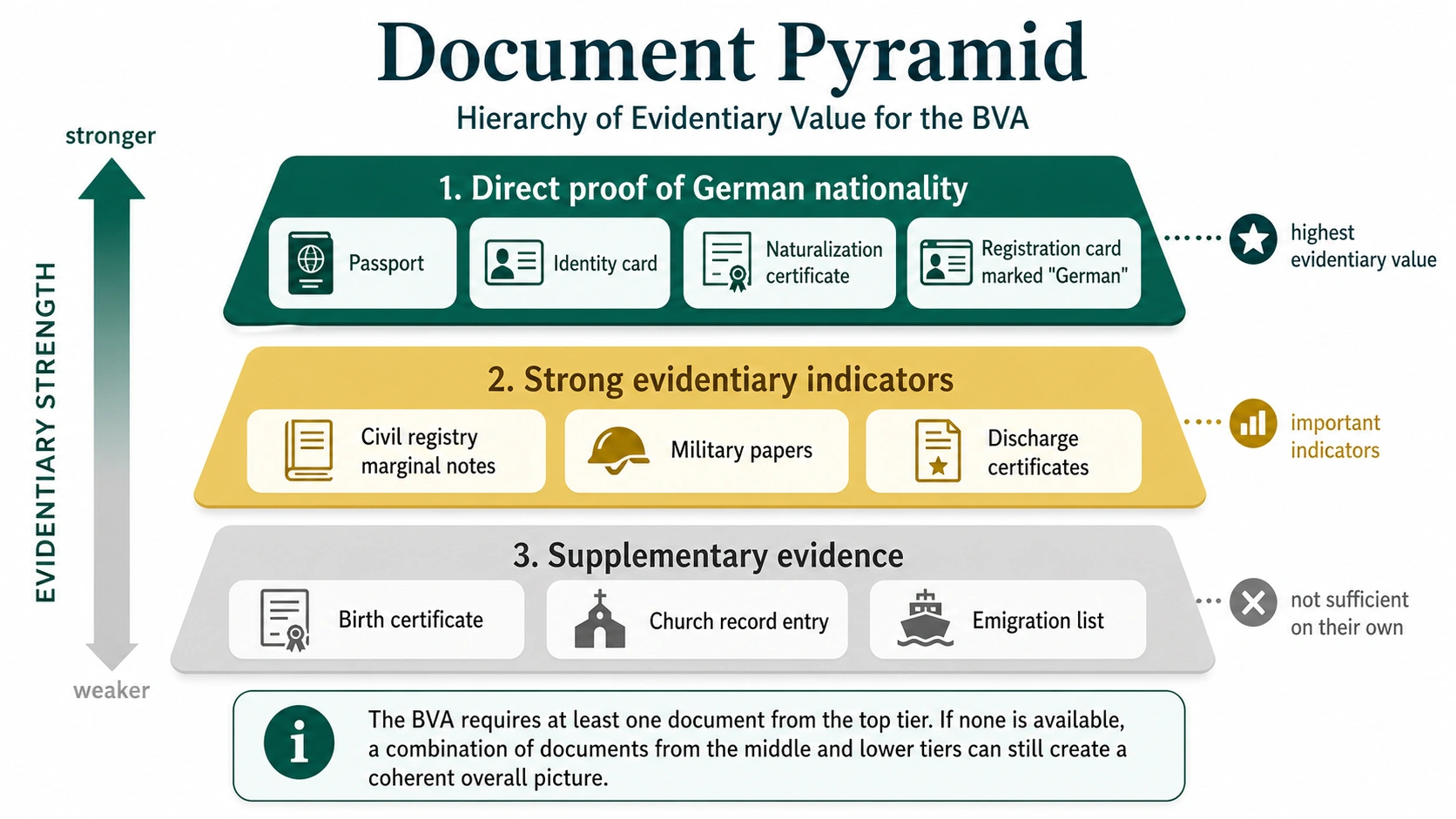
What the BVA specifically requires is a document which proves German nationality immediately apparentan old German passport, an identity card, an entry in the resident registration register marked „German“, a certificate of naturalisation or an entry in a civil register that indicates citizenship. Without such proof, the application will stall – no matter how plausible the family story sounds.
Understanding the German Archive System
Germany does not have a central personal register. Anyone looking for an ancestor must know where that person lived - and when. These two pieces of information determine which archive is responsible. The whole process follows a clear logic, but you need to know it.
The 110-year rule
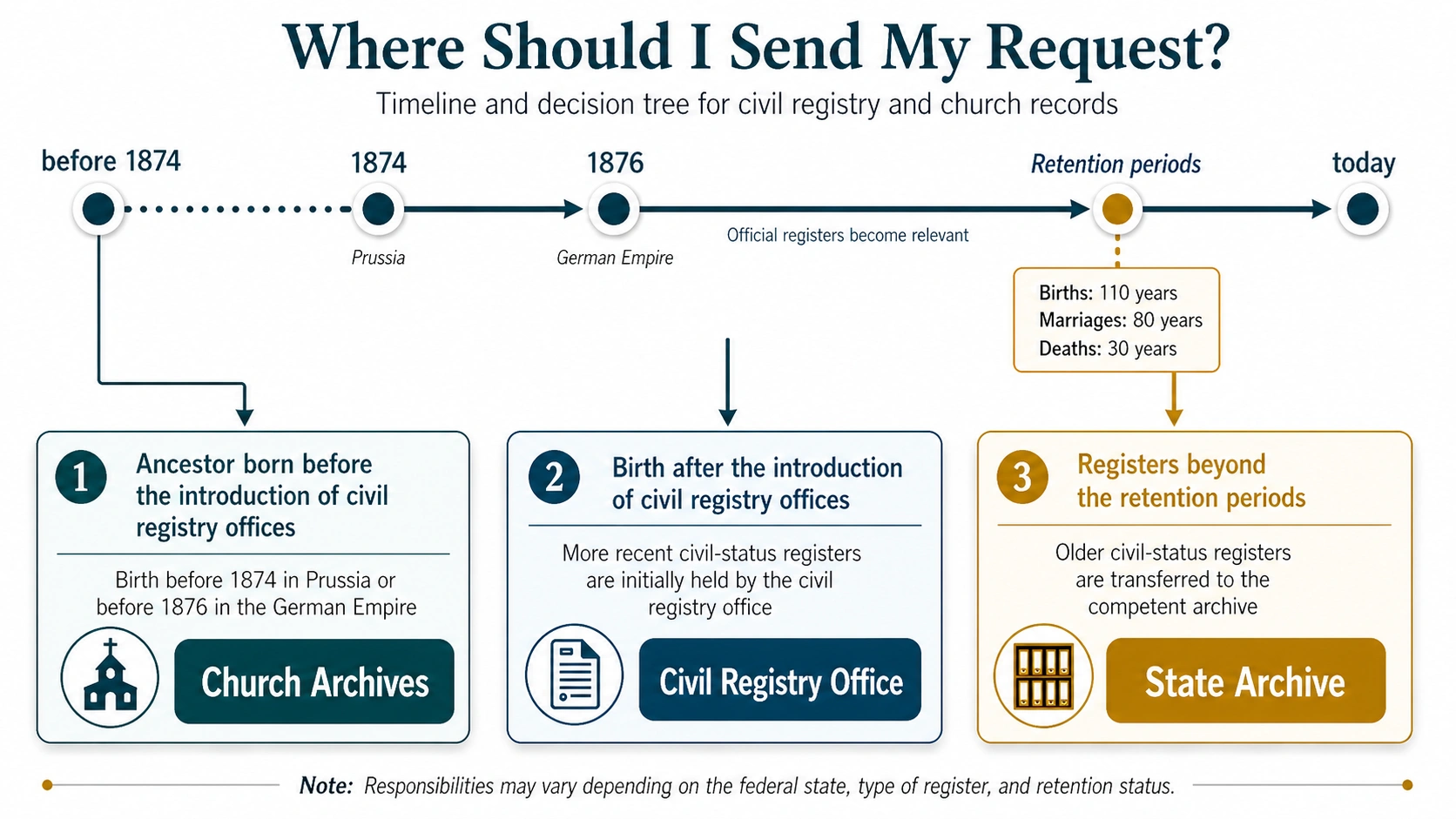
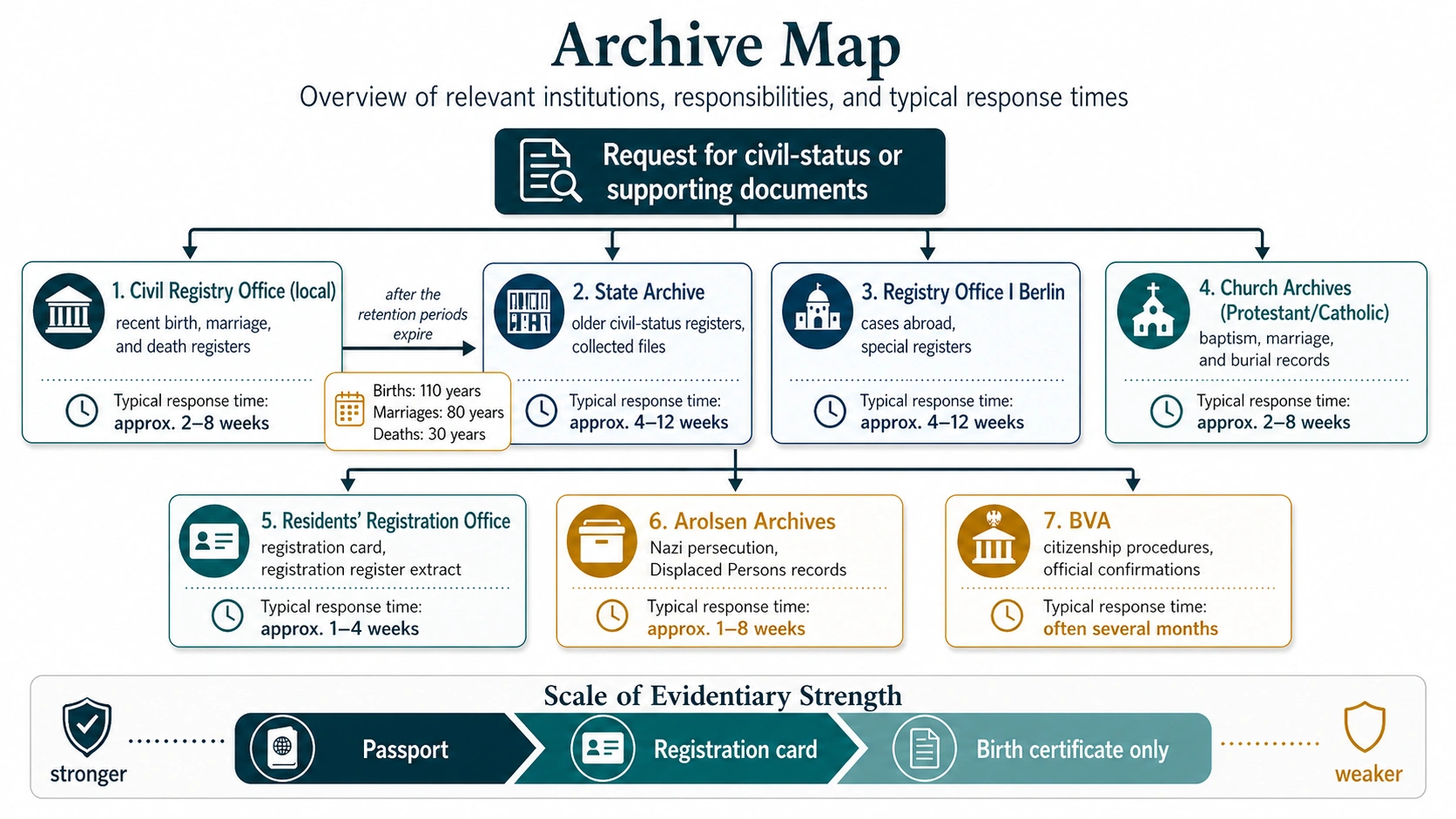
The Civil Status Act (PStG) regulates in Section 5, Paragraph 5 of the Civil Status Act (Version of 24 June 2024, Federal Law Gazette 2024 I No. 212), for how long civil registry offices keep their registers: Birth registers are kept for 110 years, marriage registers for 80 years, and death registers for 30 years. As long as these periods are running, the documents are held by the responsible civil registry office. After that, they are transferred to the public archive (§ 7(3) PStGThe registers must be kept permanently (§ 7 para. 1 PStG) – they are therefore not destroyed but merely handed over from the registry office to the competent archive.
What does this mean in practice? If you are looking for the birth certificate of an ancestor born in 1910, the birth register remained with the registry office until the end of 2020 and has since been transferred to the responsible state or municipal archive. If your ancestor was born in 1920, the register will remain with the registry office until the end of 2030.
Before 1874/1876: Church records instead of civil registry
The state civil registration of persons was introduced in Prussia on 1 October 1874 (Law on the Certification of Civil Status of 9 March 1874). For the rest of the German Empire, the obligation for civil registration came into effect on 1 January 1876 (Imperial Law on the Certification of Civil Status and Marriage of 6 February 1875). Before these dates, there are no civil registry office registers. Births, baptisms, marriages, and deaths were instead recorded in church registers.Church registers or Church register) are kept. Depending on the denomination, these are located in different archives: Protestant church records are generally held by the state church archives, and Catholic ones by the diocesan archives.
Important: Even after 1876, church registers can be the only source – specifically when civil registration records were destroyed due to war. In such cases, German authorities recognise church register entries as substitute proof.
Which archive for which period?
The following overview shows where you need to go depending on the period and document type.
| Period | Competent body | Important notes |
| From 1876, within the continuation period | Registry office of the municipality of birth/marriage/death | Access only for the person concerned, direct ascendants and descendants (§ 62 PStG) |
| From 1876, after the continuation period expired | Appropriate State or Municipal Archive | Access under archive law – usually significantly easier than with the registry office |
| Before 1874 (Prussia) / 1876 (rest of the Empire) | Church archives (Regional church archives, diocesan archives) | No state civil registries exist; church records are often the only source (in some regions, older civil registries from the Napoleonic era did exist). |
| Former Eastern Territories (Silesia, East Prussia, Pomerania, etc.) | Civil Registry Office I in Berlin, Polish/Russian State Archives | Many registers were transferred to Berlin after 1945; waiting times at the civil registry office I of several years are common |
| Marriage data (place of residence, nationality entry) | Local Registration Office or Town Archive of the former place of residence | Registration cards often include the note „German“ - precisely the proof the BVA is looking for |
Which archive documents are particularly valuable
Not every document from the archive is equally helpful. Some only prove the place of residence, others only marital status. The crucial point is whether a document reveals the ancestor's nationality – directly or indirectly.
Documents with direct proof of citizenship
- Old passports and identity cards: A historical German passport or identity card belonging to an ancestor is generally a strong indication of their German nationality — even if, depending on the period of issue and context, it is not always considered conclusive proof (cf. BVA guidelines on determining nationality). Nevertheless, it is among the most informative documents accepted by the BVA. However, passport files are usually only kept by the passport authorities for ten years — older documents can sometimes be found in state or municipal archives (BVA, Notes on passport documents, available at bva.bund.de).
- Resident registration files The historical registration records of many cities have been preserved and, in addition to the address, often also contain nationality. In Berlin, for example, the State Archive holds registration records from 1874 onwards – with details of the head of household, the wife, and the children.
- Naturalisation records If an ancestor was naturalised, the relevant record provides irrefutable proof. These records are often held by the regional councils or the responsible state archives.
- Certified copies from civil status registers: Civil registration records occasionally contain marginal notes concerning nationality, particularly in the case of marriages involving foreign nationals.
Documents with indirect evidentiary value
Where no direct proof exists, other archival documents can also supplement the chain of evidence: church records, military papers, emigration lists, expatriation certificates, or restitution files. Individually, these are rarely sufficient. However, taken together, they can form a coherent picture that convinces the authorities.
Common pitfalls when researching archives
- Wrong contact person Anyone who approaches the registry office even though the retention period has already expired will be referred to the archives – and lose weeks. Conversely, the archives cannot issue civil status certificates as long as the registry office is still responsible.
- Lack of local knowledge Without the specific place of birth or residence of the ancestor, it is not possible to contact any archive. There is no „search all registers“ mechanism. Immigration records of the destination country (e.g. US naturalisation applications) often mention the place of birth and are therefore a good starting point.
- Registry Office I in Berlin — extreme waiting times: This registry office holds the civil status registers from former German Eastern territories and is responsible for subsequent registrations when no domestic place of residence exists (see berlin.de/labo/standesamt-i-in-berlin). According to the Federal Foreign Office, the processing time is currently at least three years (germany.info, as of 2026).
- Destroyed documents Bomb damage from the Second World War has left significant gaps in the records. In such cases, one should request a certificate of non-availability („Bescheinigung der Nicht-Auffindbarkeit“) and search for alternative sources: church records, duplicate registers, or registration records.
- Name changes and Germanisation: Surname changes or Germanisations occurred particularly with families from the former eastern territories following their resettlement. This significantly complicates their identification in registers. Old family documents, in which both name variants appear, are helpful here.
Special case: Displaced persons and persecuted individuals
Special rules apply to descendants of expellees and victims of Nazi persecution. Article 116 (1) of the Basic Law (GG) defines „Germans“ within the meaning of the Basic Law not only as persons with German citizenship, but also as refugees and expellees „of German ethnicity“ as well as their spouses and descendants who were admitted to the territory of the German Reich as of December 31, 1937. Therefore, these are not necessarily former citizens, but persons who felt they belonged to the German people on the basis of language, culture, and creed (so-called "Statusdeutsche", see § 6 Federal Expellees Act - BVFG). Furthermore, Article 116 (2) GG allows former German citizens, who were deprived of their citizenship between January 30, 1933, and May 8, 1945, for political, racial, or religious reasons, as well as their descendants, to reacquire citizenship upon application.
In both cases, archival research is particularly challenging. For displaced persons, refugee passes, expellees' identity documents, or registration certificates from reception camps need to be found. For victims of Nazi persecution, restitution files, emigration documents, deportation lists, or expropriation notices are relevant. Specialised archives such as the International Tracing Service (ITS) in Bad Arolsen – now Arolsen Archives – or memorial site archives can provide further assistance here.
Which path to reparations is the right one — Article 116 (2) of the Basic Law (GG), Section 15 of the Citizenship Act (StAG), or Section 5 of the Citizenship Act (StAG) — we explain in detail in our article Art. 116 vs. § 15 StAG: Which route leads to naturalisation?
Practical Timetable: A five-step guide to archive proof
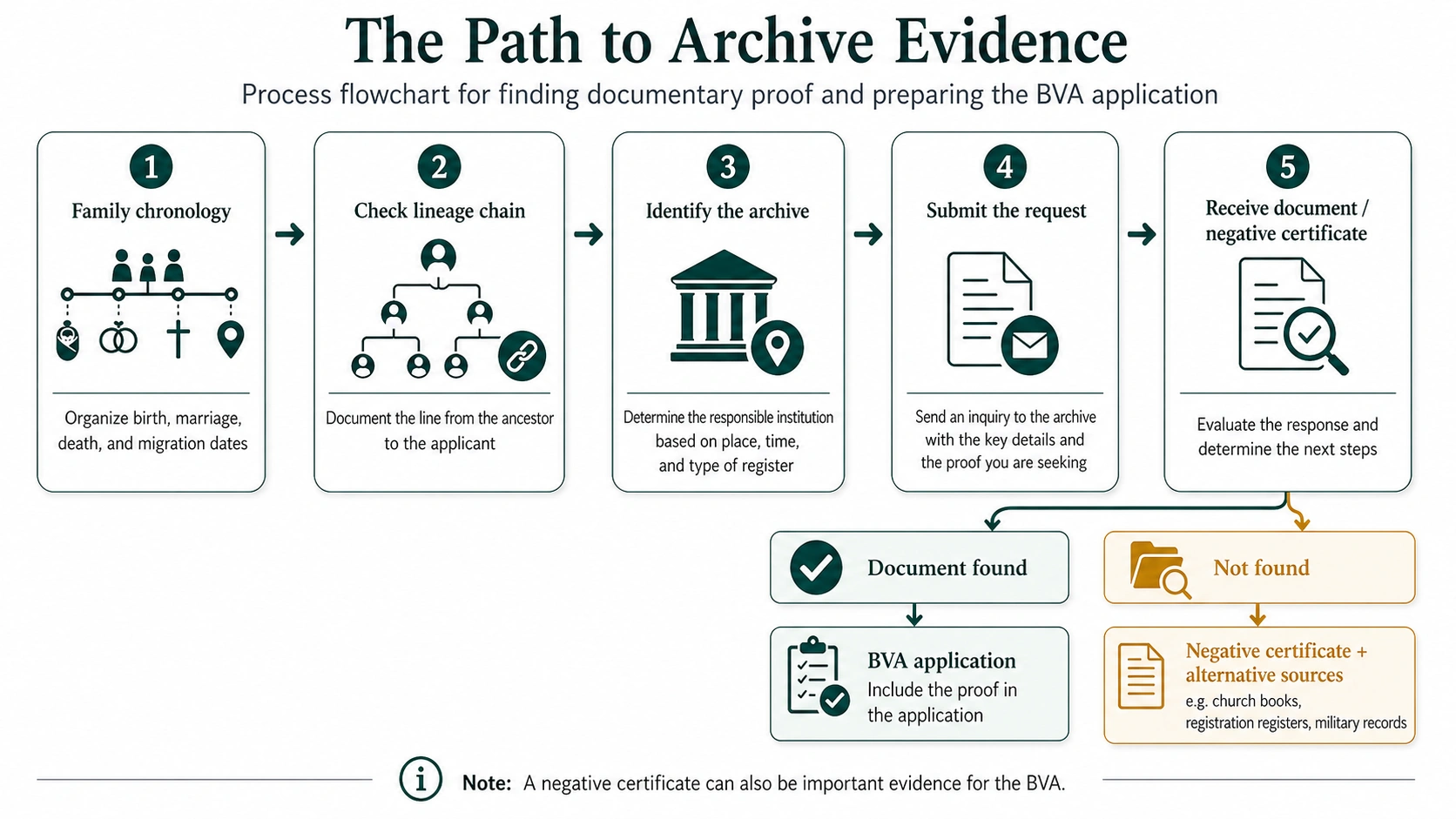
- Create a family chronology: Gather all known data – names, dates of birth, places of birth, dates of marriage, dates of emigration. Pay attention to both name variants if name changes have occurred.
- Check lineage: The chain must be unbroken: from the German ancestor through each intermediate generation to you. Each generation must have possessed German citizenship at the time of the birth of the next descendant.
- Identify the correct point of contact: Based on the place of birth/residence and the time period, determine whether the registry office, the state archive, a church archive, or the registry office I in Berlin has jurisdiction (see table above).
- Formulate a request: Please write to the archive as precisely as possible, including: the full name of the person you are looking for, their date of birth (at least approximate), and their last known address. Please provide proof of your direct lineage, as only ancestors and descendants have a right to information from the registry office according to § 62 PStG.
- Request a negative certificate, if necessary: If the archive cannot find the documents, get written confirmation. This negative certificate shows the BVA that you have seriously pursued the research and opens the way to substitute evidence.
When to consult a lawyer
Many archive searches can be carried out by yourself. Registry offices and archives in Germany generally also process enquiries from abroad – in German, sometimes in English. However, if the matter gets more complicated, legal support can make the difference between success and rejection.
This is particularly relevant in the following situations: when the chain of descent includes a generation in which nationality may have been lost (e.g., through the marriage of a German woman to a foreigner before 1953 or the acquisition of a foreign nationality before 27 June 2024), when documents from the former Eastern territories are missing and alternative evidence is required, or when the BVA has already rejected the application and an objection or legal action is being considered.
As a law firm specialising in immigration and nationality law, we assist clients with compiling evidence, communicating with archives and the BVA (Federal Office of Administration), and – if necessary – with the judicial enforcement of claims. If you are unsure whether your documents are sufficient, we would be happy to advise you in an initial consultation.
Further articles
German nationality by descent — Guide for applicants abroad Line of descent, cutoff dates, generational analysis, § 4 German Nationality Act
Art. 116(2) of the Grundgesetz or § 15 of the Nationality Act: Which path leads to naturalisation? — Three Paths to Reparations Compared
§ 5 StAG: Acquisition of German nationality by declaration Gender discrimination, case groups, deadline until 19 August 2031
Dual Citizenship in Germany: What is permitted since 2024 — Reform, § 10 StAG, § 5 StAG, right of soil
Preliminary check: Check German nationality from abroad Free, no-obligation initial assessment via online form
Re-naturalisation of former Germans abroad under Section 13 of the Nationality Act — Prerequisites, procedures, costs
Frequently asked questions
Is my grandfather's birth certificate sufficient proof of German nationality?
As a rule, no. A birth certificate proves the place of birth and lineage, but not nationality. What the BVA accepts are documents that directly indicate nationality – such as an old passport, an identity card or a registration certificate with the notation „German“.
My ancestor came from Silesia. Where can I find his records?
Records of civil status from the former German Eastern territories are partly held by the Standesamt I in Berlin and partly in Polish state archives. Processing times at the Standesamt I are currently at least three years. Church records from these areas are often preserved in the archives of the Protestant Church or in Polish diocesan archives.
What is a certificate of no objection and why do I need one?
A negative certificate is a written confirmation from an archive or registry office that a particular document cannot be found. It is not proof, but it documents to the BVA that you have carried out the research. This can open the way to alternative proof.
Can I carry out the archive research from abroad?
Yes, generally speaking. Most registry offices and archives accept written enquiries – by post, and sometimes by email. The fees are usually between €10 and €40 per document. For complex research, for example, if the exact place of birth is unclear, it may be advisable to engage a lawyer or a specialised local researcher.
Sources and further information
- Civil Status Act (PStG) of 19 February 2007 (Federal Law Gazette I p. 122), last amended by Article 4 of the Act of 24 June 2024 (Federal Law Gazette 2024 I No. 212). In particular, Section 5 (5) PStG (retention periods: 110/80/30 years), Section 7 (3) PStG (submission to archives), Section 62 PStG (right to information).
- Basic Law for the Federal Republic of Germany: Article 116 (1) GG (Definition of „German“, ethnic affiliation), Article 116 (2) GG (Re-naturalisation following Nazi persecution).
- Nationality Act (StAG) as amended on 22 February 2024 (Federal Law Gazette 2024 I No. 60). In particular, § 4 StAG (Acquisition by birth), § 5 StAG (Acquisition by declaration, deadline until 19 August 2031), § 15 StAG (Restitutionary naturalisation).
- Federal Office of Administration (BVA), information on the determination of German nationality and on passport documents of ancestors: bva.bund.de (Section Nationality > Determination).
- Lviv, Civil Registry Office I, State Office for Civic Affairs and Order: Responsible for post-registration in cases without a domestic residence and for civil status registers of former German Eastern Territories. Current processing times according to the Federal Foreign Office: at least three years (as of 2026).
- Law on the Registration of Civil Status and the Form of Marriage of 9 March 1874 (Prussia, in force since 1 October 1874). Imperial Law on the Registration of Civil Status and Marriage of 6 February 1875 (German Empire, in force since 1 January 1876).
- Federal Expellees Act (BVFG), particularly Section 6 BVFG (Definition of German Ethnic Origin).
- Arolsen Archives – International Centre on Nazi Persecution, Bad Arolsen: arolsen-archives.org. Central contact point for persecution documents, deportation lists and inmate files.
Lawyer Helmer Tieben
Tieben Law Firm — MTH Partner
Sachsenring 34, 50677 Cologne | Tel.: +49 221 20426165 | www.mth-partner.de
Areas of focus: Immigration law • Nationality law • Tenancy law • Employment law