
If the rented property is defective, the rent is reduced by operation of law (Section 536 of the German Civil Code [BGB]). This applies to commercial property leases just as it does to residential space. The crucial difference lies elsewhere: In a commercial lease agreement, the right to a rent reduction may be restricted by contract – even in standard business terms. For residential property, that is ruled out. Many commercial tenants therefore withhold rent in the belief they have a right to do so that their own contract has effectively curtailed – thereby risking cancellation without notice due to late payment.
Note: This article serves for general information and does not replace individual legal advice. Whether and to what amount a reduction is justified depends on the specific defect and the specific contract. Have this legally examined before you reduce the rent.
At a glance
- The reduction takes effect by operation of law. It does not need to be declared – but it must be justified.
- Section 536(4) of the German Civil Code (BGB) only protects residential tenants from deviating agreements. In commercial tenancy law, a restriction is therefore generally possible, including in standard form contracts.
- The limit: The tenant must not be deprived of every opportunity to reclaim overpaid rent.
- An unjustified or excessive deduction leads to delayed payment – and thus potentially to summary dismissal without Warning letter.
- Anyone who was aware of the defect at the time of concluding the contract loses the right to a rent reduction (§ 536b BGB). Anyone who fails to report it is liable for damages (§ 536c BGB).
- Anyone who continues to pay the full rent without reservation for a prolonged period despite a defect risks forfeiting the right to a rent reduction for the past.
When is there a defect?
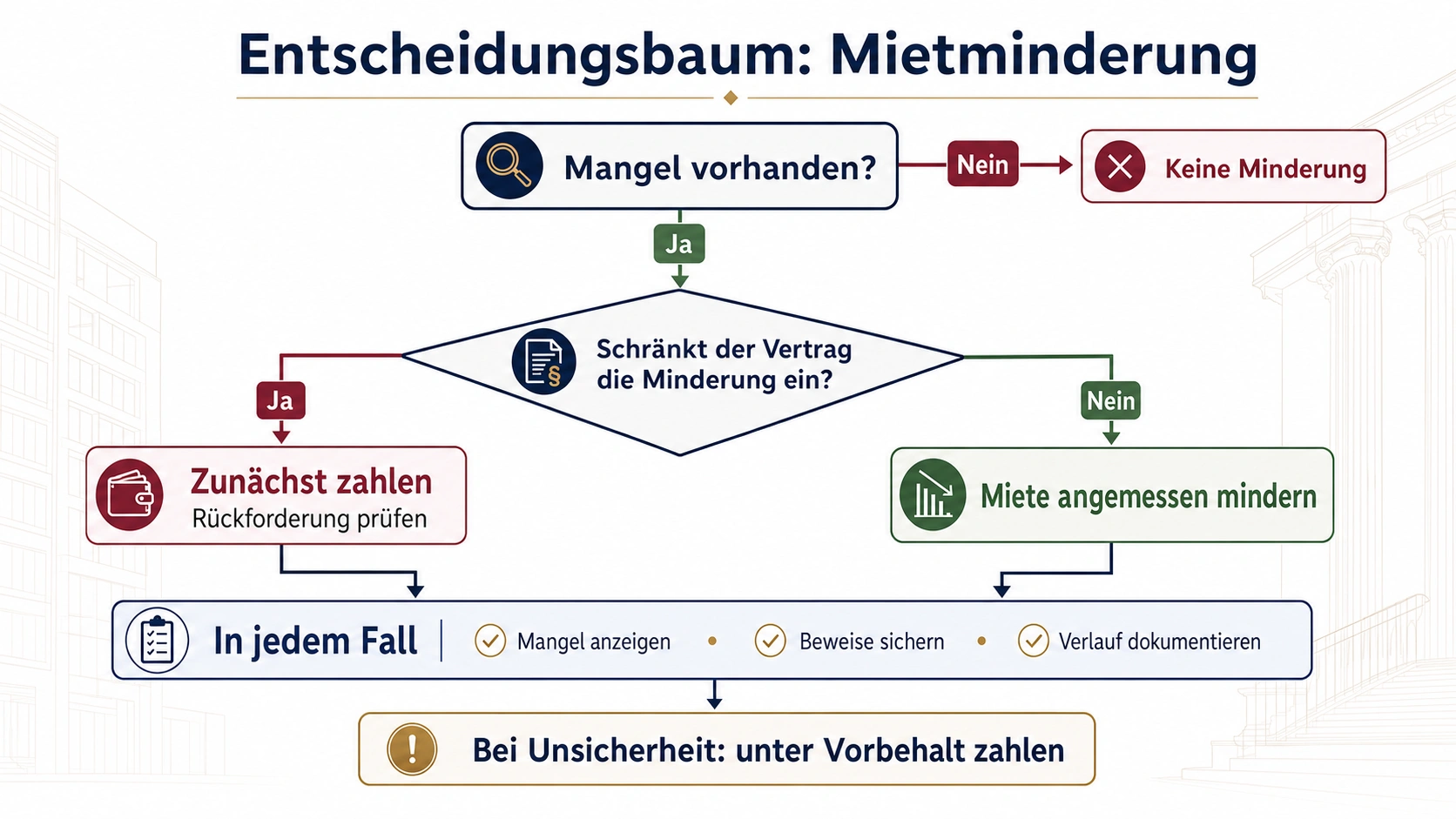
A defect is any discrepancy between the actual condition of the premises and that required under the contract which is detrimental to the tenant and which negates or impairs the suitability of the rented premises for their intended use as set out in the contract. The intended use agreed in the contract is always the decisive factor: what may be insignificant for a warehouse could constitute a significant defect for a doctor’s surgery or a restaurant.
Common defects in commercial premises:
- Structural defects – damp, mould, a leaky roof, a faulty heating or air-conditioning system
- Area deviation – if the actual area differs significantly from the agreed area, this constitutes a defect; for further details, see our article on Determining the lettable area
- Restrictions on use under public law – if a licence required for the agreed operation is missing, this may constitute a defect; see our article on Lack of an official licence
- Breach of non-compete clause – if the landlord permits unauthorised competition, this constitutes a defect within the meaning of Section 536 of the German Civil Code (BGB); see Protection against competition and the obligation to operate
- Withdrawal of treatment – if the landlord cuts off electricity, water or heating, they are depriving the tenant of the contractual use of the property; on this, see our article on suspension of utilities in commercial lease law
- Disruption caused by building works – Noise, dust, restricted access, particularly if the landlord is doing the building work themselves; see Breach of contract in a construction project
Which is not a shortcoming
Not every economic disappointment is a defect. If the hoped-for turnover does not materialise because the situation is worse than expected or fewer customers come, the tenant bears this as an entrepreneurial risk. The disappointing profit forecast does not give rise to a claim for a rent reduction. This also applies if the local environment deteriorates – for example, due to properties standing empty in the neighbourhood – provided the landlord has not contractually agreed to be liable for this.
The key difference from residential tenancy law
Section 536 subsection 4 of the German Civil Code (BGB) stipulates that any agreement to the detriment of the tenant is void in the case of residential space. A corresponding provision is lacking for commercial space. It follows by converse conclusion that: In the commercial lease agreement, the right to a reduction to be restricted – and not just individually, but fundamentally in standard terms and conditions too.
This is the most important practical point in this article, and it is regularly overlooked. Anyone who, based on residential tenancy law, assumes that the right to a rent reduction is sacrosanct, reduces the rent and suddenly finds themselves in arrears.
Which exclusion clauses are valid – and which are not?
Case law distinguishes between the exclusion of the right to a reduction as such and the restriction on its enforcement.
Usually effective is a clause which merely prevents the tenant from enforcing the reduction by deducting it from the current rent: the tenant pays the full amount initially and then asserts their claim for a refund. It is also common to find clauses that make the rent reduction conditional upon prior written notice or upon the defect being undisputed or having been established by a final and binding decision.
Invalid is a clause that also deprives the tenant of the right to claim back overpaid rent. If he is cut off from both the deduction and the subsequent recovery, he is left with no economic remedy at all against a defect – which unreasonably disadvantages him (§ 307 BGB).
Also invalid is a prohibition of set-off that deprives the tenant of the right to offset even undisputed or legally established counterclaims. This limit arises from Section 309 No. 3 of the German Civil Code (BGB) and, via Section 307 BGB, also applies in commercial transactions.
Practical tip for landlords
If reduction, withholding and set-off are jointly excluded in a single sentence and one of these exclusions is too broad, the invalidity may affect the entire clause. A reduction to the extent that it is legally permissible (geltungserhaltende Reduktion) does not take place under standard terms and conditions law. Therefore, regulate the three points separately – that way, if there is an error, the rest remains valid.
By how much can the amount be reduced?
Fixed percentages do not exist. The reduction is calculated according to the extent to which the suitability of the rooms for their contractual use is actually impaired. So-called rent reduction tables come almost exclusively from residential tenancy law and cannot be applied to commercial premises: the benchmark there is not the quality of living, but the impairment of business operations.
Therefore, the decisive factors are: which part of the area is affected, whether the business is fully or partially restricted, how long the disruption lasts and – in cases involving competition or construction sites – how turnover has demonstrably developed.
The rent reduction is to be calculated from the gross rent including advance payments for service charges, and not solely from the net cold rent.
The procedure: notification, reservation, deadlines
Notice of defect (§ 536c BGB)
The tenant must report a defect without undue delay. If they fail to do so, they may be liable to compensate for the resulting damage and, in extreme cases, lose their right to a rent reduction. The report should describe the defect specifically rather than making a general complaint, and should be done in a documented manner.
Knowledge at the time of concluding the contract (§ 536b BGB)
Anyone who knows of the defect at the time the contract is concluded cannot claim a reduction in rent. Anyone who is unaware of it due to gross negligence cannot do so either, unless the landlord has fraudulently concealed it. Anyone who accepts the premises without reservation while being aware of the defect also loses this right. Therefore, every recognisable defect must be included in the handover protocol.
pay under protest
Anyone who unconditionally pays the full rent over a prolonged period despite a defect risks forfeiting the right to a rent reduction for the past. Anyone who is unsure whether and to what extent a reduction is justified should therefore pay under protest and explain this in writing. This preserves the claim for repayment and at the same time avoids the risk of default.
The main risk: unjustified reduction
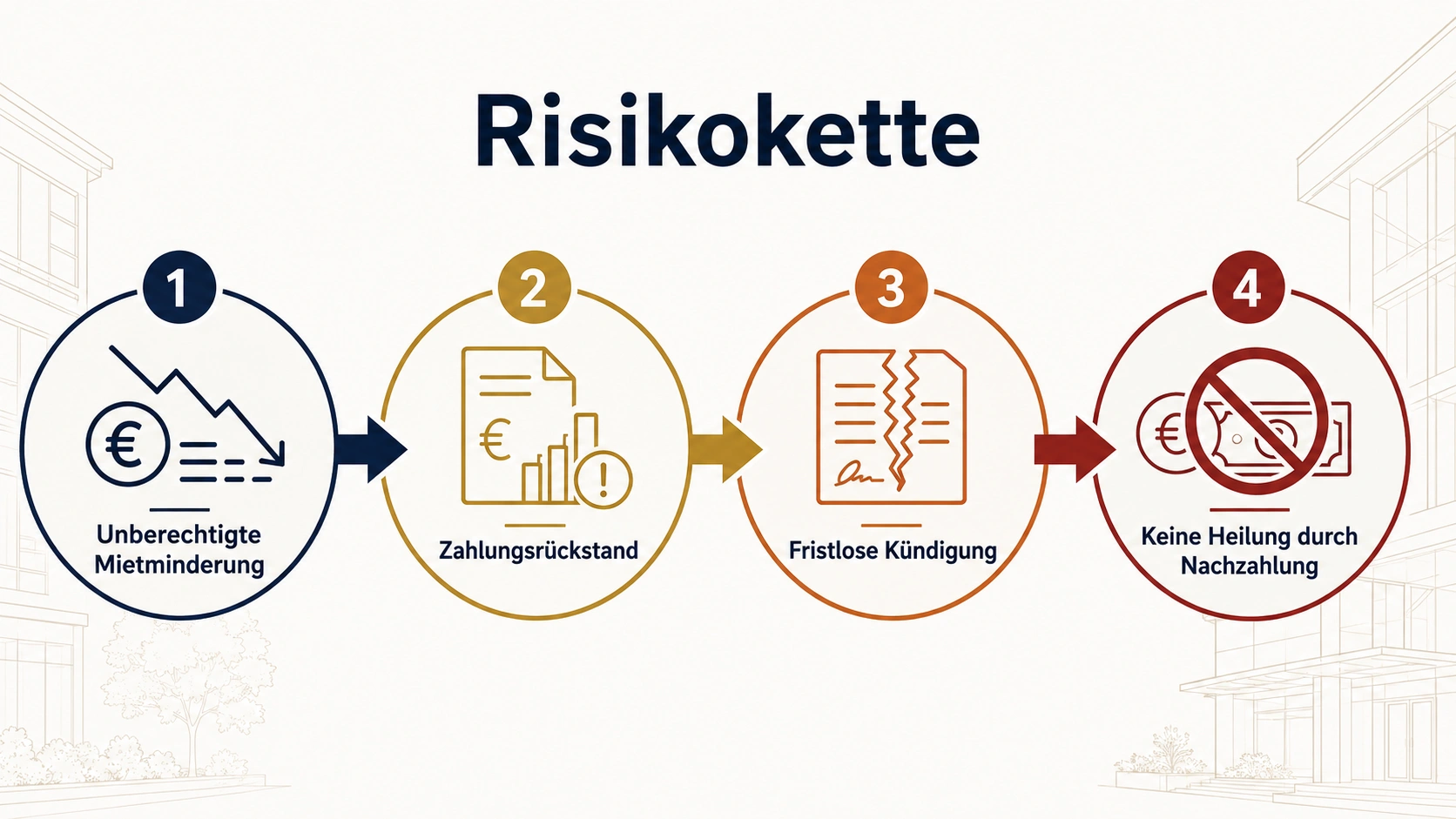
If the tenant reduces the rent unjustifiably or by too much, they are in default of payment. If the arrears reach the threshold of Section 543(2) sentence 3 of the German Civil Code (BGB), the landlord can terminate the tenancy without notice – specifically without prior warning, because the law does not require them in this case.
To make matters worse, the grace period payment known from residential tenancy law does not apply to commercial tenancy law. Anyone who settles the arrears after receipt of the termination notice does not thereby cure it. Details in our guide on Termination of the Commercial Lease Agreement.
Precisely for this reason, payment under reserve is the safer way in cases of doubt: it preserves the claim without jeopardising the existence of the tenancy.
In addition to reduction: further rights
- Rectification of defects – the tenant can demand that the landlord remedies the defect (Section 535(1) sentence 2 of the German Civil Code (BGB)).
- Right of retention – as long as the defect persists, a part of the rent can be withheld, provided the contract does not effectively exclude this. The right to withhold rent is a coercive measure and ceases to apply once the defect has been remedied.
- Compensation for damages – in the case of initial defects, delay in remedying them, or fault on the part of the landlord (Section 536a(1) of the German Civil Code (BGB)).
- Self-performance – if the landlord does not remedy the defect despite the setting of a deadline, the tenant may have it remedied themselves and demand compensation (§ 536a para. 2 BGB).
- Termination without notice – if the contractual use is wholly or substantially withheld and the landlord fails to remedy the situation despite a formal warning, termination pursuant to Section 543 of the Civil Code (BGB) may be considered.
What does that mean for commercial tenants?
Check the contract first, not the defect. If it contains an effective restriction on rent reductions, reducing the ongoing rent is the wrong approach, even if the defect is undisputed. Report the defect immediately and specifically, document it, and if in doubt, pay under protest. In the case of impairments that affect turnover – construction work, competition, restricted access – provide reliable figures from the outset: without a before-and-after comparison, the amount of the reduction cannot be enforced later.
What does that mean for landlords?
A clause that is drafted too broadly is worse than a moderate one. If the exclusion of price reduction, retention and set-off is combined in a single sentence and part of it goes too far, the entire provision may fall away – in which case the statutory rules apply, and that is less favourable than an effective restriction to the path of seeking recovery.
Furthermore, respond to notices of defects promptly and in a documented manner. Delay in remedying them gives rise not only to a reduction in rent, but also to claims for damages and opens the way for the tenant to carry out the work themselves at your expense.
Frequently asked questions
Do I need to declare the rent reduction?
The reduction occurs by operation of law and does not need to be declared. However, you must report the defect (§ 536c BGB) – and whether you are actually allowed to reduce the rent also depends on your contract.
Can the right to a rent reduction be excluded in a commercial lease agreement?
Yes, to a limited extent, even in standard form contracts – Section 536(4) of the German Civil Code (BGB) only protects residential tenants. The limit lies where the tenant is also deprived of the right to reclaim overpaid rent.
Do rent reduction tables also apply to commercial premises?
No. These tables come from residential tenancy law. In commercial premises, what matters is the impairment of the specific business operation, measured against the contractually agreed purpose of use.
What happens if I make an unjustified price reduction?
You are falling into arrears with your payments. If the arrears reach the threshold of Section 543(2) No. 3 of the Civil Code (BGB), the landlord can terminate the lease without notice – without a warning, and a subsequent payment does not cure the termination in commercial lease law.
Is lost revenue a defect?
No. The disappointed profit expectation is the tenant's entrepreneurial risk, not a defect in the leased property.
Can I withhold rent if the landlord is doing construction work in the building?
If noise, dust or restricted access noticeably impair the contractual use, a rent reduction may be considered. Document the extent and duration of the impairment as well as the effects on operations.
to pay under protest
You pay the full rent, but state in writing that the payment is made without acknowledgment of any legal obligation and under the reservation of recovery. In this way, you avoid default and retain your right to reclaim the money.
How long can I claim back overpaid rent?
The claim for recovery is subject to the statutory limitation period. Irrespective of this, the right to a rent reduction for the past can be forfeited if you pay the full rent without reservation over a longer period.
We are reviewing your situation
Whether a defect exists, to what extent a rent reduction is permitted, and whether your contract allows this are three separate questions. Answered incorrectly in commercial tenancy law, they can quickly cost you the tenancy. We review your contract and your defect situation, draft the notice of defects, and represent you against the opposing party. If you would like to have the contract reviewed anyway, you can find the procedure under Have a commercial lease checked.
Free initial assessment
Phone: 0221 - 80187670
E-mail: info@mth-partner.de
Solicitor Helmer Tieben · Sachsenring 34 · 50677 Cologne
Important Note: The content of this article has been prepared to the best of our knowledge and belief. However, due to the complexity and constant evolution of the subject matter, we must exclude liability and warranty. The content of this post has been created to the best of our knowledge and belief. However, the complexity and constant evolution of the subject matter make it necessary to exclude liability and warranties. If you require legal advice, please call us without obligation on 0221 – 80187670 or write to info@mth-partner.de.