
It's decided: the eviction is coming. A bailiff has announced the date. And the tenant faces – for health, personal or family reasons – a situation that goes beyond what a forced eviction already entails.
For precisely these cases, the legislator has created a final instrument: the Application for a stay of eviction under Section 765a of the Code of Civil Procedure. However, this application is not a simple deferral, nor is it an objection to the eviction order. It is a safety valve – and subject to strict conditions.
Note: This post is for general guidance only and does not constitute individual legal advice. If you are facing an eviction, act immediately – time is of the essence. Seek advice from a Solicitor for tenancy law advise.
What is an eviction protection application?
After a Court representation in landlord/tenant disputes With a legally binding eviction order, the landlord can instruct a bailiff to carry out the compulsory eviction. By this point, the tenant has usually already exhausted all regular legal remedies – objection, appeal, eviction period under Section 721 of the German Code of Civil Procedure (ZPO).
application for protection against eviction pursuant to Section 765a of the German Code of Civil Procedure (ZPO) is the final remedy. It is not directed against the judgment itself, but against the specific enforcement measure – the impending eviction. And it only intervenes if, under the given circumstances, this eviction constitutes a Unreasonable hardship would represent.
Contra bonos mores — that sounds dramatic. And that's precisely what it is. Section 765a of the German Code of Civil Procedure (ZPO) is an exceptional provision. Courts interpret it restrictively, and the hurdles are deliberately high. This is because, on the other side, stands the landlord's constitutionally protected right to property (Article 14(1) of the German Basic Law) and their right to effective legal protection (Article 19(4) of the German Basic Law).
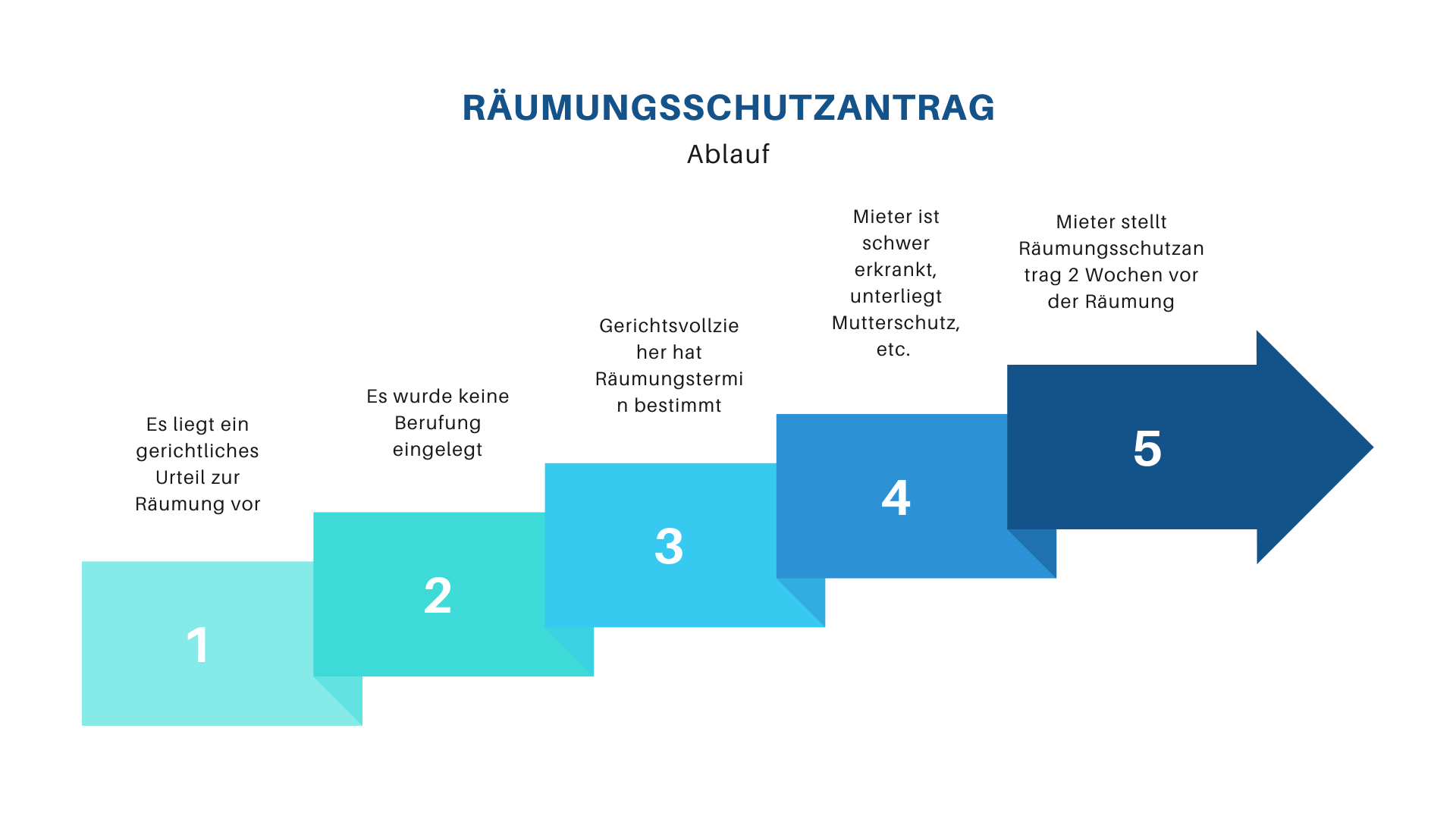
Prerequisites: When is eviction protection granted?
The court considers two questions for every application for protection against eviction:
- Would the eviction lead to a completely unbearable outcome for the tenant?
- On balance, and taking into account all the circumstances, do the tenant's interests outweigh the landlord's interest in enforcing their claim for possession?
Only if both are affirmed is a temporary stay of enforcement possible.
Recognised grounds for eviction protection
What constitutes an immoral hardship always depends on the individual case. Over the years, however, case law has developed typical groups of cases:
- Concrete risk of suicide — the most common and, at the same time, legally most complex case. The court must examine whether there is a serious danger to life and whether this danger cannot be averted in another way (more on this below)
- Serious illness — if a move would demonstrably and significantly worsen the tenant's or a relative's health status. A mere assertion is not sufficient; a specific medical certificate referring to the eviction is required
- Pregnancy or recent childbirth
- Endangerment of child welfare — if minor children were to find themselves in a concrete emergency situation as a result of the eviction
- Short-term impending move to a replacement apartment — if the tenant can prove that they can move into a new flat within a few weeks
- Need for care — if a severely ill dependent relative is being looked after in the flat and a transfer would be immediately dangerous to their health
Not enough against it: general economic difficulties, the strained housing market as such, a general burden on health without a specific connection to the eviction, or the desire to remain in familiar surroundings.
The two-week deadline: When must the application be submitted?
The application for protection against eviction must be submitted no later than two weeks before the scheduled eviction date at the competent local court - the enforcement court (§ 765a para. 3 ZPO). Caution: The day of the eviction appointment itself does not count.
And here's a catch: if the last day of the deadline falls on a Saturday, Sunday or public holiday, the deadline is extended not until the next working day. The Federal Court of Justice has expressly decided this – the deadline is intended to protect the landlord, not the tenant.
Exceptions to the deadline exist only in two cases:
- Die Gründe für den Antrag sind only arose after expiry of the deadline
- The tenant was through no fault of one's own prevented from applying in good time
Anyone who is late, without one of these exceptions applying, will have their application rejected for formal reasons alone – regardless of how serious the grounds may be.
Special case risk of suicide: what case law requires
Suicide risk is the most common and, at the same time, the most legally demanding reason for a protection from eviction application. The courts take these cases seriously – but they also have high requirements.
Three court examination stages
From the case law of the BGH, a three-stage test can be derived:
- Is there a concrete danger of suicide? — The court must determine whether suicide can be reasonably expected. For this purpose, it usually obtains an expert opinion. Sweeping claims are not sufficient, but the Federal Court of Justice has also clarified that no excessive demands may be placed on the burden of proof (BGH V ZB 124/10).
- Can the danger be countered in other ways? — For example, by involving the Ordnungsbehörden (regulatory authorities), the Betreuungsgericht (guardianship court), or through stationary crisis intervention. Only when all these alternatives are ruled out is a suspension of the eviction to be considered.
- Do the tenant's interests prevail? — The balancing of fundamental rights: protection of the tenant's life (Art. 2(2) of the Basic Law) against the landlord's guarantee of property (Art. 14 of the Basic Law). The court also considers whether the tenant himself contributes to eliminating the danger.
Tenant's duty to cooperate
This last point is crucial – and often underestimated. The Federal Court of Justice (BGH) reiterated this in 2023 (Ref. I ZB 11/23): The tenant can every reasonable effort to demand a reduction in health risk. Anyone who refuses an assessment, rejects offered therapy, or evades inpatient treatment must expect the court to deny eviction protection – even in cases of existing suicidal ideation.
And the Federal Constitutional Court (BVerfG) has also drawn the lines: In October 2024 (2 BvR 1308/24), it rejected a constitutional complaint against the refusal of eviction protection. The courts had carefully weighed the interests – that is all the Basic Law requires.
A BGH case from practice: I ZB 15/13 (15.05.2014)
A case that the Federal Court of Justice monitored over several years shows how such a procedure can unfold in practice.
The facts of the case
A tenant was ordered to vacate a property with a residential building. They applied for protection against eviction, citing a delusional disorder that would lead to suicide if the eviction were carried out. The local court initially rejected the application – the tenant had failed to attend a scheduled assessment.
Consequently, a legal guardian ad litem was appointed, as the tenant was partially incapacitated. A court-appointed expert was unable to examine the tenant in person – he refused to cooperate in any way. Nevertheless, the expert prepared an assessment based on the available documents: in the event of a forced eviction, suicide was probable.
The district court then ordered the eviction unlimited in.
The BGH's decision
As a result, the BGH fundamentally upheld the dismissal – but corrected a crucial point: The indefinite Setting is not compatible with the landlord's property guarantee. The state's duty to protect the tenant's life cannot be resolved indefinitely by a prohibition of enforcement.
Instead, the setting must limited and with conditions to be provided – with the aim of improving the tenant's health. The tenant must be expected to work towards their recovery and prove the status of their treatment to the court. After the deadline has passed, the tenant must again demonstrate that the conditions for protection from eviction continue to exist.
The court specifically limited the suspension to three years.
What this case shows
Three lessons from this judgment:
- Risk of suicide can stop an eviction – but only temporarily, not permanently
- The court may use an expert report based on the case files if the tenant refuses a personal examination.
- Even in cases of concrete danger to life, a fixed-term lease with a therapeutic condition must be granted – the tenant cannot permanently block enforcement.
Eviction protection and hardship objection: What is the difference?
The application for protection against eviction under Section 765a of the German Code of Civil Procedure (ZPO) is often confused with the objection to eviction on grounds of exceptional hardship under Section 574 of the German Civil Code (BGB). However, the two instruments have different scopes of application. at different times:
| Hardship appeal (§ 574 BGB) | Application for Protection from Eviction (§ 765a ZPO) | |
| When? | Before the eviction order — against the termination | Following the eviction judgment — against enforcement |
| Against what? | Against the termination of the tenancy | Against the specific eviction measure |
| Deadline | Two months before expiry of the Cancellation period | 2 weeks before the eviction date |
| Scale | Unreasonable hardship | Unconscionable hardship (higher threshold) |
| Effect | Continuation of the tenancy | Temporary suspension of evacuation |
For tenants, the order of events is crucial: anyone who has missed the objection under § 574 BGB can not to refer to § 765a of the German Code of Civil Procedure. The application for protection against eviction is subsidiary—it only applies when all other protection options have already been exhausted.
What must the eviction protection application contain?
Case law does not place excessive formal demands on the content of an application. However, the more specific and well-supported the application is, the higher the chance of success.
An effective eviction protection application should contain at least:
- Designation of the eviction order — Court, case number, date of judgment
- Notification of the set eviction date
- Explanation of the Grounds for Hardness — concrete, with reference to the impending eviction
- Evidence — Medical certificates, expert reports, proof of apartment search, employer or social welfare agency certificates
- Application for interim injunction — until a decision is made on the main application
The application may be submitted in writing or registered in person at the registry of the local court. The local court within whose district the dwelling is located is responsible.
Frequently Asked Questions about the Eviction Protection Application
What is a stay of eviction application under § 765a ZPO?
It is the last resort against an impending eviction. It can temporarily halt the eviction if carrying it out would constitute an unconscionable hardship—for example, in cases of suicidal tendencies, serious illness, or pregnancy.
By when must the application be submitted?
At the latest two weeks before the eviction date (§ 765a para. 3 ZPO). If the last day falls on a weekend, the deadline is not extended. Exceptions only apply in cases of subsequently arising reasons.
Which reasons are recognised?
Concrete suicide risk, serious illness with a risk of deterioration, pregnancy, endangering the welfare of a child, caring for a severely ill relative, impending move into accommodation. General financial difficulties or a tight housing market are not sufficient.
Is a doctor's note sufficient?
A medical certificate is important, but usually not sufficient on its own. The court will generally obtain an expert opinion. The medical certificate must specifically refer to the threatened eviction.
Does the eviction get stopped automatically if the application is made?
No. But the court can order a temporary stay until the application is decided. Apply for both at the same time.
Can eviction protection be granted indefinitely?
No. The Federal Court of Justice has ruled that an indefinite tenancy is incompatible with the landlord's property guarantee. The protection must be limited in time and subject to conditions (e.g. therapy).
Does the tenant have to help with the removal of the danger?
Yes. The Federal Court of Justice requires the tenant to make every reasonable effort to reduce the risk (I ZB 11/23). Refusal to cooperate can lead to the rejection of the application – even if there is a danger of suicide.
Eviction protection application — we advise you
If you are facing eviction and believe there are exceptional reasons why it should not proceed – act straight away. The two-week deadline is unforgiving, and a poorly prepared application will be refused.
Call Lawyer Helmer Tieben under an 0221 - 80187670 or write to info@mth-partner.de. We will review your situation and support you with your application.
More about our rental law services in Cologne → | Arrange an appointment
Related articles in tenancy law
- Eviction lawsuit in Cologne: Requirements, procedure and costs
- Termination due to personal use: How can I, as a tenant, defend myself against it?
- Termination for economic reasons due to refurbishment and renovation
- Free 72-Hour Emergency Plan for Immigration Cases
- Rent Reduction Calculator — calculate online
Important Note: The content of this article has been prepared to the best of our knowledge and belief. However, due to the complexity and constant evolution of the subject matter, we must exclude liability and warranty. The content of this post has been created to the best of our knowledge and current understanding. The complexity and constantly changing legal situation necessitate the exclusion of liability and warranty. For your specific situation, please consult a solicitor.




5 responses
Outrageous. This is how you are robbed of your property here
I have a possession order date for 15.04.2026 at 8:30 am and the post was put through the letterbox on 18.03.2026 and the post is stolen from us. I only got it out of the letterbox yesterday and the application for eviction protection must be submitted 14 days beforehand.
I have 2 days left and no lawyer
What can I do about it?
Now in 2 days, the ones I still have. My husband has been ill with a heart condition since 2019, and yes, what can I say? Eviction proceedings never arrived, although they should have come before.
I don't know what to do
I urgently needed a lawyer for protection against eviction, as I received an eviction notice with a court date.
We'd also found a flat, but the new landlord scammed us, and a report for fraud has already been filed with the police.