The letter is on the table: your landlord is terminating your tenancy – for personal use. Perhaps they want to move in themselves, perhaps their son is to get the flat. We explain what this means exactly, whether the termination is even valid, and what options you have now.
Because a notice of termination for personal use does not have to be accepted simply. The legislator has set narrow limits, and in practice many notices fail due to formal errors, lack of reasons, or because the personal use simply does not genuinely exist.
Note: This post serves as a general guide and does not replace individual legal advice. Cases of personal use always depend on the specific circumstances. Have your situation assessed by a Solicitor for tenancy law Check before you act.
What is a private occupancy termination?
A notice of termination due to own need is the ordinary cancellation termination of a tenancy by the landlord because they require the flat for themselves or for certain relatives. The legal basis for this is found in Section 573 (2) No. 2 of the German Civil Code (BGB): The landlord can terminate the tenancy if they „require the rooms as a dwelling for themselves, their family members or members of their household.“
Sounds easy. But it isn't.
There's a lot of potential for dispute in the details – starting with the question of who actually counts as a „relative,“ through the correct justification, to the proof that the need actually exists and isn't just a pretence.
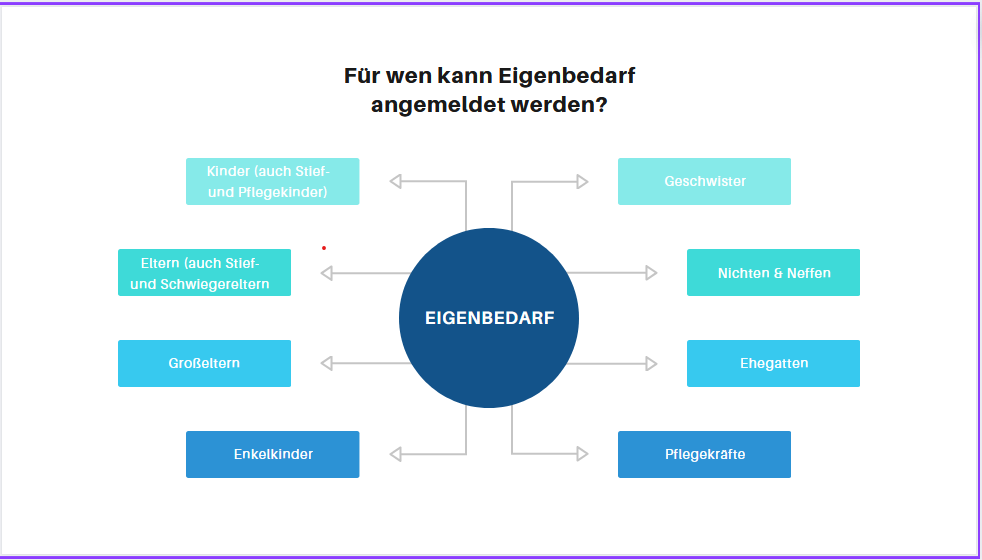
A landlord can claim 'eigener Bedarf' (own use) for themselves, their close family members, or members of their household. This typically includes: * **The landlord themselves:** For personal use. * **Close family members:** Such as children, parents, or siblings. * **Members of the household:** This can include individuals who live with the landlord or for whom the landlord has a special responsibility, such as a carer. The specific definition of "close family members" and "members of the household" can vary slightly depending on regional laws and court interpretations within Germany, but the core principle is that the landlord needs the property for their own living space or that of people they have a close personal connection with and a genuine need to house.
Not for everyone. The law refers to family members and household members. Case law has specified this group over the years:
| Personal use possible | Not possible for own use |
| Landlord themselves | Divorced spouses |
| Spouse / registered civil partner | Ex-in-laws |
| Children, stepchildren, grandchildren | Cousins and Cousins (BGH VIII ZR 276/23) |
| Parents, siblings | Distant relatives (great-aunts etc.) |
| Nieces and nephews (since BGH 2010) | Legal entities (GmbH, AG) |
| Domestic staff, nursing staff | Friends, acquaintances |
| GbR Partner (for themselves) |
A point that many people don't know: A limited liability company (GmbH) or public limited company (AG) cannot claim personal use as a legal entity. A partnership under civil law (GbR), on the other hand, can – but only for one of its partners personally.
Checklist: Is your own-use termination effective?
Before you react, you should carefully check the notice. Many notices for personal use are faulty. The following points must all be met for the notice to be effective:
- In writing. The notice must be given in writing – an email or verbal notification will not suffice.
- To all tenants. If several people are listed on the rental agreement, the termination must be addressed to all of them.
- Signed by all landlords. If there are multiple landlords (e.g. a married couple), both must sign.
- Beneficiary named. The landlord must specify exactly who is to move into the flat and their relationship to them (BGH VIII ZR 184/14).
- Understandable reasoning. The reason must be specific – not just „for personal use“, but why this particular flat is needed.
- Notice of the right to object. The landlord must inform you that you can object to the termination (§ 574b para. 1 BGB). If this notice is missing, your objection period is extended.
- Statutory notice periods observed. More on that shortly.
If even one of these points is missing, the termination may be invalid. But be careful: not every error automatically leads to invalidity. Some defects are curable, others are not. This is exactly where legal review is worthwhile.
Legal notice periods for personal use
Even in cases of personal use, the landlord must adhere to the statutory notice periods according to § 573c of the German Civil Code (BGB). The longer you live in the flat, the longer the notice period:
| Rental period | Cancellation period |
| Up to 5 years | 3 months |
| Over 5 years | 6 months |
| Over 8 years | 9 months |
The notice must be received by the third working day of a month at the latest, so that it becomes effective at the end of the month after next. Therefore, someone who has lived in their Cologne flat for ten years has at least nine months before they have to move out – assuming the notice is effective at all and no objection applies.
How can I defend myself against a notice for personal use?
1. Check termination for formal errors
This is the first and most important step. Check the termination using the checklist above. If the reason is completely missing, the termination is clearly invalid – you don't even need to object to it and can simply wait. For other errors – such as a missing signature – you should reject the termination in writing without delay.
2. Objection due to exceptional hardship (social objection under § 574 BGB)
Even if the termination is formally and substantively correct, you can object – if the departure would entail hardship for you or your family Unreasonable hardship would represent. The law calls this contradiction a social contradiction.
Recognised grounds for hardness include, for example:
- Serious illness or need for care
- Old age, particularly when combined with deep roots in the social environment.
- Pregnancy
- School-aged children for whom a change of school would be unreasonable
- Suicide risk—the Federal Court of Justice has explicitly recognised this as a ground for hardship.
- Demonstrably unsuccessful intensive flat search
- Dementia or severe mental illness where moving would worsen their health condition
Important new development from 2025: The Federal Court of Justice ruled on 16 April 2025 (Ref. VIII ZR 270/22) that proving hardship does not necessarily require a specialist medical certificate. The statement of a therapist or a naturopath is also sufficient, provided that the medical justification is comprehensible, specific, and technically sound. This significantly lowers the hurdle for tenants.
The deadline for objection: it must In writing and no later than two months before the expiry of the notice period received by the landlord (§ 574b Para. 1 BGB). If your tenancy ends on 31 March, your objection must be received no later than 31 January. Do not miss this deadline.
If an objection is raised, the tenancy will continue – potentially indefinitely. The court can also order a temporary extension until the grounds for hardship no longer apply.
3. Check obligation to offer
If your landlord owns other flats in the same building or manages them, they must offer you a comparable vacant flat before enforcing a notice to quit for personal use. This so-called Supply obligation for the entire notice period — meaning even if a flat only becomes available after the notice has been given.
If the landlord breaches their duty to offer, the termination may be abusive of rights in individual cases and therefore invalid. However, not every breach automatically leads to invalidity. The Federal Court of Justice has clarified that it depends on the circumstances of the individual case.
So check: does your landlord have any other flats?
4. Uncovering Pretended Self-Occupancy
In large cities like Cologne, it unfortunately happens that landlords feign genuine need for their own use – in order to renovate a flat after the tenant moves out and re-let it at a significantly higher price. This is unlawful.
Signs of feigned self-employment can include:
- The flat is advertised at a significantly higher rent shortly after the tenant moves out.
- The purported person in need of accommodation is not moving in at all, or only for a few weeks.
- The landlord already offered the flat for sale before the notice to quit.
- The grounds for dismissal in the termination letter are vague or contradictory.
If it later transpires that the owner's occupation was only a pretext, you are entitled Compensation for damages Reimbursable expenses include, among others, removal costs, estate agent fees, the difference in rent for the new flat, and legal fees. In one case, the Federal Court of Justice confirmed a basic claim for damages of €28,500 (File No. VIII ZR 99/14).
Termination moratorium: Special protection after purchasing a flat in Cologne
If your rented flat has been converted into a condominium and subsequently sold, you as a tenant enjoy special protection. The new owner may only terminate your tenancy for personal use after a blocking period has expired.
The statutory minimum period is three years (Section 577a (1) BGB). However, the federal states can extend this period – and North Rhine-Westphalia has done so.
For Cologne, the following applies: 8-year notice period prohibition under the NRW Rent Protection Ordinance (in force since March 2025, valid until 28 February 2030). The same deadline applies to Bonn, Düsseldorf, Münster and all independent cities in NRW. For 33 further municipalities in NRW, the moratorium is five years.
What does that mean in concrete terms? Anyone who bought a rented condominium in Cologne in 2024 can terminate it for personal use at the earliest in 2032. A termination issued within the blocking period is invalid.
And another point that the Federal Court of Justice clarified in August 2025 (Ref. VIII ZR 161/24): The lock-in period only begins with the actual acquisition of the condominium – not already with the purchase of the entire building by a GmbH & Co. KG. The so-called „Munich Model“, with which investors wanted to circumvent the lock-in period, therefore no longer works.
Special cases in termination for own use
Two-family house with landlord in the same building
If the landlord lives in one of the two flats in a two-flat house, they have an easier right of termination under § 573a BGB. They can then terminate without giving a specific reason – meaning, not even for personal use. However: The statutory Cancellation period in this case, it is extended by three months.
Personal use of a second home
Even those who only wish to use a flat as a second home can claim it for personal use – provided there are reasonable grounds. The Federal Court of Justice has ruled that a notice of termination for personal use is also justified if the landlord has their main residence in another city and regularly needs the flat for professional stays (Ref. VIII ZR 180/18).
Personal use after selling one's own flat
The German Federal Court of Justice (BGH) made a ruling in September 2025 (Ref. VIII ZR 289/23) clarifying that a notice of termination for personal use can also be valid if the landlord wishes to sell their own property and move into the rented apartment. The court emphasized that this does not constitute a Realisation cancellation, as the owner's own flat is being sold, not the rented one.
What happens if I don't move out?
If you object to the termination or simply ignore it, the landlord must Court representation in landlord/tenant disputes lodge at the competent court. In Cologne, this is the District Court of Cologne.
The court then examines:
- Is the termination legally valid, both in form and substance?
- Does the self-occupation genuinely and seriously exist?
- Was the duty of care observed?
- Does a hard case exist that justifies the continuation of the tenancy?
Only when a court issues an eviction order and it becomes legally binding can the landlord instruct a bailiff to carry out a forced eviction. Until then, you are allowed to remain in the flat. Any unauthorised attempts by the landlord to evict you are prohibited and punishable.
Termination agreement as an alternative
It doesn't always have to come to legal action. Often, an amicable solution is better for both sides. In a Cancellation agreement (also known as a tenancy termination agreement) you can agree individual terms with your landlord — for example:
- An appropriate notice period (often 6–12 months)
- Reimbursement of moving costs by the landlord
- A severance payment (in practice, between €3,000 and €15,000, sometimes significantly more, depending on the housing market and rental period)
- Waiver of cosmetic repairs
A termination agreement saves both sides time, money, and stress. But don't be pressured: you are not obligated to agree to such a contract. And don't sign anything without having the contract reviewed by a lawyer beforehand.
Frequently Asked Questions about Termination for Personal Use
How long do I have to object to a notice of termination for personal use?
The objection must be submitted to the landlord in writing no later than two months before the expiry of the notice period (§ 574b para. 1 BGB). If your tenancy ends on 31 December, your objection must be received by 31 October at the latest. If you miss this deadline, you will lose your right of objection – unless the landlord has not informed you of your right of objection.
A landlord can claim 'eigener Bedarf' (own use) for themselves, their close family members, or members of their household. This typically includes: * **The landlord themselves:** For personal use. * **Close family members:** Such as children, parents, or siblings. * **Members of the household:** This can include individuals who live with the landlord or for whom the landlord has a special responsibility, such as a carer. The specific definition of "close family members" and "members of the household" can vary slightly depending on regional laws and court interpretations within Germany, but the core principle is that the landlord needs the property for their own living space or that of people they have a close personal connection with and a genuine need to house.
For oneself, spouse, children, stepchildren, grandchildren, parents, siblings, nieces, nephews, and household members. Not for cousins (BGH VIII ZR 276/23), divorced spouses, or distant relatives. A GmbH or AG cannot claim personal use. A GbR can do so for its partners.
What constitutes a hardship case in the event of an eviction for personal use?
Serious illness, need for care, advanced age with deep roots, pregnancy, suicidal ideation, dementia, or demonstrably unsuccessful housing search. Since April 2025 (BGH VIII ZR 270/22), a statement from a therapist is also sufficient for proof – a medical specialist's certificate is no longer mandatory.
Is there a notice period for self-occupation termination after purchasing a flat in Cologne?
Yes. For converted condominiums, a blocking period of 8 years applies in Cologne (NRW Tenant Protection Ordinance, valid until 28.02.2030). The federal legal minimum period is 3 years.
A notice of termination for personal use is ineffective when:
Among other things, in cases of missing or insufficient justification, failure to name the beneficiary, formal errors, breach of the duty to offer, an ongoing blocking period, or sham self-occupation.
Can I claim damages if the purported use by the owner was a pretence?
Yes — removal costs, agent fees, rent difference, and legal fees are reimbursable. The Federal Court of Justice has fundamentally upheld compensation claims totalling €28,500 (VIII ZR 99/14).
Do I have to move out immediately with a self-occupancy termination?
No. The statutory notice periods (3, 6 or 9 months depending on the length of the tenancy) also apply in cases of personal use. Eviction can only be enforced after a legally binding eviction order has been issued.
Can I exclude self-occupation termination in the rental agreement?
Yes, if both sides agree. The exclusion also binds subsequent purchasers. In practice, however, this rarely happens.
Important court rulings on termination for personal use
The following selection shows how courts have ruled in typical dispute cases:
- BGH 16.04.2025 (VIII ZR 270/22): Proof of hardship possible even without specialist's certificate — therapist's statement sufficient
- BGH 24.09.2025 (VIII ZR 289/23): Self-use is effective, even if the landlord sells their own flat and moves into the rented one.
- BGH 06.08.2025 (VIII ZR 161/24): The lock-in period only begins upon actual acquisition of the condominium unit – not upon purchase by a GmbH & Co. KG
- BGH (VIII ZR 276/23): Cousins are not „close relatives“ for the purposes of personal use.
- BGH (VIII ZR 180/18): Personal use is also permissible for a second home if regular stays are required for professional reasons
- BGH (VIII ZR 99/14) Compensation of 28,500 Euros for sham self-occupation
Every case is different. On our website, you will find numerous further individual case decisions on notice for personal use:
- Defence against termination for own use by citing the tenants' advanced age
- Proper justification and mention of the beneficiary
- Termination for own use invalid if intent to sell exists simultaneously
- Not every breach of the duty to offer makes the termination invalid
- Termination for personal use ineffective in cases of tenant's suicidal ideation
Received a notice of termination for personal use? We'll assess your situation.
An eviction for personal use doesn't have to mean the end. But the deadlines are short, and anyone who waits too long loses options. Whether it's an objection, a termination agreement or a legal dispute — the right strategy depends on your specific case.
Call Lawyer Helmer Tieben under an 0221 - 80187670 or write to info@mth-partner.de. We are reviewing your cancellation and will advise you on the next steps.
More about our rental law services in Cologne → | Arrange an appointment
Related articles in tenancy law
- Eviction lawsuit in Cologne: Requirements, procedure and costs
- Termination for economic reasons due to refurbishment and renovation
- Self-occupation also for the second home – is „culture and family“ enough?
- Free 72-Hour Emergency Plan for Immigration Cases
- Rent Reduction Calculator — calculate online
Important Note: The content of this article has been prepared to the best of our knowledge and belief. However, due to the complexity and constant evolution of the subject matter, we must exclude liability and warranty. The content of this post has been created to the best of our knowledge and current understanding. The complexity and constantly changing legal situation necessitate the exclusion of liability and warranty. For your specific situation, please consult a solicitor.