
With the new law that came into force in March 2020 Skilled Labour Immigration Act and the implementation in November 2023 of the requirements of the Directive (EU) 2021/1883 (Blue Card Directive), the legislator has created numerous new regulations with regard to labour migration. One of the most important innovations is the Settlement permit for skilled workers according to § 18c AufenthG, which enables qualified foreign workers to obtain an unlimited residence permit (permanent residence) in Germany under simplified conditions. The following describes who can be recognised as Specialist applies and which current requirements (legal status November 2025) must be met for this settlement permit to be issued.
Who is considered a „skilled worker“?
As Specialist According to the law, the following persons with qualified training or employment are considered to be "qualified persons" within the meaning of the Residence Act:
-
Specialists with vocational training - Persons with a professional qualification recognised in Germany or a foreign professional qualification recognised as equivalent (legal basis: § 18a AufenthG).
-
Specialists with an academic education - Persons with a German university degree, a recognised foreign university degree or an equivalent qualification (legal basis: § 18b AufenthG).
-
Researchers - Foreigners who are working in Germany for research purposes and hold a corresponding residence permit (legal basis: Section 18d AufenthG).
-
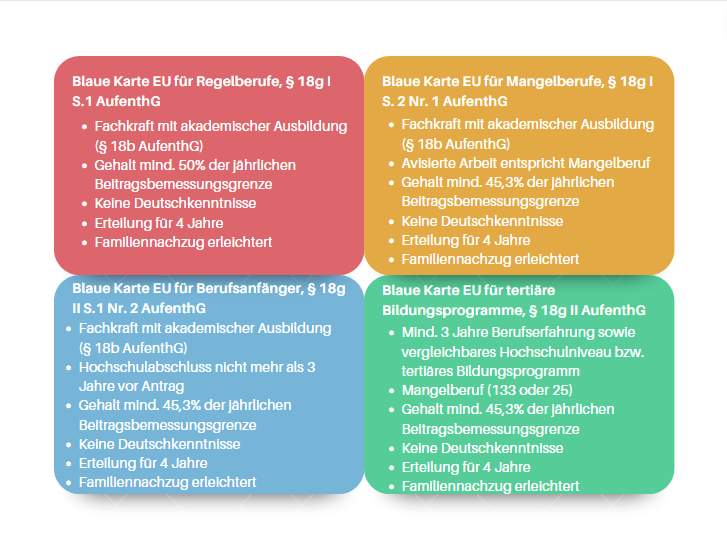
Holders of the EU Blue Card - Highly qualified persons with a university degree (or comparable qualification) and a higher income who are in possession of an EU Blue Card (legal basis: § 18g AufenthG).
These four categories of residence permits are the basis for the Specialist status. Various simplified immigration options were created on this basis - including the settlement permit for skilled workers in accordance with Section 18c AufenthG.
Settlement permit for skilled workers (Section 18c (1) AufenthG)
Specialists who are in possession of one of the above-mentioned Residence permit for the purpose of gainful employment (Sections 18a, 18b, 18d or 18g AufenthG) may, in accordance with Section 18c (1) AufenthG, under certain conditions privileged conditions apply for a settlement permit (permanent residence permit). These privileged conditions deliberately deviate from the general requirements of § 9 AufenthG (which, for example, generally require 5 years of prior residence and 60 months of pension contributions) in order to enable qualified workers to change status more quickly. The settlement permit is an unlimited residence title and authorises unrestricted gainful employment in Germany.
Prerequisites: A skilled worker can obtain a settlement permit in accordance with Section 18c (1) AufenthG, if they all of the following conditions are met:
-
Duration of the previous stay: The specialist has been at least three years in possession of a qualified residence permit in accordance with § 18a, § 18b, § 18d or § 18g AufenthG. (This period was shortened from 4 years to 3 years by the legislative reforms in 2023/24).
-
Qualification-adequate employment: She is in employment (job) that corresponds to her qualifications and which she is authorised to occupy in accordance with the requirements of Sections 18a, 18b, 18d or 18g AufenthG. This means that the current job must be suitable for the skilled worker status she has acquired and any necessary professional licences have been obtained.
-
Pension insurance contributions: She has at least 36 months Compulsory or voluntary contributions paid into the German statutory pension insurance scheme or can provide evidence of expenses for an entitlement to comparable benefits from a pension or insurance institution. (This requirement has also been lowered compared to the previous 48 months. In comparison, a regular settlement permit in accordance with § 9 AufenthG usually requires 60 months of contributions).
-
German language skills: The specialist has sufficient knowledge of the German language, which in practice corresponds to the Level B1 of the Common European Framework of Reference for Languages. A B1 language certificate (e.g. from the Goethe-Institut or TELC) regularly serves as proof.
-
Further integration criteria: The General requirements of § 9 para. 2 sentence 1 No. 2, 4-6, 8 and 9 AufenthG must be present. This includes the following points in particular, which for all permanent stays apply: The applicant must have a valid secure livelihood (i.e. be able to earn a living without social benefits), it must be No danger to public safety or order he/she must not commit any serious criminal offences or extremist activities, he/she must Basic knowledge of the German legal and social order (usually proven by the naturalisation test or orientation course certificate) and have sufficient living space for themselves and, if applicable, their family. (Note: Certain of these requirements - such as a work permit - are usually already met by skilled workers with a valid work visa)*.
When all the above criteria are met, there is a Legal claim for the issue of a settlement permit for skilled workers in accordance with Section 18c (1) AufenthG (the immigration authority must therefore issue it). Important: For skilled workers who have obtained their qualification in Germany, the following apply Conditions eased once again. If the specialist has a successfully completed a degree programme or vocational training in Germany, the required pre-stay period is reduced to two years and the required pension contribution period to 24 months. The aim is to ensure that talented people trained in Germany are more quickly and permanently retained in the labour market.
Settlement permit for holders of the EU Blue Card (Section 18c (2) AufenthG)
For holders of a EU Blue Card special privileges apply once again when granting a settlement permit. The EU Blue Card is aimed at highly qualified skilled workers with an academic degree and above-average salary, and it opens up faster access to permanent residence.
Pursuant to Section 18c (2) AufenthG, a foreigner who holds an EU Blue Card must be granted a settlement permit if they fulfil the following requirements:
-
He has for at least 27 months exercised employment pursuant to Section 18g AufenthG (EU Blue Card) and paid pension insurance contributions during this period. (This period was also reduced in 2023 - previously 33 months were required).
-
It has basic knowledge of German, accordingly Level A1.
Shortening with better language skills: If the Blue Card holder has sufficient German language skills (level B1), the required period of employment is reduced from 27 months to 21 months. This means that well-integrated Blue Card holders can obtain permanent residence after just one and a half years*.
In addition, the foreigner must - as with the skilled worker settlement permit - fulfil the general requirements, in particular the livelihood is secured be, it may No threats to public safety or order be present, it must Basic knowledge of the German legal and social order and sufficient living space for themselves and, if applicable, their family members. These criteria correspond to the above-mentioned requirements from Section 9 AufenthG and are also assumed in the Blue Card case. In practice, Blue Card holders are usually already in a position to fulfil these points due to their employment and income (high salary → secure livelihood; often academic integration → basic knowledge of society).
Note: The periods mentioned (27 or 21 months) only apply to holders of the German EU Blue Card. Periods spent in other EU countries with a Blue Card can be not be counted towards these 27/21 months, but may be useful for acquiring the EU permanent right of residence (topic Permanent residence-EU).
Special features for graduates and highly qualified specialists (Section 18c (1) and (3))
Shorter times for graduates: As mentioned above, foreign companies benefit from Graduates of German universities or vocational training programmes Shortened waiting times. If a skilled worker has completed their studies or training in Germany, it is sufficient to two years Possession of a skilled worker residence permit (instead of 3 years) and 24 months Pension contributions (instead of 36 months) for the settlement permit. This concession is intended to make it easier for talented individuals educated in Germany to remain in Germany and is in addition to the other requirements (language skills, living expenses, etc.).
Highly qualified skilled workers (Section 18c (3)): For particularly highly qualified The law provides a further exception for skilled workers with an academic qualification. According to § 18c Para. 3 AufenthG shall A highly qualified skilled worker may even be granted a permanent residence permit in special cases, if not all of the above conditions are met. However, this “fast-track” regulation only comes into effect under strict conditions: in particular integration into German living conditions is likely to succeed without problems and the livelihood is sustainably secured so that no state aid is required. In addition, it goes without saying that none the person poses a threat to public safety - the Forecast must be positive be that the person will be able to cope economically and socially in Germany.
In such exceptional cases, the settlement permit will be without the consent of the Federal Employment Agency (Section 18c (3) sentence 1 AufenthG), which is otherwise often required for work stays. However, the respective State government stipulate that the approval of the highest state authority must be obtained before the permit is issued (Section 18c (3) sentence 2 AufenthG). The hurdles for this exception are high, but it theoretically offers top researchers, for example, the opportunity to obtain a settlement permit even without fully meeting all the standard criteria.
As Highly qualified specialists within the meaning of Section 18c (3) are deemed by law to be for example Scientists with Specialised technical knowledge as well as teachers or research assistants in prominent functions. This list is not exhaustive, but makes it clear that these must be people with exceptional qualifications and several years of professional experience. In practice, such cases are likely to be rare and require thorough persuasion of the immigration authority that integration is practically guaranteed.
Important Note: The content of this article has been prepared to the best of our knowledge and belief. However, due to the complexity and constant evolution of the subject matter, we must exclude liability and warranty. The content of this article has been compiled to the best of our knowledge and according to the current state of knowledge (legal status: November 2025). Nevertheless, due to the Complexity and constant change of foreigners law, no guarantee can be given for the correctness and completeness of this information. This article represents No legal advice but general information. If you require individual legal advice, please contact us without obligation at Tel. 0221 - 80187670 or by e-mail to info@mth-partner.de. We are at your disposal as experts in residence law.
Lawyers in Cologne advise and represent clients nationwide in immigration law.