
The European and German economies continue to rely on highly qualified personnel from abroad. Particularly in areas such as digitalisation, IT security, artificial intelligence and specialised research, the demand for skilled workers is higher than can be met by the domestic training and university system; demographic change is further reinforcing this trend.
In order to counter this shortage of skilled labour, a standardised regulation has been created at European level: the EU Blue Card. It is modelled on the US „green card“ and is a residence permit for highly qualified employees from third countries. The blue colour is based on the blue European flag and emphasises the European character of the regulation.
What is the EU Blue Card?
The EU Blue Card is a plastic card in cheque card format and serves as official proof of a residence permit for highly qualified skilled workers from abroad. It is both a residence and work permit and enables the holder to take up qualified employment in the member state that issues it.
In Germany, the EU Blue Card is regulated in Section 18g of the Residence Act (AufenthG); in addition, the general provisions on skilled labour immigration in Section 18 AufenthG apply. The EU Blue Card is issued by the participating EU member states, which means that the specific requirements may vary slightly from country to country. Not all EU states are participating: Denmark and Ireland have not implemented the corresponding EU directive.
How do you get the EU Blue Card in Germany?
The requirements for submitting an application in Germany are described below. The core target group is skilled workers with an academic education, i.e. people with a German university degree or a recognised foreign university degree or one that is comparable to a German degree.
The EU Blue Card is issued for the purpose of domestic employment appropriate to the qualification. The job must therefore match the qualification („qualification-appropriate employment“). For example, a computer scientist with a degree should work as a developer, IT consultant or in a similarly qualified position and not as an unskilled labourer. An employment contract or a binding job offer must be submitted as proof; in addition, the specific job offer must provide for a period of employment of at least six months.
No approval from the Federal Employment Agency is required for the „normal“ EU Blue Card in accordance with Section 18g (1) sentence 1 AufenthG. However, as soon as lowered salary thresholds are used, the approval of the Federal Employment Agency is required.
What types of EU Blue Card are there?
§ Section 18g AufenthG is essentially based on three factors: Qualification, occupational group and salary.
- classic blue card („standard occupations“):
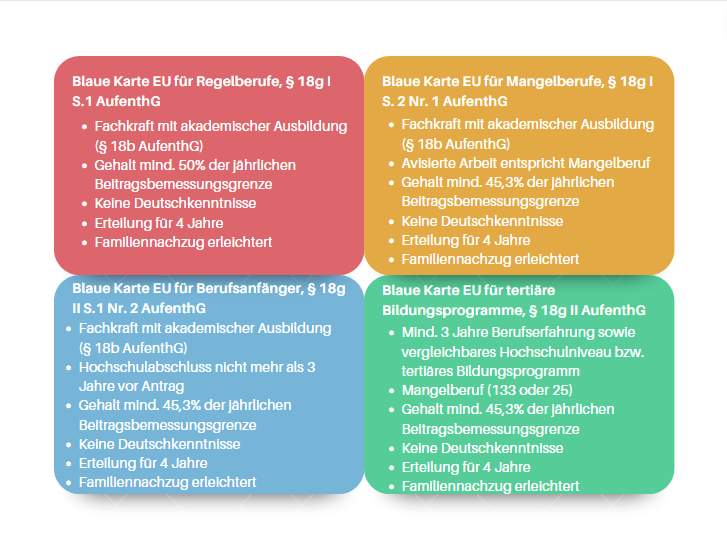
Skilled workers with an academic education receive an EU Blue Card if they are in employment that is commensurate with their qualifications and earn a salary of at least 50 % of the annual contribution assessment ceiling in the general pension insurance scheme. As of 2025, this corresponds to a minimum annual gross salary of around 48,300 EUR; The exact amount is announced annually by the Federal Ministry of the Interior and for Home Affairs.
- lowered salary threshold of 45.3 %:
A lower salary threshold applies in three constellations:
-
Shortage occupations: certain occupational groups according to the ISCO-08 classification in which there is a particular shortage of skilled labour, e.g. numerous STEM occupations as well as healthcare, nursing and education occupations.
-
Career starters: Anyone who has obtained their last university degree or equivalent qualification no more than three years before submitting their application can use the lowered threshold in occupations with appropriate qualifications („Blue Card for young professionals“).
-
certain IT specialists without a formal qualification: Anyone who does not have an academic or equivalent tertiary qualification but has at least three years of relevant professional experience in the last seven years in an IT profession in ISCO groups 133 or 25 (IT management or IT professionals) can also obtain an EU Blue Card.
In all cases of the lowered salary threshold, approval from the Federal Employment Agency is required. As of 2025, the required annual gross salary here is approx. EUR 43,759.80.
- tertiary education programmes:
What is new is that the EU Blue Card is no longer only linked to traditional university degrees. It also covers skilled workers who have completed a tertiary education programme of at least three years at a level equivalent to a university degree, such as certain technical or commercial training courses, master craftsman examinations and pedagogical or therapeutic qualifications. This group of people is treated in the same way as specialists with academic qualifications and can - depending on the occupational group - benefit from the normal or reduced salary threshold.
This means that - in addition to the „classic“ Blue Card - there are de facto
-
one Blue card for shortage occupations,
-
one Blue card for young professionals and
-
one Blue card for certain IT specialists without a degree,
and the Expansion to high-quality tertiary vocational qualifications.
General requirements
It is not necessary to provide proof of German language skills in order to obtain an EU Blue Card. Formal proof of language proficiency is therefore not a prerequisite for issuing a Blue Card.
In addition, as with other residence permits, the general conditions for issuing a Blue Card apply. The EU Blue Card will only be issued if, in particular
-
the livelihood is secured,
-
the identity is clarified,
-
a valid passport is available,
-
you entered Germany with a suitable visa (if a visa was required),
-
the relevant information has already been provided in the visa application and
-
there is no interest in deportation.
In addition, there must be no grounds for refusal under Section 19f AufenthG, for example in certain constellations of temporary protection status, suspended deportation or an existing permanent right of residence in another EU country. In practice, this means that many refugees or people with purely temporary residence rights in particular typically do not receive an EU Blue Card. In addition, seasonal workers usually work with a special residence permit that is limited in time from the outset, meaning that they are generally not eligible for an EU Blue Card.
Where can I apply for the EU Blue Card?
The EU Blue Card must be applied for at the local immigration authority. If you are travelling to Germany with a visa, you must apply for the EU Blue Card before your visa expires. If no visa is required to enter Germany (e.g. for citizens of the USA, Canada, Japan or certain other countries), the EU Blue Card must be applied for at the foreigners authority before starting work; employment may only commence once the EU Blue Card has been issued.
How long is the EU Blue Card valid for?
In accordance with Section 18 (4) AufenthG, the EU Blue Card is issued for a maximum of four years when first issued. In the case of a shorter-term employment contract, it is issued for the duration of the employment contract plus three months, but also for a maximum of four years.
The following applies to changing jobs: In deviation from Section 4a (3) sentence 4 AufenthG, prior authorisation from the immigration authority is no longer required for a change of employer. However, in the first twelve months after taking up employment, the immigration authority can suspend the change for up to 30 days and refuse it during this period if the requirements for the EU Blue Card are not (or no longer) met in the new employment relationship.
Advantages of the EU Blue Card: Settlement permit and family reunification
With an EU Blue Card, it is easier for holders to obtain a settlement permit in Germany. According to the current legal situation 27 months A settlement permit can be applied for after a period of qualified employment and payment of pension insurance contributions if simple German language skills (level A1 CEFR) can be demonstrated. For German language skills at level B1, the deadline is reduced to 21 months.
There are also simplifications in the context of family reunification: Spouses generally receive a residence permit without prior language certificate and with an immediate, unrestricted work permit. Generous reunification options apply for children.
Important Note: The content of this article has been prepared to the best of our knowledge and belief. However, due to the complexity and constant changes in the subject matter, liability and guarantees are excluded.
The content of this article has been compiled to the best of our knowledge and belief. However, the complexity and constant changes in the subject matter make it necessary to exclude liability and warranty. The above statements refer to the legal situation in Germany at the time of publication. November 2025 and cannot replace an individual examination of your specific case.
Lawyers in Cologne advise and represent clients nationwide in immigration law.