
The letter is in front of you. It says „Warning letter“ in black and white. In my law firm on the Sachsenring in Cologne, I regularly deal with clients who find themselves in exactly this situation. The first question is always the same: what to do after a warning letter?
My experience from over 15 years Labour law in Cologne shows that many warnings do not stand up to legal scrutiny. Employers use overly generalised wording, forget important information or react disproportionately. These are your starting points.
But I'll be honest with you: not every warning letter can be contested. Sometimes the wiser strategy is to write a counterstatement and wait and see. Sometimes it is worth going to the labour court. What is right in your case depends on the specific circumstances.
On this page, I will explain what is important. You will find out when a warning is justified, what mistakes employers often make and how you can defend yourself. At the end, you will know whether it is worth taking action against your warning letter.
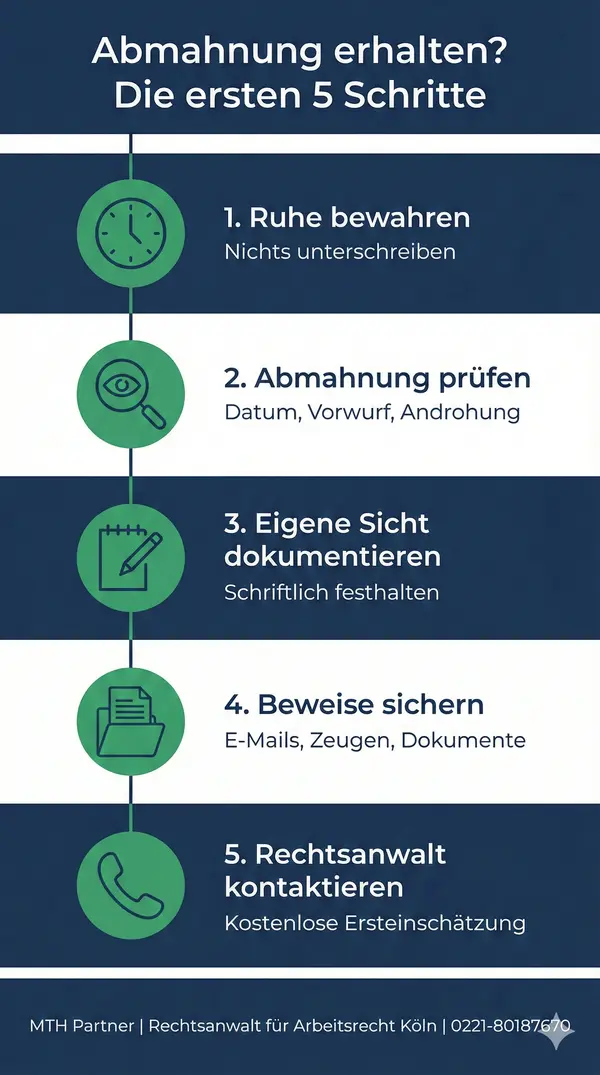
What is a warning letter and when is it justified?
A warning is more than just a reprimand. It is a formal labour law instrument that must fulfil three functions simultaneously. If even one of these is missing, it is not an effective warning.
The three functions at a glance:
Firstly, the employer must name specific misconduct and describe the duty that has been breached. This is the notification function. Secondly, he must reprimand the behaviour as a breach of contract and make it clear that he will not tolerate it. Thirdly, in the event of repetition, he must threaten consequences under labour law, specifically dismissal. Without this warning function, the letter is legally not a warning, but only an admonition.
Why is this important? Because only a complete warning can prepare for a subsequent dismissal. If the threat of dismissal is missing, the employer cannot invoke the warning in the event of dismissal.
You can find detailed information on the formal requirements in my previous article: Basic information on warnings (form and content)
When may the employer issue a warning letter?
The employer may only issue a warning in the event of a genuine breach of duty. The employee not only owes his work performance, but also the fulfilment of secondary obligations arising from the employment contract, works agreements and the law.
In my practice, I often see warnings for unpunctuality, late reporting sick, breaches of company rules or inappropriate behaviour towards colleagues. In principle, these are breaches of duty that can be cautioned if they have actually occurred and the employee could have avoided them.
The last point is decisive: the breach of duty must be based on controllable behaviour. Anyone who is unable to work due to illness is not in breach of duty. Anyone who relapses due to an alcohol-related illness is not acting in a controllable manner. In such cases, a warning is the wrong remedy.
The difference to the admonition
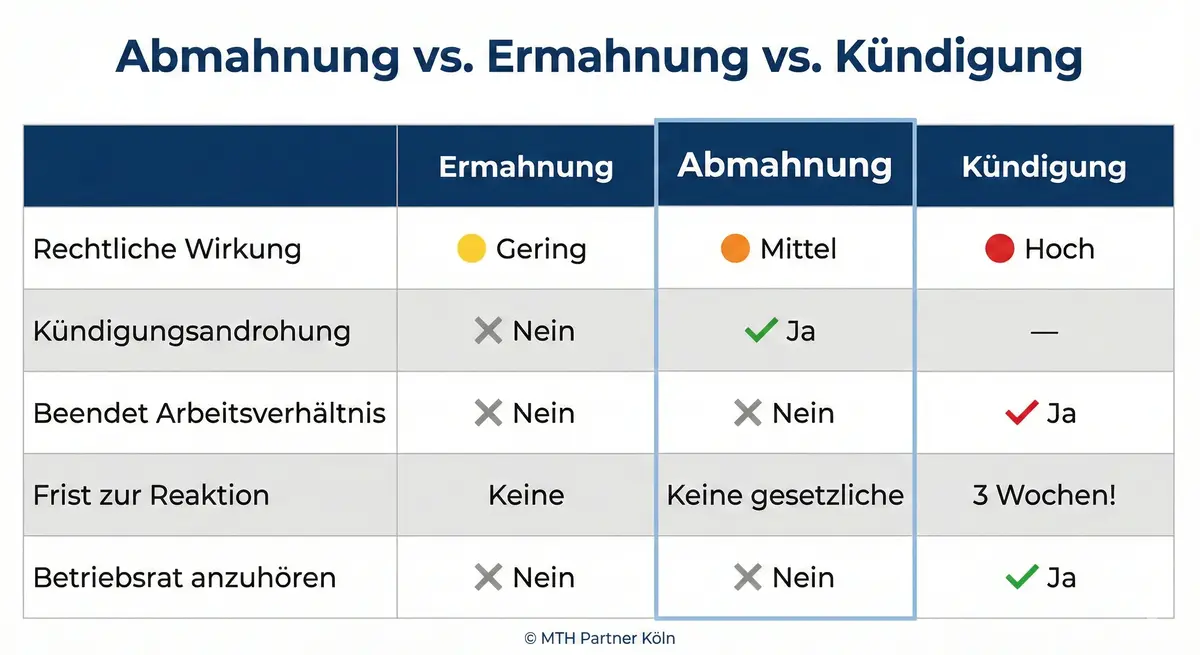
Not every criticism from the boss is a warning. Many letters that are titled „warning“ do not fulfil the legal requirements. If there is no threat of dismissal or only general mention of „consequences“, it is a warning.
The difference is significant: a warning does not prepare for dismissal. Although it documents criticism, it does not have the legal effect of a warning. You should therefore check carefully whether your letter threatens dismissal in the event of a repeat offence.
Formal requirements: When is a warning ineffective?
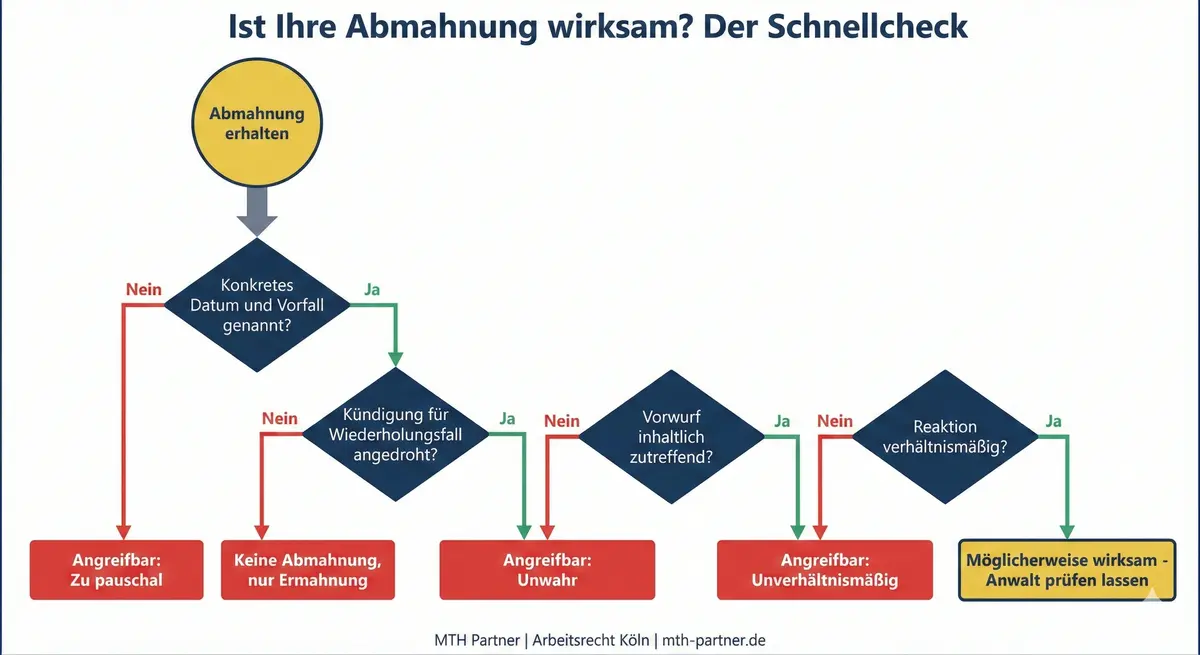
This is the greatest weakness of many warnings. Case law places high demands on the specificity of content. Many employers underestimate this.
Written form and content
Firstly, a surprise: a warning does not have to be in writing. A verbal warning is also effective. In practice, however, this hardly matters because the employer has to prove the warning if he wants to invoke it later. A verbal warning can hardly be proven.
The warning must contain the following:
The exact date of the incident, the time (if relevant), the location and the people involved. Then a precise description of what happened. Then the name of the duty that was breached with reference to the employment contract or the company rules. A clear reprimand of the behaviour. And finally, the threat of dismissal in the event of a repeat offence.
Concrete description of the misconduct
This is the point at which most warnings fail. The description must be specific enough for the employee to know exactly what they are being accused of and to be able to review their behaviour.
Phrases such as „You are often late“ or „Your work performance leaves a lot to be desired“ are not enough. The Cologne Regional Labour Court clarified this in a landmark decision in 2021: Unclear, generalised or even partially false accusations render the entire warning ineffective.
What is effective: „On 15 November 2025, you arrived at your workplace at 9:47 am. Your contractually agreed start time is 8:00 am. You neither reported to work beforehand nor gave any explanation.“
The decision of the LAG Cologne with all the details: Judgement on warnings, bonuses and dismissals with notice of change
Proportionality
Even a warning that is correct in terms of content can be disproportionate. After 20 years of impeccable service, issuing a warning for a one-off delay of 15 minutes is overstepping the mark. A verbal warning would have sufficed here.
The courts examine whether the employer's response is appropriate. The severity of the offence, the length of service to date, the employee's previous behaviour and the impact on the company all play a role.
An example from supreme court case law: The Federal Labour Court ruled that even a head physician who made private telephone calls during operations had to be warned before being dismissed without notice. In the case of controllable misconduct, it can generally be assumed that a warning can have a positive influence on behaviour.
Read more: Chief physician must be warned before termination without notice
Frequent reasons for warnings
In my practice as a lawyer for labour law in Cologne, I come across certain reasons for warnings time and again. I would like to introduce you to the most common ones.
Unpunctuality and violations of working hours
The classic reason for a warning. The employee not only owes work, but work at the agreed time. Anyone who regularly arrives late, overruns their break times or leaves early is in breach of their contractual obligations.
Working time fraud, i.e. the deliberate recording of incorrect working hours, is particularly serious. This is a breach of trust that may even result in a cancellation without notice can be justified without prior warning.
Sick note and incapacity for work
According to § 5 of the Continued Remuneration Act, the employee must notify the employer immediately of their incapacity for work. A doctor's certificate must be submitted if the absence lasts longer than three calendar days. Many employment contracts shorten this period to the first day.
Warnings can be issued for late or omitted notification of sickness and the lack of a certificate of incapacity for work. The illness itself cannot be warned. If you are ill, it is not your fault.
More on behavioural dismissal for breaches of reporting obligations: Termination for behavioural reasons in the event of reproachable breach of duty
Alcohol-related misbehaviour
This is where it gets complicated. Appearing under the influence of alcohol is generally a breach of duty. However, alcohol-related illness does not constitute controllable behaviour. The employee cannot control their consumption.
The Rhineland-Palatinate Regional Labour Court has ruled that dismissal due to alcohol addiction is to be assessed according to the principles of dismissal due to illness. A warning is ruled out because it presupposes a change in behaviour that the addict is unable to achieve.
The complete decision: LAG Rhineland-Palatinate on dismissal due to alcohol addiction
Insults and inappropriate behaviour
Insults from colleagues or superiors are subject to a warning. In the case of particularly serious insults or even threats, termination without notice and without a warning may even be justified.
The courts differentiate: A one-off insult in the heat of the moment usually requires a warning first. According to case law, calling a superior a „colleague's pig“ does not justify dismissal without a prior warning.
In addition: Insulting the superior as a „colleague pig“
The situation is different in the case of serious threats: The LAG Düsseldorf confirmed a dismissal without notice following the threat „I'll stab you!‘ to a superior.
Read more: Extraordinary termination due to threats
Your response options
You have received a warning letter and consider it to be unjustified. What do you do now? German labour law gives you several options. Which one is the right one depends on your situation.
Writing a counterstatement
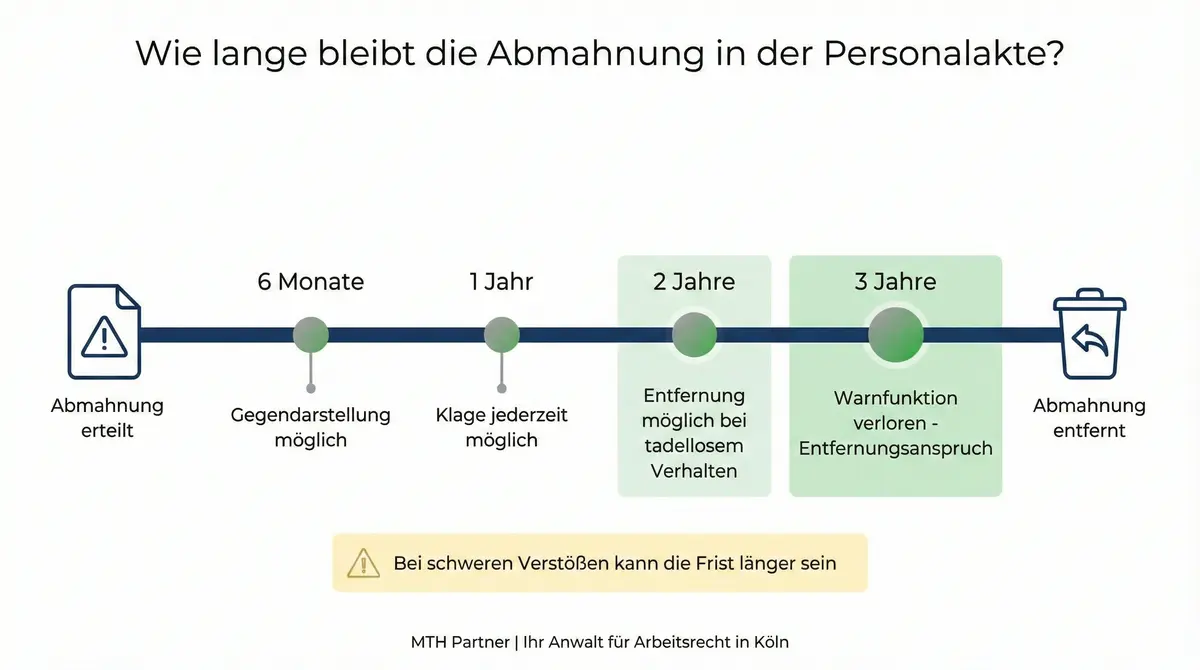
You have the right to submit a counterstatement to the personnel file. This is stated in § 83 Para. 2 of the Works Constitution Act. The counterstatement is kept together with the warning.
The counterstatement has advantages and disadvantages. It documents your view of the situation promptly and in writing. If you are later dismissed, the labour court must also take your statement into account. And you show the employer that you won't put up with everything.
The disadvantage: the warning remains in the file. A counterstatement does not automatically lead to removal.
What should a counterstatement look like? Objective and concrete. Describe the incident from your point of view. State what is wrong or incomplete in the warning. Name witnesses and evidence. Ask for the counterstatement to be added to the personnel file.
Contesting a warning letter
You can contest the warning in court. You can file an action with the labour court to have the warning removed from your personnel file.
The court then examines: Did the breach of duty take place? Is the description specific enough? Was the warning proportionate? Have all formal requirements been met?
Important: The employer bears the burden of proof. They must prove that the incident took place as described. If he fails to do so, the warning will be removed.
There is no time limit for the complaint. Theoretically, you can still sue years later. In practice, it becomes more difficult to provide evidence over time.
Regarding the costs: In labour court proceedings at first instance, each party bears their own legal costs, regardless of who wins. The costs are covered by legal expenses insurance for labour law.
Request removal from personnel file
You are entitled to have the warning removed if it is unjustified. This applies if the content of the accusations is incorrect, if there are formal errors, if the warning is disproportionate and if the warning has lost its warning function.
The last point is important: according to case law, a warning must be removed from the personnel file after around two to three years if the employee has behaved impeccably since then. The warning has then fulfilled its purpose.
The Cologne Higher Labour Court made it clear in 2021: those who object calmly but firmly have realistic chances. Precision and documentation pay off.
My advice: Firstly, ask the employer in writing to remove the warning. Set a deadline of two weeks. Explain why the warning is unjustified. Only if the employer refuses will it make sense to go to the labour court.
Warning and cancellation: The connection
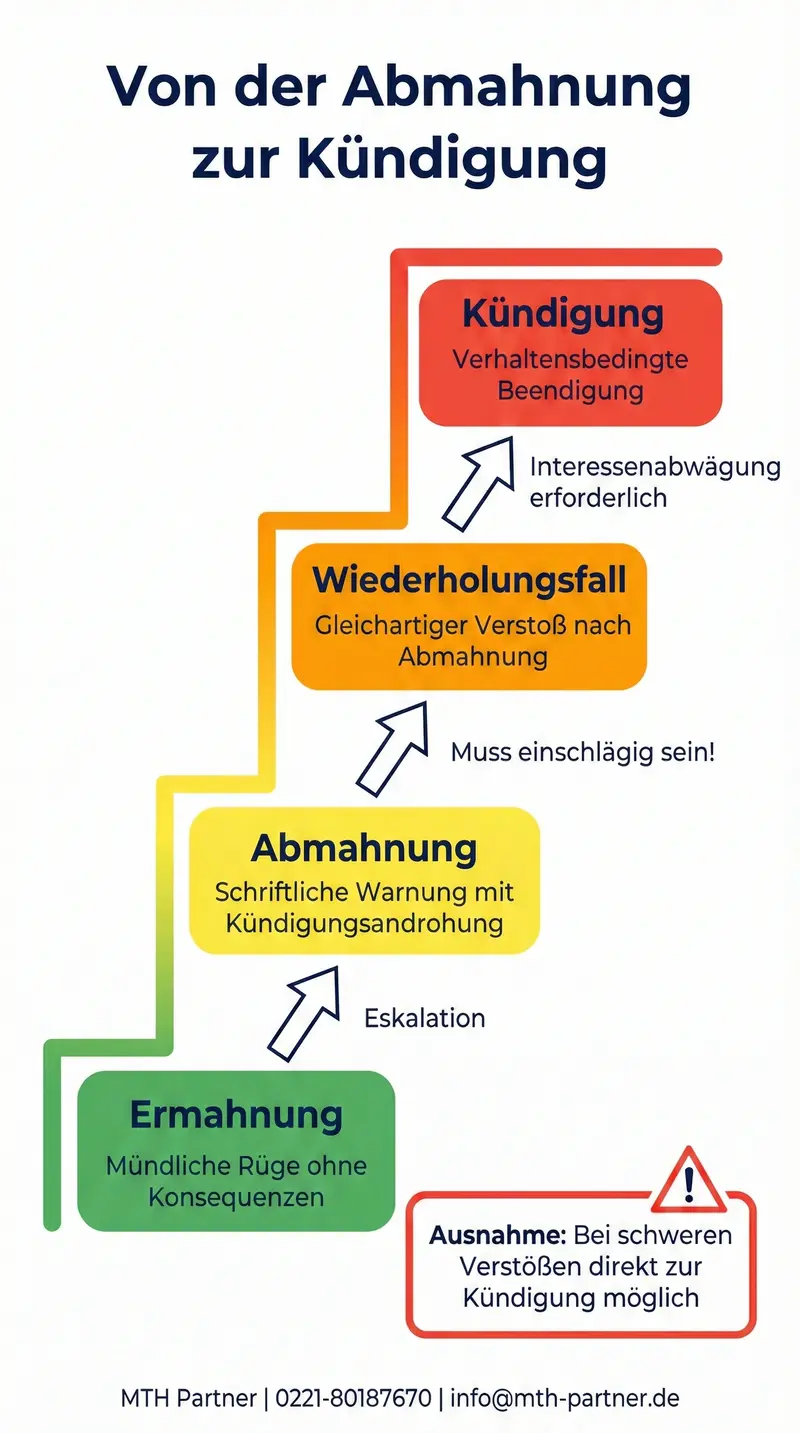
The warning does not stand alone. It is one step in a possible escalation process that can lead to dismissal. But not necessarily.
When does a warning lead to dismissal?
Principle: A warning is required before a dismissal for misconduct. The employee should have the opportunity to change their behaviour. If the employer dismisses the employee without a prior warning, the dismissal is generally invalid.
Several requirements must be met for an effective dismissal following a warning:
The warning itself must be effective. It must fulfil all formal and substantive requirements. An ineffective warning cannot prepare the ground for termination.
The employee must have committed a relevant repeat offence. This means: a similar or comparable breach of duty. A warning for unpunctuality does not justify dismissal for offence.
There must be a negative prognosis. The employer must fear that the employee will not change his or her behaviour.
And the dismissal must be proportionate. The employer must check whether milder measures such as a further warning or a transfer are sufficient.
In my practice, many dismissals for misconduct fail because one of these conditions is not met. Particularly frequently: the warning was ineffective or the case of repetition was not relevant.
Have you been dismissed after receiving a warning letter? Then read my detailed guide: Free 72-Hour Emergency Plan for Immigration Cases
When is no warning necessary before cancellation?
There are exceptions. In the event of particularly serious breaches of duty, the employer can terminate the contract immediately without giving prior warning.
This applies to criminal offences against the employer such as theft, embezzlement or fraud. In the event of serious breaches of trust such as the betrayal of business secrets. In the case of serious threats. And in the case of breaches of duty where it must have been clear to the employee that their behaviour would not be tolerated.
However, caution is also required here. The Federal Labour Court has repeatedly ruled that a warning is generally required before an extraordinary dismissal if the misconduct is based on controllable behaviour and a warning could bring about a change in behaviour.
In addition, the case law: Termination without notice must be proportionate
How many warnings before a dismissal?
I hear this question all the time. The answer is unsatisfactory, but honestly: it depends.
There is no fixed figure. The circumstances of the individual case are decisive. How serious was the breach of duty? How long has the employment relationship existed? How has the employee behaved so far? Has he responded to the warning?
In the case of minor offences such as occasional tardiness, several relevant warnings are usually required. In the case of serious offences, a single warning may be sufficient.
A word of warning: too many warnings without consequences can also backfire. The labour court could argue that the employer has signalled through repeated warnings that it does not take the violations so seriously after all.