
Anyone of German descent who lives in a state of the former Soviet Union or in another resettlement area can, under certain conditions, come to Germany as a late emigrant and acquire German citizenship there. Whether this is successful is decided by the Federal Administrative Office (BVA) in a multi-stage process – based on documents on descent and nationality, proof of language proficiency, and a detailed examination of the residence history.
Note: This article serves as general information and does not replace legal advice in individual cases. The requirements depend heavily on your documents, your country of origin, and your family history. For your specific situation, please contact a lawyer.
The most important in a nutshell
- A person who is a German national can become an expat if they have a legally required residence history in an expat area and leave it through the admission procedure (§ 4 BVFG).
- German citizenship requires German descent, a commitment to German ethnicity, and the ability to have a simple conversation in German (§ 6, paragraph 2, BVFG).
- The admission certificate must be present before departure in principle. After departure, permanent residence in Germany must be established within six months.
- Spouses and adult descendants need basic knowledge of the German language to be included; minor descendants do not.
- After entry, registration in Friedland and registration at the place of residence, the BVA issues the certificate pursuant to § 15 of the BVFG. With it, you acquire German citizenship (§ 7 StAG).
Who is a late settler?
According to § 4, paragraph 1 of the Federal Displaced Persons Act (BVFG), a late immigrant is usually a German citizen who left the former Soviet republics through the admission procedure after December 31, 1992 and has taken up permanent residence in Germany within six months. Those who are thus admitted are initially considered to be German citizens within the meaning of Article 116, paragraph 1 of the Basic Law and acquire German citizenship with the Spätaussiedlerbescheinigung. We explain the constitutional background in our article. Art. 116, Para. 1 of the Basic Law: Who is a „German“ within the meaning of the Basic Law?
The prerequisites in detail
- Residence history in the resettlement area. Living there today is not enough. § 4, paragraph 1 of the BVFG requires that you had your permanent residence there – either since May 8, 1945, or after your own expulsion or that of a parent since March 31, 1952, or since your birth. The third option only applies if you were born before January 1, 1993 and descend from a person who meets one of the two first qualifying criteria. It does not apply if parents or grandparents moved their residence to the resettlement areas after March 31, 1952. Those born before 1993 who are descended from a family that moved to the resettlement areas later can therefore fail despite being of German descent.
- Additional requirement outside the former Soviet Union. Anyone who comes from Poland, Romania, the Czech Republic, Hungary, the Baltic States, or another area of settlement outside the former Soviet Union must prove convincingly that on or after December 31, 1992, he or she was subjected to disadvantages or the effects of previous disadvantages due to his or her German citizenship (§ 4, paragraph 2, BVFG). The BVA requires concrete disadvantages that are not merely minor in nature.
- German ancestry. They must be descended from a German citizen or native-born German (§ 6, paragraph 2, BVFG). This is usually proven by family register documents over the generations.
- Affirmation of the German folk culture. As a rule, this is done through a declaration of nationality stating „German“, for example in the domestic passport. It is also possible to declare „in another way“, in particular by demonstrating German language skills at the B1 level of the Common European Framework of Reference.
- Simple conversation in German. The declaration must be confirmed by the fact that you are able to conduct at least a simple conversation in German at the time of the decision on the application for admission – in cases of urgency, according to § 27, paragraph 1, sentence 2 of the BVFG, even upon establishing permanent residence in Germany.
- No reason for exclusion. Section 5 of the BVFG excludes, among others, persons who held a significant function in maintaining the communist regime or who committed an act that would be considered a crime in Germany. A criminal conviction is not necessarily a prerequisite for this.
The admission decision and its function
The admission decision is the BVA’s decision that the conditions for admission as late returnees are met (§ 27, paragraph 1, BVFG). It is a prerequisite for the visa to enter the country as a late returnee, and it is the basis for you leaving the resettlement area „through the admission procedure“. Therefore, it must in principle be available before departure. If someone already lives in Germany, it can only be granted exceptionally if the refusal would involve special hardship and the other prerequisites are met (§ 27, paragraph 1, sentence 2, BVFG). Special rules apply to people who have traveled from Ukraine or Russia due to the war (see below).
Application and documents
The application must be submitted to the Federal Administrative Office in Cologne – either online via the Federal Portal or by post. The form „Application S“ is valid for applicants from the former Soviet Union (excluding the Baltic States), while the form „Application A“ applies to the other resettlement areas. The application must be completed in German and signed by hand. You can authorize a person living in Germany to do so in writing. Forms, fact sheets and a list of documents to be attached can be found on the BVA page on the admission process.
The documents serve three different purposes. One document can prove one thing and tell nothing about the other:
- Proof of lineage. Birth certificates from you, your parents and, if applicable, grandparents, as well as marriage certificates. They show which lineage you belong to and make name changes understandable. A birth certificate in which your father is listed as „German“ proves the descent – but not your own declaration of faith.
- Evidence of your own confession. Documents in which You yourself be held with the nationality „German“ (e.g., a domestic passport). If the nationality was changed later, the documents for the change are included. Important: The Soviet nationality entry describes ethnic affiliation, not citizenship. The entry „German“ therefore does not mean that you or your parents are German citizens.
- Evidence in the language. If available, a language certificate. Otherwise, proof of proficiency is provided through the language test.
In the absence of documents, a request to the civil registry offices and archives in the country of origin can help. Our article describes how such searches are carried out. Why archives often provide the crucial evidence.
A unique path: You are not only of German descent, but also of German origin. Nationals Apart from the late-immigrant procedure, acquiring citizenship through descent may also be considered. This is a separate legal process with its own requirements – more about that in our article on German citizenship by descent and in summary Section 5, Section 30 or Section 14 StAG: Which procedure is suitable? An initial assessment is provided by our Free citizenship check.
The process step by step
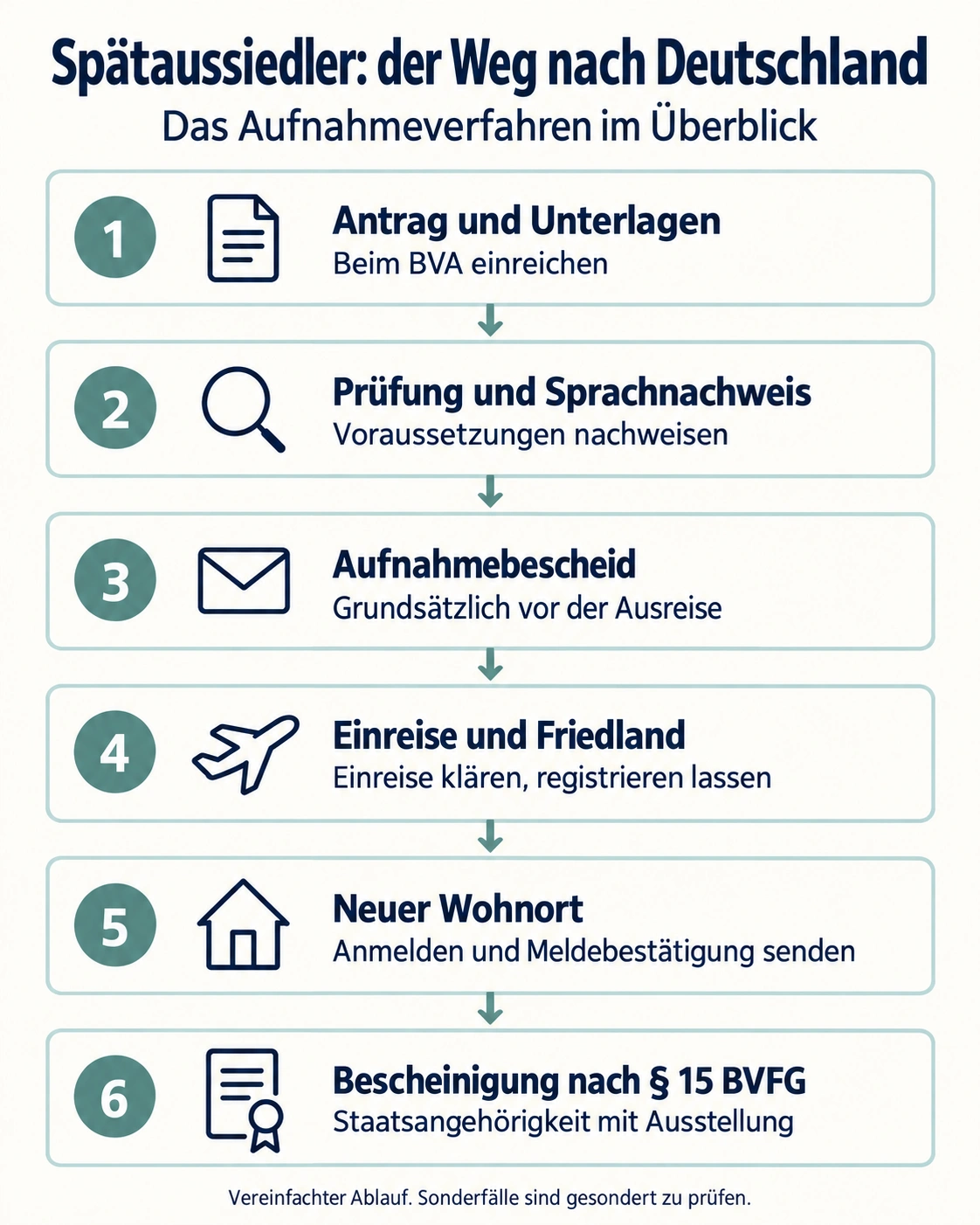
- Initial confirmation and preliminary review. You will receive an acknowledgement of receipt with a case number. The BVA will review the documents and request missing documents in writing. The processing time depends on the volume of applications.
- Language test at the foreign representation. If the remaining requirements are met, the BVA invites you to take the language test at the nearest German foreign representation. Due to limited capacity, there may be longer waiting times.
- Admission notice. If all the prerequisites are met, the BVA will issue the admission certificate. Please keep it carefully.
- Visa and entry. With the admission notice, you – if a visa is required for your entry – apply for the visa at the foreign representation and travel to Germany. As soon as you leave the resettlement area, the six-month period set out in § 4, paragraph 1 of the BVFG for establishing permanent residence in Germany – does not begin to run from the issuance of the admission notice.
- Registration and distribution in Friedland. Upon arrival, you will be registered at the border crossing camp in Friedland (Lower Saxony) and assigned to a federal state according to a fixed distribution key. Family ties as well as employment and training opportunities will be taken into account, insofar as possible. You will present your reasons for a specific place of residence in person there.
- Registration at the place of residence. At your new place of residence, you should register with the local registry office and send the registration confirmation to the BVA, location Friedland.
- Certificate of late arrival and citizenship. The BVA will examine your application and send you the certificate in accordance with § 15 of the BVFG. Upon issuing it, you acquire German citizenship (Section 7 of the StAG) – without the need for an application for naturalization. Please keep the certificate carefully; in the event of loss, a duplicate certificate can be issued (§ 15, paragraph 3 of the BVFG). Whether you retain your previous citizenship depends primarily on the laws of your country of origin – more about this in the article on dual citizenship in Germany.
Regarding step 7: An admission decision does not guarantee the certificate. The Federal Administrative Court will again examine in the admission procedure whether you are a late immigrant. The Federal Administrative Court confirmed its previous ruling in April 2026, according to which the effective admission decision is binding insofar as it can no longer be questioned whether you have left the immigration area through the admission procedure; other conditions do not affect this binding effect (BVerwG, judgment of April 23, 2026 – 1 C 23.25). However, the conversation during the admission procedure will not be repeated.
Proof of language proficiency: Who needs to know what?
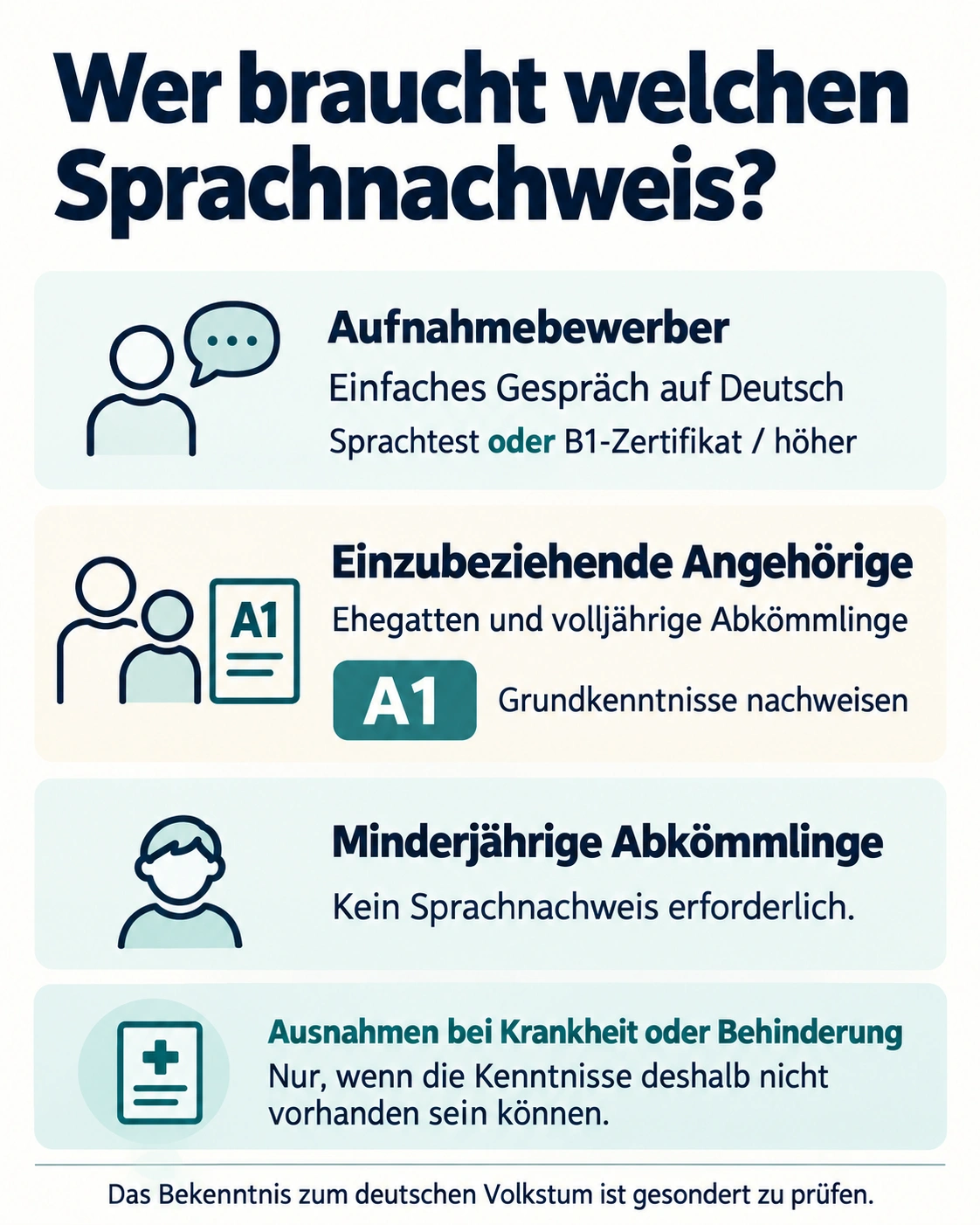
The requirements differ depending on the role within the family. The BVA provides further details on its website. Page for proof of language proficiency.
| Person | Requirement | Evidence |
|---|---|---|
| Late Emigrants (applicants on their own behalf) | Simple conversation in German (§ 6, paragraph 2 of the BVFG) | Language test at the German foreign representation or certificate at least at level B1 |
| Spouse | Basic knowledge of the German language (§ 27, paragraph 2, BVFG) | Language proficiency test at the foreign representation or certificate A1 |
| Adult descendant | Basic knowledge of the German language (§ 27, paragraph 2, BVFG) | Language proficiency test at the foreign representation or certificate A1 |
| Minor offspring | No proof of language proficiency required | - |
| People with illness or disabilities | Exemption from the language requirement if they are unable to possess the knowledge due to this. The late immigrant himself must nevertheless prove his commitment to German culture. | Evidence of illness or disability |
At the time of the application: The decisive factor for the simple application is basically the time of the decision on the application for admission. In cases of urgency pursuant to § 27, paragraph 1, sentence 2 of the BVFG – that is, when the admission decision is not issued until after the relocation – the time at which permanent residence in Germany was established is decisive, not the later decision point (§ 6, paragraph 2 of the BVFG). In these cases, therefore, language skills that were acquired in Germany only afterwards do not help.
A B1 certificate can be doubly useful for the late immigrant: it can prove the commitment to German culture in a „different way,“ and the BVA also accepts it as proof of language proficiency. The BVA explicitly lists certificates from the Goethe Institute as examples of such documents.
Repetition, costs, and age of majority
- Repetition. According to the BVA, those who do not pass the language test will not have their application for admission rejected. You can improve your German skills and retake the test. A new appointment will not be automatically issued – you must contact the BVA.
- Costs. Language tests and language proficiency tests at the BVA are free, even for repeat applicants. You bear the cost of travel and accommodation yourself; examinations at the Goethe-Institut are subject to a fee.
- Full age before departure. If a child involved in the process becomes of age before departure, the decision to involve them will be null and void according to the BVA. The involvement must then be applied for again, and the young adult must now prove basic knowledge of the German language themselves. Therefore, the timeline for families with almost-adult children should be planned early.
Taking the family along: Inclusion under § 27, paragraph 2, of the BVFG
Spouses and descendants (children, grandchildren) may be included in the Spätaussiedler admission certificate. They do not themselves need to be German citizens. The following requirements are particularly important:
- More explicit request. The late-immigrant must explicitly request inclusion.
- Residence in the resettlement area. The dependents to be included must themselves live in the resettlement area.
- For spouses: The marriage must have lasted for at least three years. Basic knowledge of the German language is also required.
- In adult descendants: Basic knowledge of the German language.
- In the case of minor descendants: They can only be included if they are accompanied by their parents or the parent with parental responsibility.
- For all those involved: No grounds for exclusion under § 5 of the BVFG.
Spouses or descendants who initially remained in the resettlement area may subsequently be included in the admission certificate of the late emigrant under the other conditions (§ 27, paragraph 2, BVFG). Inclusion can also be invalid, especially if the marriage is dissolved before the departure of both spouses or the person receiving the benefits dies before the included persons are admitted.
Like the late immigrant himself, those included acquire German citizenship with their certificate. However, according to the BVA, they have no specific claims to a pension under the Foreign Rent Act.
Other relatives: § 8 BVFG does not grant the right to enter the country
Family members who do not meet the requirements for inclusion – such as a son-in-law or daughter-in-law – may be included in the distribution process under § 8, paragraph 2, of the BVFG if they arrive together with the late emigrant. § 8 of the BVFG only regulates the joint distribution to a federal state. Whether these relatives may enter and remain in Germany depends on the residence law and must be clarified separately there. They will not become German citizens under the BVFG; subsequent naturalization depends on the general rules of the Nationality Act. Our contribution provides an overview. The new naturalization law.
What could endanger the application
- An earlier „counter-declaration“. In an older document, if another nationality is stated, for example „Russian“, the jurisprudence previously required proof of an internal change in consciousness and its external manifestation. Since December 23, 2023, a new version of § 6, paragraph 2, of the BVFG has been in effect: A declaration of nationality changed only to German ethnicity before leaving the resettlement area takes precedence over earlier declarations, and even serious efforts to make such a change are sufficient. How strictly this should be examined is judged differently by the OVG NRW (judgment of May 23, 2025 – 11 A 2449/24) and the VG Köln (judgment of July 7, 2025 – 10 K 3795/22). A published decision of the Federal Administrative Court that conclusively clarifies this question was not known to us at the time of writing (October 2026). Background information on the reform can be found in our article on Article 116, paragraph 1, of the Basic Law on the Constitution of the Federal Republic of Germany.
- Attempts at change that are inherently hopeless. If the country of origin does not allow a change to the nationality entry to be legally made, futile attempts after the OVG NRW do not count as „serious efforts“ (judgment of June 11, 2026 – 11 A 2817/24). The timing of the efforts is also important. In such cases, it is necessary to determine whether the declaration can be proven by other means – for example, through language skills at the B1 level.
- Gaps in the lineage. If a document in the chain lacks a certificate or the spelling of a name differs between documents – for example due to different transliterations from the Cyrillic alphabet – this gap must be filled in another way. If this is not possible, the lineage remains unproven.
- An inappropriate residential history. If the family did not move to the resettlement areas after March 31, 1952, the time-bar rule of § 4, paragraph 1, no. 3 of the BVFG may exclude the claim.
- Departure without an admission decision. Anyone who moves to Germany without a residence permit risks losing the opportunity to become a late-arriving immigrant. The hardship case regulation of § 27, paragraph 1, sentence 2 of the BVFG only applies in exceptional cases. There are separate rules for wartime departures (next section).
- Discrimination not proven. For applicants outside the former Soviet Union, the application may fail if no concrete disadvantages or their consequences can be demonstrated on or after December 31, 1992.
Military-related departure from Ukraine or Russia
Anyone who has left their country of origin since February 24, 2022 because of the war – possibly before the admission application was decided – must be familiar with the War-Related Residence Extension Ordinance (KrWoFGV). It was published in August 2024, retroactively applies to the start of the war, and regulates under what conditions residence in the resettlement area remains valid despite departure. The ordinance clearly distinguishes between Ukraine and Russia. In neither of these cases is it an automatic exception.
Departure from Ukraine
- Who is being recorded. Persons who, due to the war, departed from Ukraine after February 23, 2022 and entered Germany.
- Staying outside the resettlement areas. Even a stay of more than six months outside the resettlement areas will continue the residence in Ukraine under the terms of the regulation. The regulation is linked to a deadline that extends to at least one year after the final cessation of hostilities in Ukraine.
- Hardship claim from Germany. Anyone who wishes to remain in Germany can submit an application for a hardship case under § 27, paragraph 1, sentence 2 of the BVFG. For this application, the residence in Ukraine until the day of submission of the application is considered to be continued if the application was submitted within two years of entry. For earlier entries, the alternative deadline was February 15, 2025 – this deadline has expired.
- Integration requirements. In addition, the regulation refers to certain requirements under § 9, paragraph 2, sentence 1 of the Residence Act, such as a secure livelihood, sufficient German language skills and sufficient living space.
Departure from Russia
For persons who have traveled from the Russian Federation due to war, the rule is significantly stricter: it requires that the person be recognized as eligible for asylum in Germany or have received international protection. Those who have traveled from Russia and do not possess such a protection status cannot rely on the residence extension.
In both cases, accurate data are crucial: departure, entry, application submission, and, if applicable, protection status. Critics such as the Bund der Vertriebenen also point out that longer stays in third countries can be problematic. Therefore, anyone who has traveled due to war should have the regulations reviewed early to determine whether and how they apply in their own case. The BVA has prepared a own leaflet on KrWoFGV published.
What to do if the application is rejected?
You can legally defend yourself against a negative decision from the BVA. Which legal remedy is permissible and within what time frame – usually one month from notification – is set out in the instructions for appeal at the end of the decision. A missed deadline can only be remedied in exceptional cases. If the rejection remains, the administrative court in Cologne is usually competent to file a lawsuit against the BVA.
Another problem is a procedure that simply does not progress. If an authority decides not to act within a reasonable timeframe without sufficient reason, a negligence action under § 75 VwGO may be considered – in principle not before three months have passed since the application was submitted. Whether a long processing time at the BVA constitutes a „sufficient reason“ is a matter of individual case. How courts handle the workload overload of authorities is shown in our contribution Increased workload is not a sufficient reason for slow processing.
If your application was rejected before the December 2023 legal change due to a lack of knowledge, and the decision is final, an application to reopen the proceedings may be considered; § 27(3) of the BVFG does not provide a deadline for this. Which course of action is appropriate in your case depends on the content of the old decision and your current documentation.
When legal assistance is advisable
You can file an application without a lawyer; the BVA provides forms and leaflets. Legal advice is especially useful if your case deviates from the standard: in the case of prior acquaintance, incomplete documents or a difficult residence history, after a war-related departure, upon rejection, or if the BVA refuses to include family members.
Lawyer Helmer Tieben advises in Aliens and nationality law, examines decisions of the Federal Administrative Office and represents applicants in opposition and litigation proceedings. If you have already received a decision from the BVA, please send it to us via the Contact form – be sure to observe the deadline specified in the instructions for appeal.
Status: October 2026. Procedures and case law may change; the current versions of the BVFG, KrWoFGV, and StAG are decisive, as are the instructions of the Federal Administrative Office.