
From the Holy Roman Empire to the Federal Republic of Germany
Attorney Helmer Tieben, LL.M. MTH Partner Lawyers, Cologne
As of: June 2026
Note: This article is for general information only and does not replace individual legal advice. Nationality law is complex and depends on the specific historical circumstances of each individual case. Please consult a lawyer for your specific situation.
Anyone with German ancestors will at some point ask themselves a simple question: Am I perhaps already German? However, the answer to this is rarely straightforward. This is because German nationality law is not based on descent. It is not enough to prove German roots. A complete legal chain must be demonstrated – from a demonstrably German ancestor, through each individual generation, down to you.
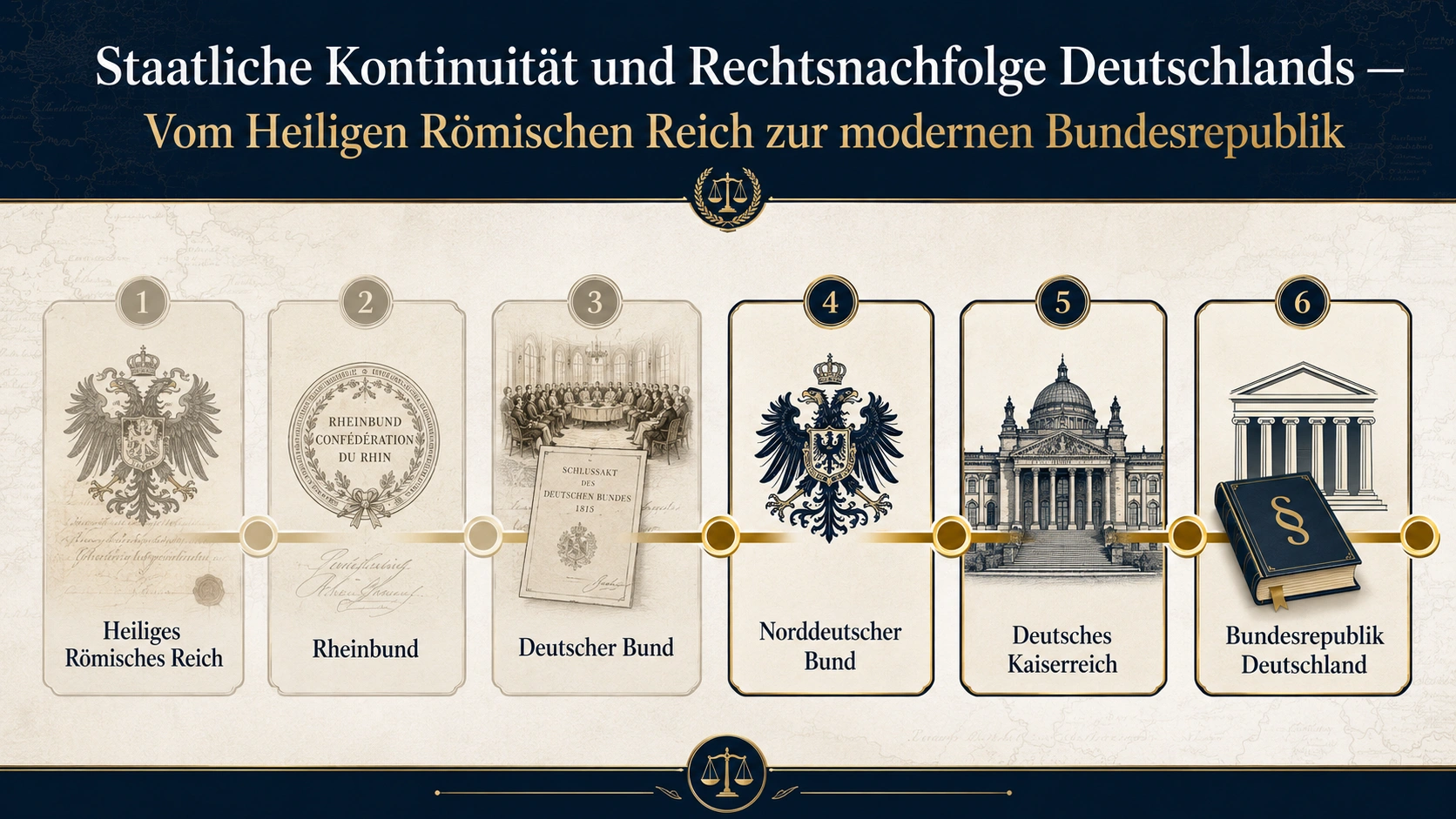
Whether this continuity exists or whether it was broken at some point depends not only on family documents. It also depends on which law applied at which time – and that means: it depends on the history of the German state itself. Because the German state as we know it today did not newly emerge in 1949 or 1990. It has a legal history that reaches back through the German Empire, the North German Confederation, and the German Confederation to the time of the Holy Roman Empire.
This article explains why the continuity of the German state can be crucial for your claim to citizenship – and at which historical turning points the legal situation fundamentally changed.
Why state succession is crucial for nationality claims
A claim to the German nationality by descent is a legal claim, no cultural or ethnic. It presupposes that an ancestor in the legal sense German war — also who has possessed the nationality of a German state — and that this Nationality by has been effectively passed down through every generation without ever being interrupted.
This means: If your great-great-grandfather emigrated from Bavaria to Brazil in 1880, it is not enough to prove his Bavarian origin. It must be examined whether he was a Bavarian national at the time of emigration, whether he retained this nationality abroad, whether the legal order of the German Reich recognised his nationality as continuing, and whether it was passed on to the next generation.
And here the question of state succession comes into play: for if the German state has fundamentally changed several times – from the German Empire, through the Weimar Republic, the National Socialist regime, the occupation period, to the Federal Republic – does the law that your ancestor once acquired still apply at all?
The answer of German constitutional law is: Yes. And it reads as follows, because from a constitutional perspective the Federal Republic of Germany is not a new state, but identical to the German Reich — a position that the Federal Constitutional Court has confirmed in constant case law (cf. BVerfGE 36, 1).
Was there German citizenship before 1871?
The Holy Roman Empire of the German Nation (1648–1806)
The Holy Roman Empire was not a nation-state in the modern sense. It consisted of hundreds of territories – kingdoms, duchies, principalities, bishoprics, free imperial cities – each with its own legal system and subject relationships. A unified „German nationality“ did not exist. Someone born in Nuremberg was a citizen of Nuremberg, not „German“ in today's sense.
For the practice of citizenship assessment, this means: Ancestors from the time of the Holy Roman Empire do not in themselves establish a claim to German citizenship. The legal chain is generally too remote, and the civil rights of that time can neither be equated with today's nationality nor reconstructed seamlessly up to the present day.
The Holy Roman Empire is not a predecessor state of the present-day Federal Republic in terms of public law. There is no direct legal succession.
The Confederation of the Rhine (1806–1813)
The Confederation of the Rhine was a confederation of German states founded under Napoleonic influence. It formally replaced the Holy Roman Empire, but it had no common nationality and no lasting legal consequences. It has no practical significance today for matters of nationality.
The German Confederation (1815–1866)
The German Confederation, founded at the Congress of Vienna in 1815, was an international association of 39 sovereign states. It was no federal state and had no common citizenship. Each member state — Bavaria, Prussia, Saxony, Württemberg, Baden, and many others — regulated the belonging of its inhabitants according to its own law.
Anyone who emigrated during the period of the German Confederation was therefore not a „German national“, but, for example, a Bavarian or Prussian national. For a modern nationality check, therefore, the Specific nationality of the specific individual state be proven – and that this individual state later acceded to the German Reich.
The North German Confederation and the Birth of Federal Nationality (1867–1871)
The North German Federation, founded in 1867, was the first modern German federal state. It marks the beginning of a unified German nationality in the modern sense.
On 1 June 1870, the Law on the acquisition and loss of federal and state citizenship in force. It established the basic structure that remained in place until it was replaced by the RuStAG of 1913. The essential principles:
- Principle of descent (ius sanguinis): Nationality was acquired by descent from the father, not by place of birth.
- Double structure: One was simultaneously a member of a federal state (e.g. Prussia) and a member of the North German Confederation. Federal citizenship automatically followed from citizenship of a member state.
- Ten-year period (§ 21): Anyone who stayed abroad for ten consecutive years automatically lost their citizenship – unless they had registered in the consular records.
This law is considered the cornerstone of modern German nationality law. And it is also the source of one of the biggest practical problems for descendants of early emigrants: the automatic loss of citizenship through ten years of residing abroad.
The German Empire (1871–1918)
The German Empire arose in 1871 not through a new foundation, but through the expansion and renaming of the North German Confederation. The South German states — Bavaria, Württemberg, Baden, and Hesse south of the Main — joined. The citizenship law of 1870 continued to apply in the Empire.
From a constitutional law perspective, there is direct continuity between the North German Confederation and the German Empire. This is important for citizenship checks: anyone who was a Prussian national, and therefore a national of the North German Confederation, on 31st December 1870 automatically became a national of the German Empire on 1st January 1871.
The Ten-Year Limit: Why So Many Claims Fail Before 1904
The ten-year period stipulated in Section 21 of the 1870 Act is one of the most frequent reasons for the failure of citizenship claims by descent. The rule was simple and harsh:
If a German national lived abroad continuously for ten years without registering with the consular rolls of a German consulate, they automatically lost their nationality – by operation of law, without notice, without warning.
In practice, this meant that the vast majority of German emigrants in the 19th century knew neither of this rule nor of the existence of a German consulate where they could have registered – let alone that they would have travelled there if the nearest consulate was days' travel away.
The cut-off date of 1904 is explained as follows: The new Nationality and Citizenship Law (RuStAG) came into force on 1 January 1914 and abolished the ten-year deadline. Therefore, anyone who emigrated before 1904 and had not registered with the consulate had already lived abroad for ten years by 1 January 1914 – and had lost their citizenship by operation of law. They could not pass citizenship on to the next generation.
Who is against it emigrated after 1903 The ten-year period had not yet expired for him when the RuStAG came into force. In the best-case scenario, he remained a German national, and the chain could continue.
Practical guide: Consular registers
Consular registration – the so-called German consular register – was the only way to interrupt the ten-year period. Those who completed it retained their nationality. The relevant documents are held in the German Federal Archives in Berlin and partly in the archives of the respective consulates abroad.
In reality: in only a few cases can such a registration still be proven today. However, if it can be proven, it can be decisive to the success or failure of a citizenship application.
The Reich and Nationality Act of 1913
On 1 January 1914, the Reich and Nationality Act (RuStAG) came into force. It replaced the 1870 Act and formed the basis of German nationality law for the entire 20th century. This Act remained in force — in an amended version — until it was replaced in 1999 by the current Nationality Act (StAG).
The most important changes compared to the 1870 law:
- Abolition of the ten-year time limit: German nationals living abroad no longer automatically lose their citizenship by residing abroad.
- Retention of the principle of descent: Nationality continued to be primarily acquired by descent from the father. Women acquired the nationality of their husband through marriage (§ 17 No. 6 RuStAG).
- Loss of citizenship through acquisition of a foreign nationality: Anyone who acquired another nationality upon application lost their German nationality.
The RuStAG is so crucial because many modern cases of descent hinge on the question: Was the ancestor Was he still a German national on 1 January 1914? If he was, the new, more favourable law applies from that point onwards. If he was no longer (for example, because the ten-year period had expired), the chain ends.
The Weimar Republic, National Socialism and the post-war period
Weimar Republic (1919–1933)
The Weimar Republic was not a fresh start. It was a constitutional amendment of the existing state. The German Reich continued to exist – it changed its form of government from a constitutional monarchy to a parliamentary republic. Nationality law remained unchanged: the RuStAG remained in force.
The Nazi era (1933–1945)
Even under the Nazi regime, the German Reich continued to exist as a state — it once again changed its constitutional form, this time to a totalitarian dictatorship. Under the Nazi regime, citizenship was exploited for political purposes:
- The Act on the Revocation of Naturalisation and the Withdrawal of German Citizenship The Act of 14 July 1933 enabled individual denaturalisations through publication in the Reichsanzeiger.
- The Eleventh Ordinance to the Reich Citizenship Law The decree of 25 November 1941 collectively stripped all Jews living abroad of their German citizenship.
These measures are the starting point for later restitution arrangements. Article 116(2) of the Basic Law and Section 15 of the State Act.
Collapse and Occupation Period (1945–1949)
Following the unconditional surrender in 1945, the Allies assumed supreme governmental authority in Germany. The German state continued to exist but was unable to act – it no longer had any functioning state organs. However, nationality persisted: anyone who was a German national on 8 May 1945 remained so during the occupation period.
The Federal Republic of Germany and its identification with the German Reich
This is the most important legal point for understanding state continuity and its significance for nationality law.
The Basic Law of 1949 assumes that the Federal Republic of Germany not a new state but identical to the German Empire. This position was established with binding effect by the Federal Constitutional Court in its ruling on the Basic Treaty of 31 July 1973 (BVerfGE 36, 1):
„The Basic Law — not merely a thesis of international law or constitutional law! — is based on the assumption that the German Reich survived the collapse of 1945 and did not cease to exist either through the surrender or through the exercise of foreign state authority in Germany by the Allied occupying powers, nor did it cease to exist at a later date.“
— BVerfGE 36, 1 (headnote)
The Federal Republic is therefore not the „legal successor“ to the German Reich — it Section 25b of the Residence Act (AufenthG) stipulates that persons with tolerated status who have been residing in Germany for a longer period may be granted a residence permit under certain conditions, provided they have sustainably integrated into the society and living conditions in Germany. The German Reich in its current form. This has an immediate practical consequence: The nationality law that applied under the Empire or the Weimar Republic continues to be effective today. A nationality that existed in 1910 or 1920, if it has not since been lost, still exists in principle today.
German Reunification 1990
The reunification did not change this principle. The GDR joined the Federal Republic in accordance with Article 23 of the Basic Law in its former wording. No new state was founded. As stated in the memorandum on the Unification Treaty, the Federal Republic thereby achieved „its territorial completeness“.
Which historical emigration periods raise which legal questions
The following overview shows which central legal questions arise depending on the period of emigration of an ancestor. It does not replace an individual case review – but it provides guidance on where the typical hurdles and opportunities lie.
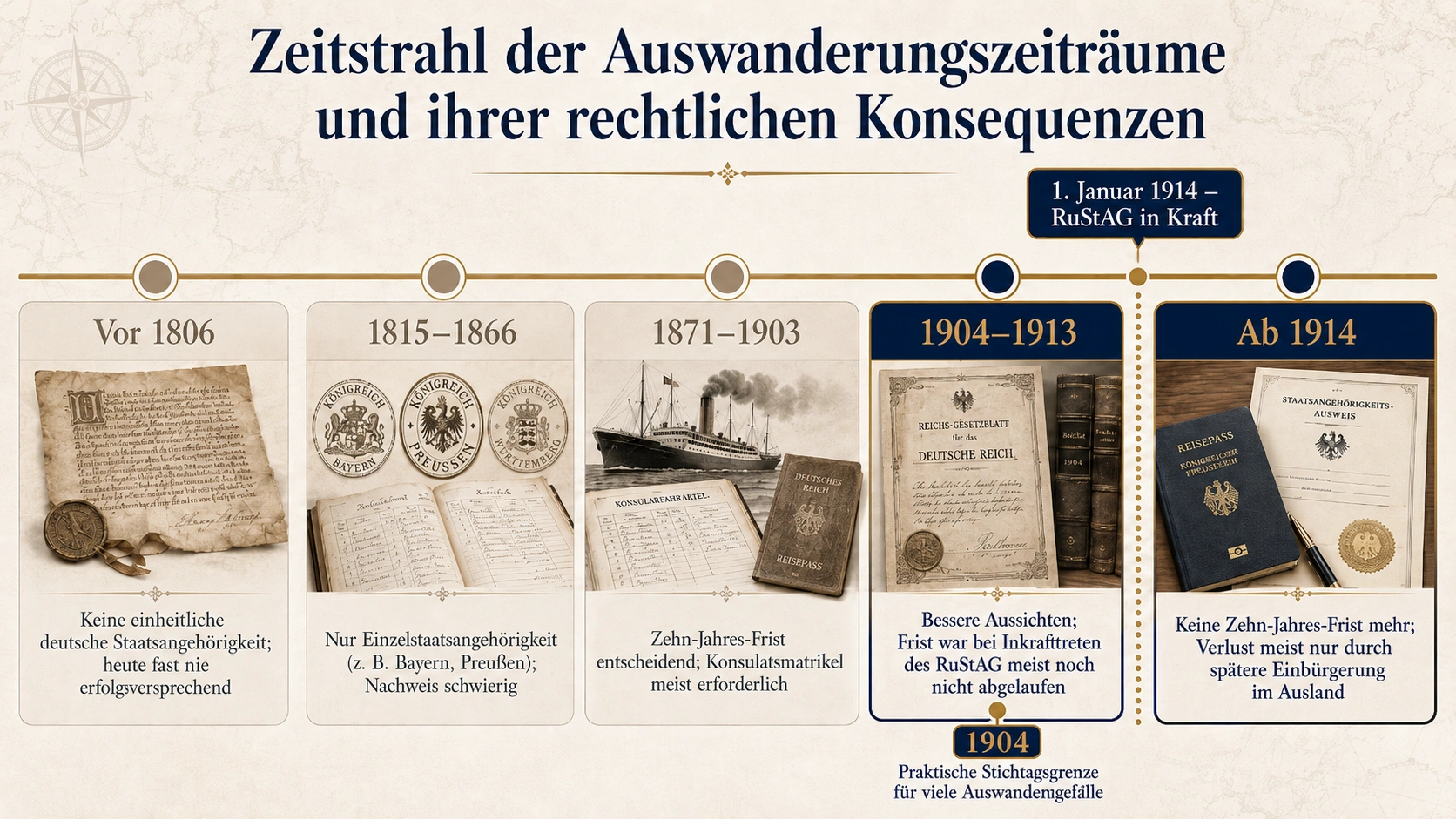
| Period | Central question | Opportunities and hurdles |
|---|---|---|
| Before 1806 | Was there a verifiable citizenship of a later German federal state? | Almost hopeless. No uniform German nationality, no legal succession to the present-day German state. |
| 1815–1866 | Can individual state nationality (e.g. Bavaria, Prussia) be proven? | Possible only in special cases. The individual state nationality must be proven and seamlessly able to be transferred to the imperial nationality under the law of 1870. |
| 1871–1903 | Has the ancestor interrupted the ten-year period by consular registration? | Possible, but difficult. The consular register is the key. Without it, nationality was generally lost before 1914. |
| 1904–1913 | Was the ancestor still a German national on 1 January 1914? | Significantly better prospects. The ten-year period had not yet expired when the RuStAG came into force. |
| From 1914 | Did the ancestor later acquire a different nationality upon application? | Cheapest. No more ten-year deadline. Loss mainly occurs through naturalisation abroad before the birth of the next child. |
Detours: When the chain of descent is broken
The unbroken chain of descent is the standard. However, German law recognises several corrective mechanisms that come into play when the chain has been broken for historical or discriminatory reasons. These regulations make claims possible that appear hopeless at first glance.
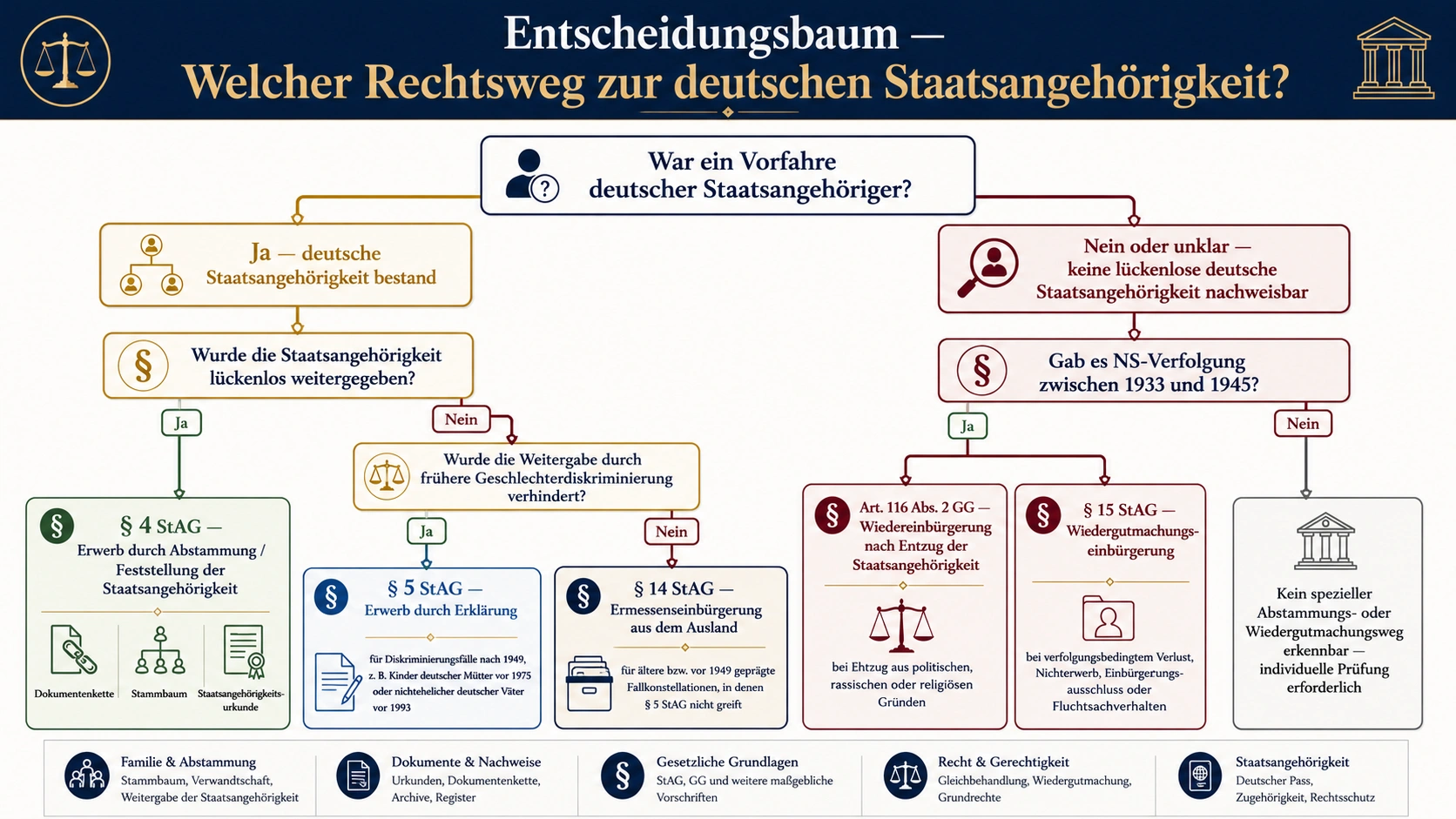
Acquisition by declaration: § 5 StAG — Gender discrimination after 1949
Since 20 August 2021, individuals born after 23 May 1949 who did not acquire German nationality by birth due to previously applicable gender-discriminatory regulations can acquire it through a simple declaration. The regulation also applies to their descendants.
The main categories of cases:
- Legitimate children of a German mother and a foreign father born before 1 January 1975. Under the law at the time, nationality could only be passed from father to child.
- Non-marital children of a German father and a foreign mother, born before 1 July 1993. Here, too, transmission of nationality through the father was not provided for.
- Children of a mother who lost her German nationality before 1 April 1953 durch marriage to a foreigner.
First: The right of explanation expires on 19 August 2031. Those affected should act now – sourcing documents from archives abroad can take years.
Naturalisation by descent from abroad: § 14 StAG — The older generation
For people who born before 23 May 1949 were also affected by the gender-discriminatory legal situation, § 5 StAG not. For these individuals and their descendants, discretionary naturalisation according to § 14 StAG in connection with the BMI decree of 30 August 2019.
The decisive difference to Article 5 StAG: Naturalisation under Article 14 StAG is not a declaration with a legal claim, but a discretionary decision by the Federal Administrative Office. It requires:
- Very close ties to Germany
- Sufficient German language skills
- Independent maintenance provision
- Impunity
There is no legal entitlement to naturalisation. The prospects of success depend heavily on the individual case.
Why ancestors who emigrated before 1904 can still fall under § 14 StAG
This is a point that is often overlooked: even if the line of descent is broken by the ten-year rule – for instance, because an ancestor emigrated before 1904 and the consular records are not traceable – the connection to German citizenship can still exist if the ancestor had a German parent and the non-transmission was due to gender-discriminatory rules.
For example: If a German woman in the 19th century married a foreign man and consequently lost her nationality (§ 17 No. 6 RuStAG), she could not pass it on to her children. The children were never German. However: It is precisely this gender-discriminatory rule that is the reason why § 14 StAG today provides a route to naturalisation – even if the family left Germany long before 1904.
Restoration Citizenship: § 15 StAG — Nazi Persecution
Since 20 August 2021, there has been a claim to naturalisation under § 15 of the Nationality Act (StAG) for persons and their descendants who lost their German citizenship due to National Socialist persecution on political, racial or religious grounds, without having a claim under Article 116 (2) of the Basic Law (GG).
The difference from Art. 116 (2) GG: Art. 116 (2) covers persons who have been deprived of their nationality revoked by the state was — typically through the expatriation laws of 1933 and 1941. Section 15 of the Nationality Act goes further: it also covers persons who have not lost their nationality through an act of the state, but due to persecution given up have — for example, through flight and subsequent naturalisation in the receiving country.
Why ancestors who emigrated before certain cut-off dates may fall under Section 15 of the Nationality Act
This is the second commonly overlooked connection: Imagine your ancestor emigrated to the USA as a German Jew in 1880. The ten-year rule applied, and by 1890, their German citizenship was lost – for purely formal legal reasons unrelated to later Nazi persecution. In this case, § 15 StAG applies. not, because the loss of citizenship preceded the Nazi regime in time and causality.
The situation is different when:
- An ancestor who still possessed German citizenship when Nazi persecution began (after 30 January 1933) and subsequently lost it due to persecution – through flight and naturalisation abroad, through the expatriation decrees, or through refusal of naturalisation.
- An ancestor never possessed German citizenship because it was withheld from them for discriminatory reasons — the BVA here cites the example of Jewish families in Danzig who were denied citizenship during the collective naturalisation of the Danzig population.
The scope of § 15 StAG is therefore considerable. However, the crucial point is always: the loss or non-acquisition of nationality must causally linked to Nazi persecution. A purely temporal coincidence is not enough.
Reacquiring nationality under Article 116(2) of the Basic Law
Article 116, paragraph 2 of the Basic Law is the constitutional foundation for restitution in nationality law. It grants former German nationals, who were deprived of their nationality between 30 January 1933 and 8 May 1945 for political, racial, or religious reasons withdrawn and their descendants a right to naturalisation. The right is unlimited in time, does not require any knowledge of the German language, residency in Germany, or renunciation of current citizenship, and is free of charge.
What proof is required for historical nationality claims
The Federal Office of Administration (BVA) in Cologne requires an unbroken chain of evidence for each generation in the line of descent. Different documents are accepted depending on what is still available:
- Birth certificates all persons in the line of descent
- Marriage certificates, as far as relevant for the lineage
- Old German passports or identity cards
- Certificates of Nationality (if applicable)
- Certificates of naturalisation from the country of origin (to prove when German nationality may have been lost)
- Consular Register — on emigration before 1904
- Archive certificates from the Federal Archives, Civil Registry Office I in Berlin, Arolsen Archives or foreign archives
- Church registers, if civil status certificates no longer exist
- Proof of trace (for applications under Article 116(2) of the Basic Law or Section 15 of the Citizenship Act): Deportation lists, emigration documents, restitution files, entries in victim databases
The BVA has expressly pointed out that missing documents no reason not to apply. The authorities are aware, particularly in cases of restitution, that original documents have often been destroyed during prosecution processes. Proof of plausibility and statutory declarations can be accepted.
Lineage alone is not enough — but the legal situation offers more possibilities than many think
Acquiring or establishing German nationality by descent is a legal process, not a genealogical one. It is not about tracing a family tree, but rather a Legally sound chain to reconstruct that can withstand the historical breaks and legal changes of German history.
The good news is that German law has created significant correction mechanisms in recent years. The gender-discriminatory provisions of the old RuStAG can be rectified today via § 5 StAG or § 14 StAG. The consequences of National Socialist persecution are addressed via Art. 116(2) of the Basic Law (GG) and § 15 StAG.
The crucial question is almost always: What exactly happened when? In which year did the ancestor emigrate? When did they adopt another nationality? Was the mother or father the German parent? Was there a history of Nazi persecution?
The answers to these questions will determine which legal path is the correct one – and whether a claim exists that initially seemed impossible.
Checking German citizenship from abroad
Do you have German ancestors and live abroad? With our free online check, you can test without obligation whether a claim to German citizenship through descent, declaration according to § 5 StAG, restitution or discretionary naturalisation may be possible.
The online preliminary check does not replace individual legal advice and does not establish a client relationship.
Frequently asked questions (FAQ)
Can I claim German citizenship if my ancestor came from the Holy Roman Empire?
Generally, no. The Holy Roman Empire did not have a unified nationality in the modern sense. A legal chain to the present day can normally not be established from that period. The prehistory only becomes relevant from the point at which individual state nationality (e.g., Prussia or Bavaria) can be proven, which later passed into imperial nationality.
2. What is the ten-year rule, and why is the year 1904 so significant?
Until the RuStAG came into effect on 1 January 1914, Germans who resided abroad for ten consecutive years automatically lost their nationality – unless they had registered with a German consulate. Those who emigrated before 1904 had already exceeded the ten-year period by 1914. This explains why claims based on ancestors prior to 1904 are particularly difficult – though not impossible in every case.
What is the difference between Article 116 (2) of the Basic Law and Section 15 of the Citizenship Act?
Article 116 (2) of the Basic Law covers persons who were deprived of their nationality by a state act between 1933 and 1945 withdrawn wurde. § 15 StAG geht weiter und erfasst auch Personen, die ihre Staatsangehörigkeit abandoned pursuit (e.g., by fleeing and subsequently naturalising abroad) or who were never able to acquire nationality because it was discriminatorily withheld from them.
4. My ancestor emigrated before 1904. Can § 15 StAG still apply?
This depends on whether the loss of citizenship is causally linked to Nazi persecution. If the ancestor already lost their citizenship before 1933 due to the ten-year rule, the loss occurred at the time before of Nazi rule and is not due to persecution. In such cases, § 15 StAG does not apply. It may be different if other family members were later affected by persecution or if the emigration itself was related to early discrimination measures.
5. What is the difference between § 5 StAG and § 14 StAG?
- Article 5 of the StAG grants a right of declaration with a legal claim for individuals born after 23 May 1949 who were disadvantaged by gender-discriminatory rules. Section 14 of the StAG offers discretionary naturalisation for persons who before born on 23 May 1949 and were in the same situation. The latter additionally requires close ties to Germany and language skills and grants no legal entitlement.
6. Is the Federal Republic of Germany the legal successor to the German Reich?
No — and that's the point. The Federal Republic is not Successor in title of the German Empire, but identical with him. The Federal Constitutional Court has established in its consistent jurisprudence that the German Reich survived the collapse in 1945 and that the Federal Republic is its current legal manifestation (BVerfGE 36, 1). This has direct consequences for nationality law: Law that was valid under the German Empire or the Weimar Republic continues to apply to this day.
7. What documents do I need for an application to the BVA?
Birth certificates, marriage certificates, and proof of German nationality for each generation in the line of descent. In cases of restitution, proof of persecution is also required. Missing original documents are not grounds for exclusion – the BVA conducts its own investigations. A detailed overview can be found in our guide to archive research.
8. How long does processing take at the BVA?
Processing times vary considerably and depend on the complexity of the case and the completeness of the documents. Experience shows times ranging from six months to several years. For § 5 StAG, the deadline of 19 August 2031 must be observed – timely application is crucial, as simply obtaining the documents can take months or years.
Is proof of an individual state nationality that existed before 1871 still possible?
In isolated cases, yes – for example, through certificates of origin, lists of subjects, citizenship registers, or church records from Bavaria, Prussia, or other individual states. The chances of success depend heavily on which archives have survived and how good the records are in the respective region.
10. Can I acquire German citizenship even if no ancestor was ever German?
Yes — in certain cases. Section 15 of the Nationality Act (StAG) also allows for naturalisation if an ancestor was discriminatorily denied citizenship. The Federal Office of Administration (BVA) cites Jewish families as an example, who were excluded from naturalisation despite having lived in Germany for decades. In these cases, it is not about restoring an existing right, but about correcting a historical injustice.