This article is for general information only and does not replace individual legal advice. If you have a specific question about your entitlement to German nationality, please consult a lawyer specialising in nationality law.
€690,000 for an EU passport — and still unlawful
Until April 2025, it was possible to buy citizenship in Malta. Not in a figurative sense, but quite literally: anyone who paid at least €600,000 to the Maltese state, acquired property worth at least €700,000 or rented for at least €16,000 per year and additionally donated €10,000 to a charitable organisation, could become a Maltese citizen after a waiting period of twelve to 36 months – and therefore automatically a European Union citizen.
The programme was one of the most expensive in the world. Depending on the chosen route, the minimum investment ranged from around 630,000 euros to over 1.4 million euros. And yet, there were enough interested parties. Why? Because the Maltese passport meant access to the European Union: the right to live, work and study in 27 member states. Visa-free travel to 185 countries. Consular protection worldwide. Protection against deportation. And the possibility of passing this status on to one's children.
On 29 April 2025, the European Court of Justice (ECJ) declared this model unlawful. In case C-181/23 (Commission v Malta), the Grand Chamber ruled that granting citizenship in exchange for pre-determined payments constituted a „commercialisation“ of EU citizenship — incompatible with Art. 20 TFEU and the principle of sincere cooperation under Art. 4(3) TEU. Malta was required to cease the scheme.
But the ruling left one question unanswered: if you cannot buy EU citizenship, what is it worth?
No purchase price, but an economic value
The ECJ's answer is clear: EU citizenship is not a commodity. It presupposes a „special relationship of solidarity and loyalty“ between a Member State and its nationals. That is the legal framework. But from an economic perspective, nationality – and particularly German nationality – has a measurable value. And it is considerably higher than most people assume.
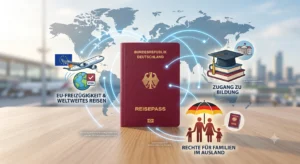
German nationality is not simply a travel document. It is a bundle of rights, each of which makes a concrete economic difference.
The five building blocks of economic value
1. Unrestricted access to the EU labour market
Anyone who holds German citizenship can work in all 27 EU member states – without a work permit, without residency restrictions, and without employer ties. This is not an abstract right. It means you can take up a job in Amsterdam, become self-employed in Vienna, or start a business in Lisbon without any authority having to approve it.
The figures show what this means in concrete terms. Eurostat data for 2024 show: the unemployment rate for non-EU citizens in Europe was 12.3 percent – almost two and a half times higher than that of EU nationals at 5.1 percent. The difference cannot be explained by qualifications alone. It has to do with access barriers: residence permits tied to a specific employer. Approval procedures that take months. And employers who do not hire individuals with uncertain residency status.
2. The salary increase from naturalisation
Various studies – including those by the Migration Policy Institute, the OECD, and the Dutch Central Bureau of Statistics – have examined the so-called „citizenship premium“: the difference in income that arises after naturalisation. The results vary depending on the country and methodology, but the direction is clear.
In the USA, salary increases are at least 5 percent immediately after naturalisation, rising to over 10 percent within ten years. In Germany, a study by the Center for American Progress estimates the salary bonus at around 15 percent. The gross median income in Germany in 2025 was around €54,000 annually. A 15 percent income advantage over a 30-year working life mathematically results in an additional lifetime earnings of around €243,000 – solely from the citizenship premium, without considering access to the EU-wide labour market.
3. Freedom of travel and mobility
The German passport ranked fourth globally in the Henley Passport Index 2026: 185 countries visa-free or with visa-on-arrival. For comparison, the Iraqi passport ranks 104th with 29 destinations. The Syrian passport is in last place with 26. For people who rely on international mobility for professional or family reasons, the difference is not cosmetic. It determines which business meetings are possible, which conferences can be attended, and which family visits can take place without months of advance planning.
4. Protection against deportation and security of residence
German nationals cannot be deported. Article 16(1) of the Basic Law prohibits expatriation, and Article 16(2) of the Basic Law protects against extradition, with narrowly defined exceptions. For individuals with a temporary residence permit, the situation is fundamentally different: a conviction, loss of employment, or a change in immigration policy can end their stay. Citizenship permanently excludes this risk.
5. Passing on to the next generation
German nationality can be passed on to children, regardless of their place of birth. A child born in Cape Town, Buenos Aires or Tel Aviv is a German national if one parent possesses German nationality. This multiplies the value: not only do you benefit yourself, but also your children and potentially their children.
What that means in total
The following table compares the legal status of a German national with that of a holder of a residence permit and a person without EU status:
| Criterion | German nationality | Residence permit (temporary) | No EU status |
|---|---|---|---|
| EU labour market | Unrestricted, 27 states | Only in the issuing state, often employer-related | No access |
| Protection from deportation | Absolute (Art. 16 GG) | No absolute protection; residence may end | No right of residence |
| Freedom of travel | 185 countries visa-free (2026) | Only with a valid title; heavily restricted outside Schengen | Severely restricted |
| Right to vote | Federal Parliament, State Parliament, Local Council, EU Parliament | No voting rights | No voting rights |
| Social benefits | Full access according to SGB | Partially, dependent on the purpose of stay | No claim |
| Passing on to children | Automatic by birth (§ 4 StAG) | No | No |
| Study abroad in the EU | For domestic conditions | In certain circumstances as a third-country national | International charges |
| Consular protection | Through each EU member state | Only through the home state | Only through the home state |
Every single line of this table has economic value. Taken together, this results in a lifetime benefit that — depending on the individual situation — can be far in excess of €500,000. For people who would have no legal access to the labour market in the EU without citizenship, the value easily reaches a seven-figure sum.
And the official price? The naturalisation fee in Germany is exactly €255 according to § 38 StAG.
The special case: Reparation and restitution
The question of the value of German citizenship takes on a special dimension when it is asked in connection with the restitution provisions of the Basic Law and the Nationality Act.
Article 116, paragraph 2 of the Basic Law grants an entitlement to re-naturalisation for persons who were deprived of German nationality between 30 January 1933 and 8 May 1945 for political, racial or religious reasons, as well as for their descendants. This right exists without a requirement to reside in Germany, without proof of language proficiency and without a naturalisation test. It is a constitutional right, not a matter of discretion.
Alongside this, since August 2021, § 15 of the Nationality Act (StAG) has opened up a possibility for naturalisation for descendants of those persecuted by the Nazis, who previously did not fall under Article 116 (2) of the Basic Law (GG) – for example, because the persecution did not lead to a formal deprivation of nationality, but to fleeing from naturalisation or to forced emigration before acquiring nationality.
Supplements § 5 StAG a temporary naturalisation opportunity for certain groups of people who were disadvantaged by historical discrimination in German nationality law – for example, children of German mothers born before 1975 who could not acquire citizenship because the law at the time only recognised the paternal line of descent. This regulation is limited until 19 August 2031.
These applicants are not concerned with an economic advantage. It is about the restoration of a status that was taken by state injustice. The fact that this status also has a measurable economic value does not make the claim commercial – it makes it more tangible.
The Maltese Paradox
The comparison with Malta is not cynical. It is illuminating. Malta's programme was based on a simple equation: money for passport. The ECJ has ruled that this equation is incompatible with the essence of EU citizenship. EU citizenship presupposes a genuine connection – residence, language, belonging.
However, the fact that wealthy investors were willing to pay up to €1.4 million for a Maltese passport says something about the value the market places on EU belonging. And the German passport – one of the strongest within the EU – is likely to be at least equivalent in this logic.
Except that it is not an object of purchase. But a legal status. And whoever has a claim to it — be it through Naturalisation, through Descent or through the compensation schemes – should know and take this claim seriously.
What you can do now
If you suspect you have a claim to German citizenship – be it through Article 116(2) of the Basic Law, § Section 15 StAG, § 5 StAG or another way – early consideration is worthwhile. Especially with temporary regulations like § 5 StAG, every year counts.
FAQs on German Nationality
Can you buy German citizenship?
No. German nationality is not a commodity. It can only be acquired according to legal requirements, for example through birth, descent, naturalisation, or special restitution regulations.
Why does German citizenship have economic value?
German citizenship, among other things, offers free access to the EU labour market, extensive freedom of travel, security of residence, consular protection, and the ability to pass on citizenship to children.
Which rights are associated with German citizenship?
German nationals can live, work and study in Germany and the European Union. Additionally, they enjoy protection from expulsion, political participation rights and consular protection.
Can descendants of German nationals have a claim?
Yes. Depending on family history, a claim may be possible through descent, Article 116(2) of the German Basic Law (GG), Section 15 of the Nationality Act (StAG), Section 5 of the Nationality Act (StAG), or other avenues under nationality law.
Articles 116 (2) of the German Basic Law, and Sections 15 and 5 of the Nationality Act are particularly important because they address the restoration of citizenship for those who were deprived of it for political, racial, or religious reasons between 1933 and 1945. These provisions aim to correct historical injustices and provide a legal basis for descendants of those affected to reclaim their German citizenship.
These regulations concern cases in which German citizenship was lost or could not be acquired due to historical injustice, Nazi persecution, or previous discriminatory gender-based regulations.
Is § 5 StAG permanently possible?
No. The acquisition of citizenship by declaration under Section 5 of the Nationality Act (StAG) is time-limited and, under current law, expires on 19 August 2031.