By Helmer Tieben, LL.M. (International Tax) - Cologne Bar Association (admitted to the bar in 2005) - specialising in immigration and nationality law Last updated: February 2026
Definition: German citizenship by descent (ius sanguinisDefinition: German citizenship by descent (Staatsangehörigkeit durch Abstammung) is the automatic acquisition of German nationality based on parentage under the principle of ius sanguinis. Under § 4 of the German Nationality Act (Staatsangehörigkeitsgesetz — StAG), if at least one parent was a German citizen at the time of a child's birth, that child acquires German citizenship by operation of law — regardless of birthplace.
Key takeaways
You may already be a German citizen, without knowing it. Nationality is automatically transferred from parent to child at birth.
Dual nationality has been permitted without restriction since 27 June 2024. It is not necessary to give up your previous nationality.
The chain may be interrupted. If an ancestor was naturalised in another country before the birth of their child, the chain of German citizenship ended at this point. The 2024 reform does not repair past losses.
There is a deadline. In the case of historical gender discrimination (German mother before 1975, unmarried German father before 1993), § 5 StAG allows acquisition by declaration - but only until 19 August 2031.
No language certificate. No residence in Germany required.
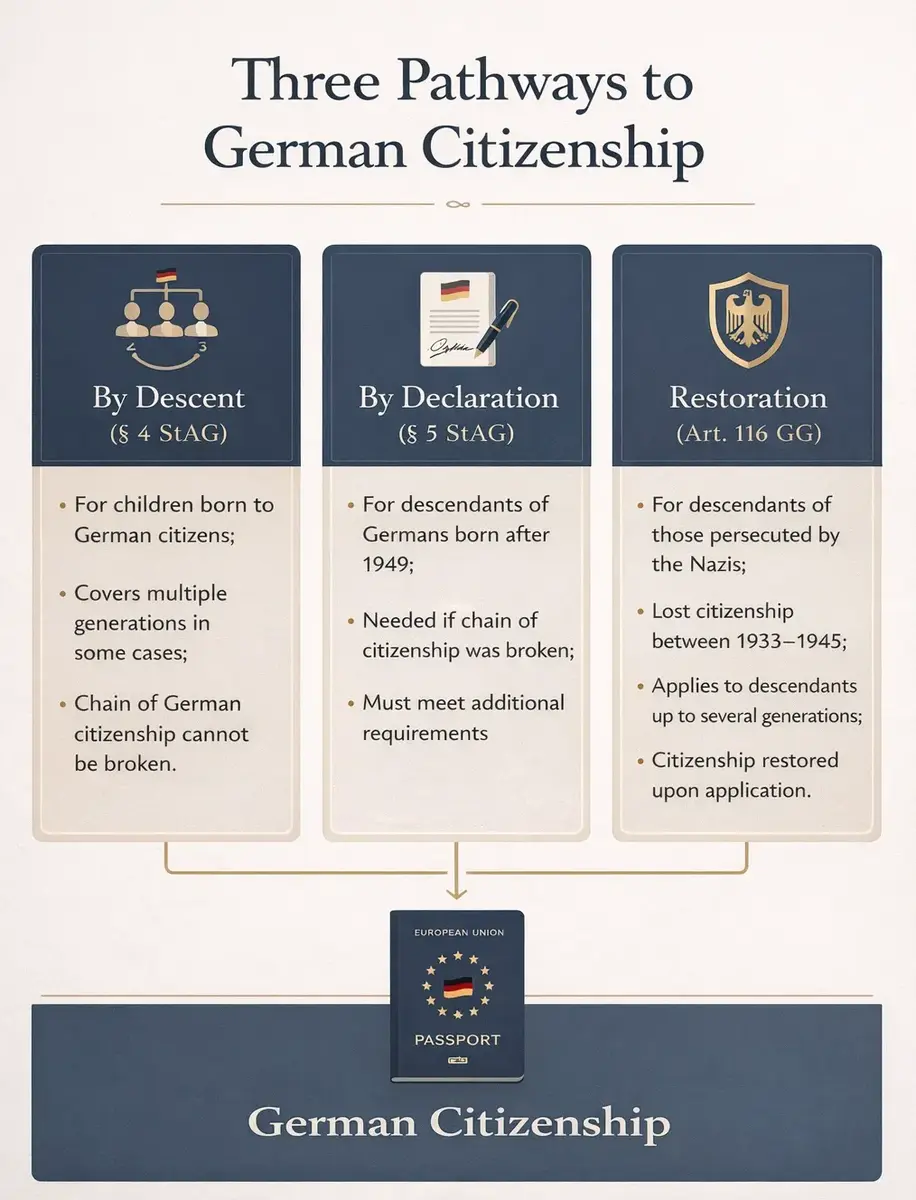
Paths to German citizenship - Eligibility overview
| Path | Who is authorised | Language / Residence | Deadline | Fee |
| Parentage (§ 4 StAG) | Child of a German parent (chain intact) | No requirements | None | 51 € |
| Declaration (§ 5 StAG) | Persons affected by gender discrimination + descendants | No requirements | 19.08.2031 | 51 € |
| Reparation (Art. 116 GG) | NS persecutees + descendants | No requirements | None | Free of charge |
| Naturalisation (§ 10 StAG) | Foreigners with residence in Germany | B1 German, 5 years residence | None | 255 € |
Every year, thousands of Americans, Canadians, Australians, South Africans, and citizens of other countries discover that they may hold German citizenship through their parents, grandparents, or even great-grandparents. Often the realisation begins with a document — a grandmother's birth certificate, an old passport, a letter from a consulate. Sometimes it begins with a question from a relative who has already been through the process.
The legal answer depends on a chain of documented facts: dates of birth, dates of marriage, the sex of ther German ancestors and the question of whether a legal event has broken the chain. The rules have changed repeatedly over the last century. They are not intuitive. But they are precise and can be analysed with a high degree of certainty as soon as the relevant data is available.
Specific question? I advise nationwide and internationally - 0221 - 80187670 or info@mth-partner.de.
Quick eligibility check
Four questions for an initial assessment:
- Can you identify at least one ancestor who was born in Germany or had German citizenship? If your only link is a DNA test, parentage is probably not an option. Nationality is a legal status, not a genetic finding.
- Can you trace an unbroken parent-child line from this ancestor to you? Each person in the chain must be the child of the previous one. Marriage alone does not confer citizenship.
- Has anyone in this lineage been naturalised in another country before the birth of their child? If so, the chain is probably broken at this point. That is the crucial question. The date of naturalisation relative to the date of birth of the next generation determines everything.
- Is the German ancestor a mother (if born before 1975) or an illegitimate father (if born before 1993)? Special rules then apply - § 5 StAG can open up a path.
If your answers are: „yes, yes, no, not applicable“ - then you are most likely already a German citizen. The procedure serves to document an existing legal status.
The core principle: Ius sanguinis
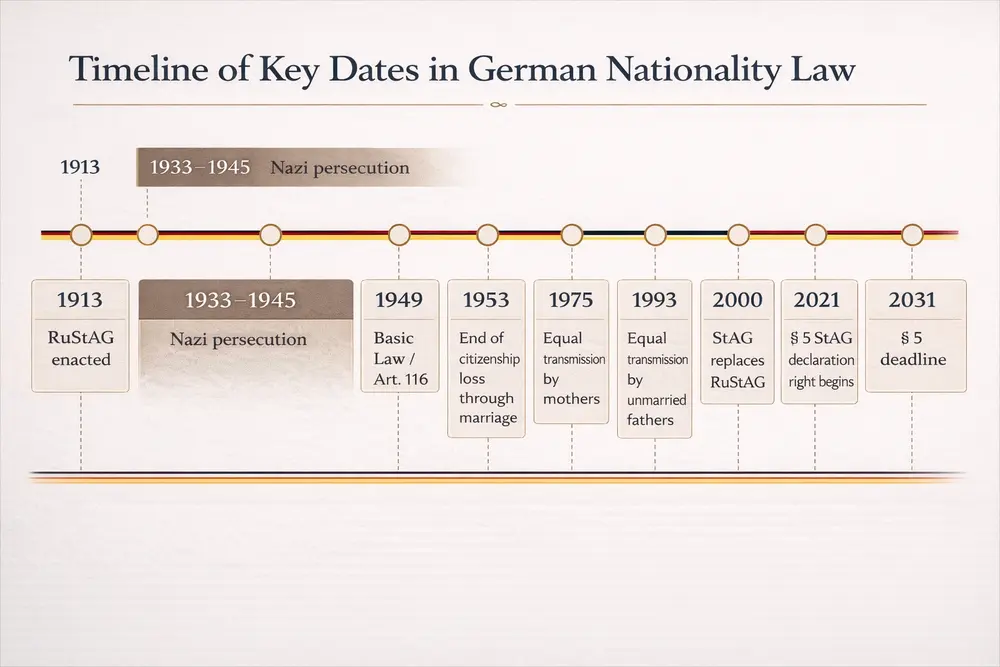
German citizenship law is based on descent, not on the place of birth. A child of a German citizen acquires German citizenship at birth, automatically, by law - whether in Berlin, Boston, São Paulo or Sydney. No application required. No residence in Germany. This principle has applied since Reich and Nationality Act (RuStAG) of 1913 and continues to exist under the current StAG.
The question is therefore always: Was at least one parent a German citizen at the time of your birth? And if that is unsafe: Was your parent the child of a German citizen at the time of birth? The chain is followed backwards, generation after generation, until an ancestor is reached whose nationality is established.
The determination of German citizenship by descent is not an „application.“ If the chain is intact, you already have German citizenship. The administrative procedure - the Determination of German citizenship - serves as proof of an existing legal status. The standard of proof of the Federal Office of Administration (BVA): probability bordering on certainty.
The 2024 reform: dual citizenship now permitted
Until 27 June 2024, the following applied: anyone who voluntarily acquired a foreign nationality automatically lost their German citizenship - provided no Retention authorisation was available. Many emigrants and their descendants were affected without realising it.
The Nationality Modernisation Act (StARModG), in force since 27 June 2024, has lifted this restriction (see Federal Foreign Office: The new citizenship law). Germany now allows multiple nationality without restriction.
The reform does not apply retroactively. This is the most important restriction. If an ancestor was naturalised before 27 June 2024, the resulting loss of German citizenship remains in place. The reform protects future acquisitions of foreign citizenship. It does not reverse past losses. Whether the chain has been retained in your family depends solely on the naturalisation and birth dates in each generation - a question of fact that must be answered on the basis of documents.
Who qualifies: The generational analysis
Parent was German - birth after 01.01.1975
Anyone who was born on or after 1 January 1975 and had at least one German parent automatically acquired citizenship - regardless of the parents' marital status and the gender of the German parent.
Required documents: Proof of the parent's nationality (birth certificate, passport or own chain of descent) and own birth certificate.
My client Mrs S. was born on 10 May 1988 in São Paulo, Brazil. Her father was a German citizen. Her parents were not married. Since Mrs S. was born after the 01.01.1975 and one of her parents was German, she automatically acquired German citizenship at birth - regardless of her parents' marital status. She had her own birth certificate + proof of her father's German citizenship (passport) as proof. No naturalisation was required here - she had been German since birth.
Birth before 1 January 1975 - Gender discrimination
Before 1975, German law treated the nationality of mother and father differently:
With marital birth between 01.01.1914 and 31.12.1974: Only the father's nationality was passed on. A German mother who was married to a foreign father could not pass on her nationality to the child. This rule applied during the first twenty-five years of the Federal Republic of Germany and is the most common reason for broken chains in American and Canadian families.
With illegitimate birth Before 1 July 1993: Only the mother could confer citizenship. A German father who was not married to the mother could not, in principle, do so unless the child was legitimised under the conditions of the applicable law.
These rules are now recognised as discriminatory. The antidote: § 5 StAG - Acquisition by declaration.
Nationality via grandparents
There is no independent „grandparent route“. Citizenship „via grandparents“ means that the chain has remained intact generation after generation - from grandparent to parent to child, with each link being checked independently.
If your German grandparent passed on citizenship to your parent and your parent was still German at the time of your birth, you have German citizenship. If the chain was interrupted at any point - most frequently by naturalisation of an ancestor - the grandparent connection alone is not sufficient. German law does not allow you to skip a generation.
My client, Mr T., was born in 1968 in Boise, Idaho (USA). His mother was a German citizen and his father was US-American. His parents were married.
According to the legal situation at the time, only the father could pass on German citizenship in the case of marital birth. The German mother was excluded from passing it on. Mr T. therefore did not acquire German citizenship at birth - solely because of this gender-related disadvantage.
I prepared a declaration for Mr T. in accordance with § 5 StAG and submitted it to the Federal Office of Administration in Cologne. After examination by the competent citizenship authority, the acquisition was confirmed.
Mr T. is now a German citizen - not through naturalisation, but through the statutory compensation for earlier discrimination.
Nationality via great-grandparents
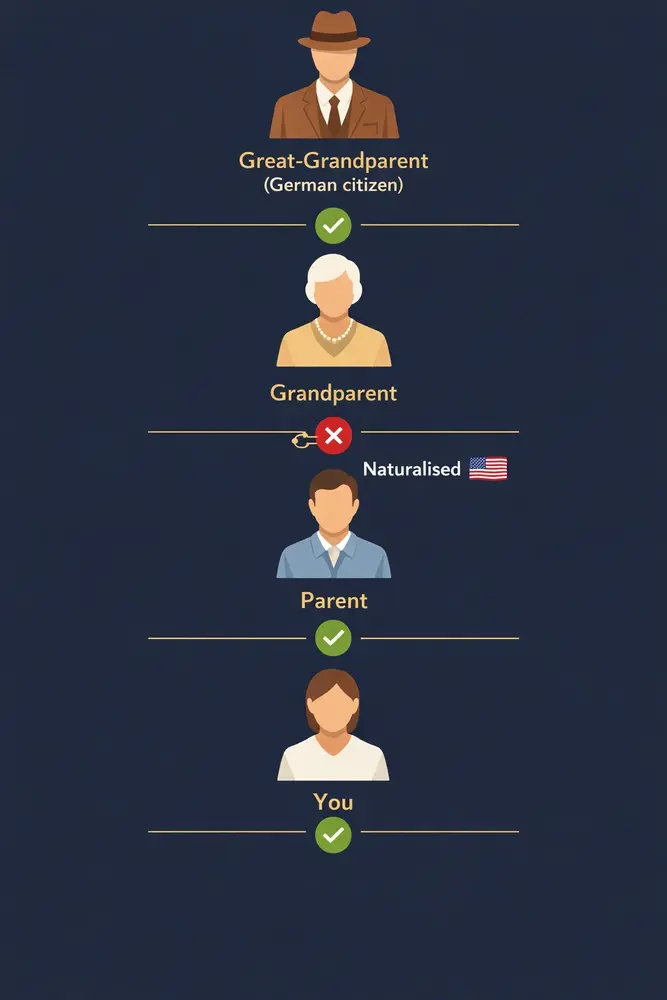
The same chain analysis, but the difficulty increases with each generation. Cases with great-grandparents require careful historical reconstruction. Decisive variables: Did the great-grandparent still have German citizenship when the grandparent was born? Did they naturalise abroad beforehand? Did the emigration take place before 1914, and do the automatic loss provisions of § 21 RuStAG apply?
These cases are often misjudged by applicants when they rely solely on genealogical records without understanding the legal implications of certain dates. The difference between a promising claim and no claim can depend on the precise sequence of a naturalisation certificate and a birth certificate - sometimes by weeks.
Emigration before 1914
21 of the Reich and Nationality Act (RuStAG) of 1913 stipulated that Germans who lived abroad for more than ten years without registering with a German consulate could automatically lose their citizenship. This provision concerned the great wave of emigration to America, South Africa and Australasia in the late 19th and early 20th centuries.
Whether § 21 RuStAG actually applied in individual cases depends on the exact date of emigration, consular registration and any naturalisation in the destination country. These cases require archival research - registry office documents, church records, passenger lists, consular archives and naturalisation files - often in several countries. The quality of German administrative documentation from this period is generally excellent, but locating the relevant archives can take considerable time.
§ Section 5 StAG - Acquisition by declaration
If the chain of descent has been interrupted solely because of the gender-related rules described above, then § 5 StAG an antidote. Affected persons and their descendants can German citizenship by declaration to the competent authority. No language test, no residence in Germany, no naturalisation test.
The four case groups (all require birth after 23 May 1949):
- Child of a German parent who did not acquire citizenship at birth due to discriminatory rules
- Person whose German mother lost her citizenship through marriage to a foreigner before 1 April 1953
- Person who lost German citizenship by legitimisation before 01.04.1953
- Descendants of persons from groups 1 to 3
Deadline: 19 August 2031. The declaration must be submitted to the competent authority by this date. received not just sent off. Obtaining documents from German and foreign archives routinely takes 12 to 18 months. It is advisable to start no later than 2028. Details on the case groups and the procedure in my detailed article on § 5 StAG.
My client, Mrs R., was born in 1972 in Asunción, Paraguay. Her mother was a German national, but had married a Paraguayan national before her birth. According to the legal situation at the time, the mother could not pass on her German nationality in the event of a marital birth.
The chain of descent was interrupted solely because of this gender-related regulation.
I prepared a declaration for Mrs R. in accordance with § 5 StAG and submitted it to the competent authority. Language skills, residence in Germany or a naturalisation test were not required.
The acquisition was confirmed following an official review.
Mrs R. is now a German citizen - her children are also entitled to make declarations as descendants.
The decisive factor was that the declaration was received on time. The statutory exclusion period ends on 19 August 2031.
Article 116(2) of the Basic Law - Restoration for Nazi persecution
Article 116 (2) of the Basic Law grants former German citizens who were deprived of their citizenship between 30 January 1933 and 8 May 1945 for political, racial or religious reasons, as well as their descendants, a constitutional right to re-naturalisation. No deadline, no language certificate, no fee, multiple nationality permitted.
Since 20 August 2021, the scope of application has been extended by administrative regulations to persons who left Germany due to persecution and subsequently lost their citizenship by other means - for example through naturalisation in the country of refuge.
The Federal Office of Administration (BVA) treats these applications with special institutional commitment. Article 116 of the Basic Law is not a discretionary act - it is a constitutional right, and the BVA's practice reflects this.
German citizenship through marriage
Marriage to a German citizen does not confer German citizenship. There is no marital path to citizenship by descent.
Marriage is legally relevant in two constellations. Firstly: Before 1 April 1953, a foreign woman could acquire citizenship by marrying a German - conversely, a German woman could lose it. Today, these historical rules justify claims under § 5 StAG.
Secondly: Foreign spouses of German nationals with residence in Germany after five years of residence (including at least two years of marriage) naturalise. This is naturalisation on the basis of residence, not acquisition by descent. It requires residence, proof of B1 language proficiency and economic capacity.
When legal representation is advisable
Step 1: Preliminary legal review
Before obtaining the deed, clarify which legal recourse is possible and whether the chain is likely to be intact. The decisive dates: Birth, marriage and, if applicable, naturalisation of each person in the chain. A preliminary check can save months of unnecessary document procurement.
Step 2: Obtaining documents
Typical documents for a determination: Birth certificates of all persons in the chain, marriage certificates, naturalisation documents or proof that no naturalisation took place, German identity documents of the ancestor, if applicable, registry office extracts, emigration documents, consular registration documents.
Country-specific sources: USA - USCIS and National Archives; Canada - Library and Archives Canada; Australia - National Archives of Australia; South Africa - Department of Home Affairs; Israel - Ministry of the Interior.
Registry offices and Registry office I in Berlin issue historical documents. Processing times: Weeks to many months. Start early.
Step 3: Application
Residence abroad: Responsible is the Federal Office of Administration (BVA) in Cologne. Submission via the German diplomatic mission abroad or directly by post.
Residence in Germany: Local citizenship authority. Application form: Application for determination of German citizenship (Form V).
Step 4: Processing and queries
Processing times at the BVA: 12 to 36 months. The BVA makes regular enquiries. Prompt responses - ideally within two to three weeks - will shorten the overall processing time. Submitting a complete application right from the start is the most effective way to avoid delays.
Step 5: Nationality card
If the decision is favourable: Nationality card. This means that a German passport can be applied for at any diplomatic mission abroad.
Requirements and costs
| Posts | Detail |
| Language certificate | Not required (determination and § 5 StAG) |
| Residence | Not required |
| Naturalisation test | Not required |
| Dual nationality | Unrestricted since 27/06/2024 |
| Fee - determination | 51 € per person |
| Fee - § 5 StAG | Free of charge |
| Fee - Art. 116 GG | 51 € per declaration |
| Processing time | 12-36 months (BVA) |
| Standard of proof | Sufficient probability |
When legal representation makes sense
Legal representation is not mandatory. The BVA accepts applications from private individuals. Simple cases - German parent, birth after 1975, clear documentation - often do not require a lawyer.
However, professional analysis is urgently recommended in three constellations. Firstly, in § 5 StAG cases, because the correct allocation to one of the four case groups requires a precise legal assessment. Secondly, in the case of emigration before 1914, because the interplay of § 21 RuStAG, consular registration rules and foreign naturalisation law requires a historical legal analysis. Thirdly, in the case of objections from the BVA or documents that are difficult to obtain.
A specialist lawyer for citizenship law can assess the prospects of success before the start of the document procurement, which Legal justification for complex applications and handle all correspondence with the BVA.
I offer a structured initial assessment by e-mail or telephone. In most cases, a 30-minute conversation is enough to clarify whether there is a viable path and which steps make sense. You will then receive a clear assessment of the prospects of success, time frame and required documents.
Country-specific notes
United States
Americans represent the largest group seeking German citizenship by descent. US naturalisation records are available from USCIS (post-1906) and the National Archives (pre-1906). The US fully permits dual citizenship. German consulates in New York, Los Angeles, Chicago, Houston, Atlanta, San Francisco, Miami, and Boston accept document submissions. See also the German Embassy's citizenship page.
Canada
Naturalisation records are available from Library and Archives Canada. Canada permits dual citizenship. German consulates in Toronto, Vancouver, and Montreal handle citizenship matters.
Australia
Australia has permitted dual citizenship since 2002. The German consulate in Sydney and the embassy in Canberra process applications.
South Africa
South Africa permits dual citizenship in certain circumstances, but South African citizens may need to apply for retention of their nationality before acquiring a foreign one. The German embassy in Pretoria handles applications.
Israel
For applicants of Jewish heritage, Article 116(2) is typically the primary pathway. Israel permits dual citizenship. The German embassy in Tel Aviv processes applications.
Argentina and Brazil
Both countries have significant German-descent communities - particularly in southern Brazil (Rio Grande do Sul, Santa Catarina) and in several Argentine provinces. Both permit dual citizenship. The German embassies in Buenos Aires and Brasília, as well as consulates in São Paulo and Porto Alegre, accept submissions. Documents in Portuguese or Spanish require certified translation into German.
Common errors
Confuse descent with nationality. A German surname, a family tree or a DNA result do not establish citizenship. Citizenship is a legal status with specific requirements based on specific data.
Do not check naturalisation data. Whether an ancestor naturalised before or after the birth of the next person in the chain determines whether citizenship was passed on. A difference of weeks can be decisive.
Submit incomplete applications. The BVA does not process partial applications. Submit once, submit in full.
- Ignore the 5 StAG deadline. 19 August 2031. obtaining deeds routinely takes 12 to 18 months. Start in good time.
Believe family stories without documentary verification. Oral traditions are a starting point. They sometimes confuse German ethnicity or language with German citizenship in the legal sense.
Frequently asked questions
Can I acquire citizenship through grandparents?
Yes, if the chain from grandparent to parent to you has never been broken. There is no „grandparent route“ - citizenship is transferred individually in each generation.
Can I acquire citizenship through great-grandparents?
Basically yes. More links mean more interruptions and greater complexity - especially in the case of emigration before 1914 or gender discrimination before 1975.
What requirements apply?
For descent according to § 4 StAG: documentary proof of each link and the nationality of the ancestor. No language test, no residence. For § 5 StAG: additional proof of the case group, declaration before 19 August 2031.
Citizenship with Jewish ancestry?
Yes, the regular chain analysis applies. In addition, Article 116(2) of the Basic Law grants Nazi persecutees and their descendants a constitutional right. No deadline, no fee. Since 2021 extended to persons who fled persecution and subsequently lost their citizenship through naturalisation.
Is dual nationality permitted?
Yes, since 27 June 2024 without restriction. The laws of your other home country also apply.
How long does the procedure take?
12 to 36 months at the BVA. Depending on complexity, completeness and speed of response to queries.
Do I have to speak German?
No. Language requirements only apply to naturalisation (§ 10 StAG), not to determination or § 5 StAG.
What does it cost?
51 € for determination, 51 € for § 5 StAG. Art. 116: free of charge. Additional costs may be incurred for obtaining documents, certified translations, apostilles and legal fees.
Which form do I need?
Application for determination of German citizenship (Form V), available from the BVA and at German missions abroad.
What happens after obtaining citizenship?
Applying for a German passport. This grants freedom of movement, residence and labour rights in all 27 EU member states, the EEA states and Switzerland. Citizenship can be passed on to children.