
Are you thinking about renting out your flat to tourists via Airbnb or Booking.com – or are you already doing it? Then this article is for you. Because Cologne has had strict rules in place for several years now, which many landlords are unaware of. Anyone who rents without permission risks a fine of up to €50,000. – per dwelling.
This article is for general information purposes only and does not constitute individual legal advice. Every situation is different. If you are unsure whether your rental property is covered by the Housing Protection Ordinance, or if you have already received an official enquiry, please consult a solicitor specialising in tenancy law.
The situation in Cologne: Why the legislature took action
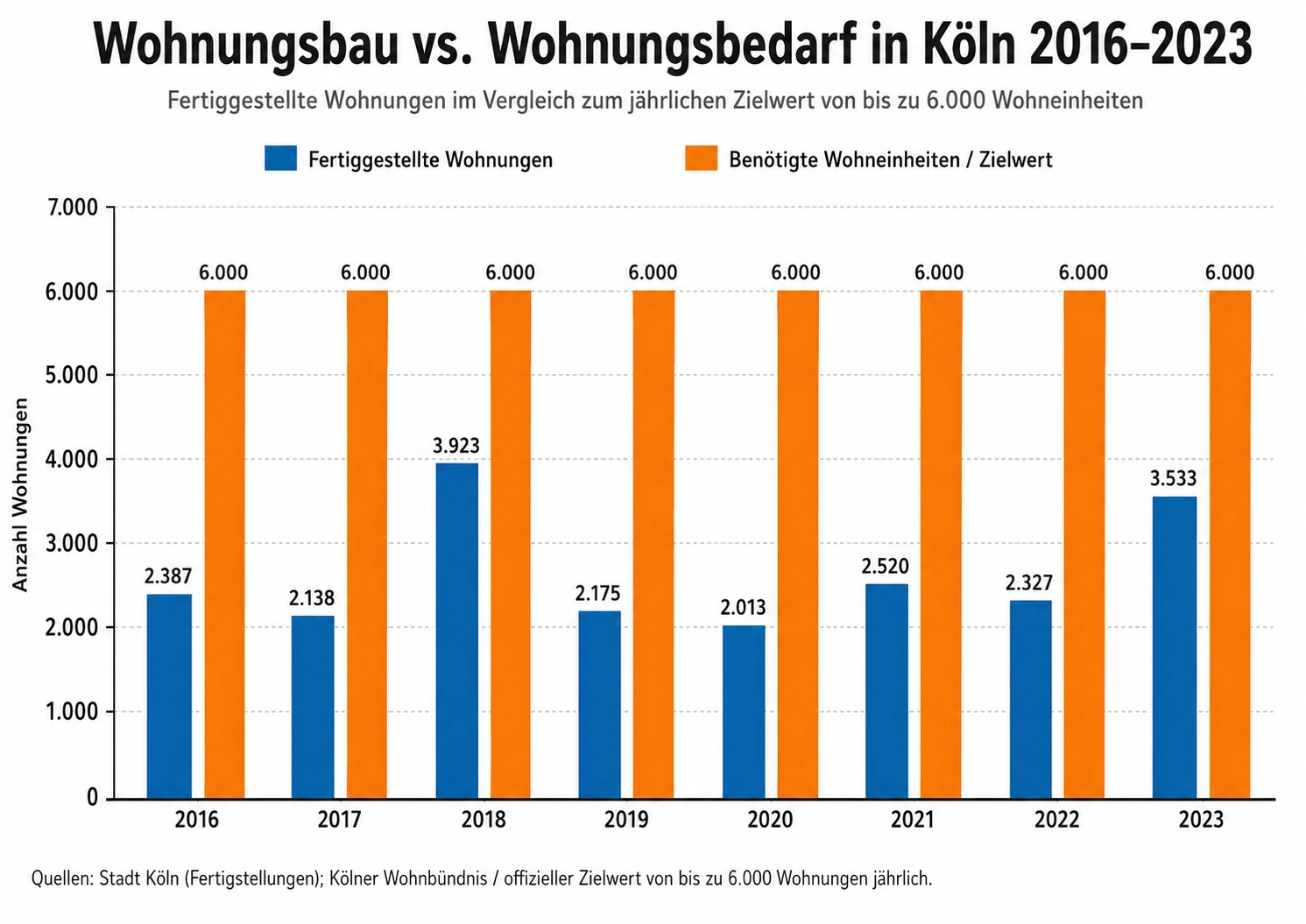
Cologne is growing. But the housing market isn’t keeping pace. For years, the number of new homes completed has been well below actual demand – a structural problem that is reflected in rising rents and long waiting lists for affordable housing.
At the same time, a lucrative business model has taken hold: flats are no longer let on a long-term basis, but exclusively for short stays – two days for trade fair visitors, a week for city breakers. Platforms such as Airbnb, Booking.com and Fewo-direkt have significantly expanded this market in many parts of Cologne, particularly in the city centre, the Südstadt and Deutz.
The result is that housing that would otherwise be needed on a long-term basis for tenant households is no longer available on the open market. It is estimated that around 7,000 rental properties are regularly let to tourists and business travellers in Cologne – although the actual figure is probably higher.
The legislature – initially at local authority level, and later at regional level as well – has responded to this. The result is a multi-tiered framework of regulations comprising regional legislation and local authority by-laws, which imposes specific obligations on landlords.
The legal basis: the North Rhine-Westphalia Housing Act (WohnStG NRW) and the Housing Protection By-law
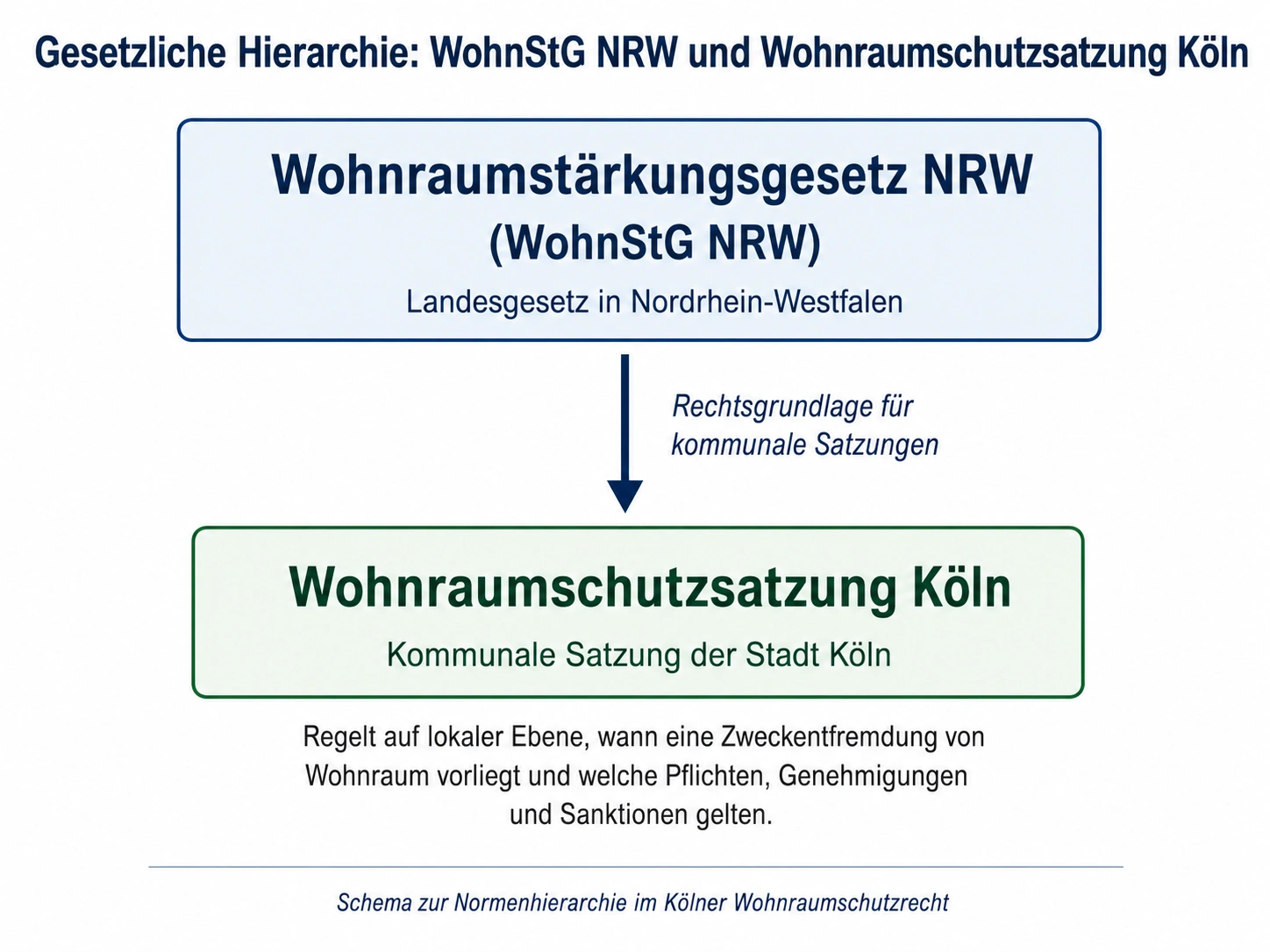
The legal framework for protecting housing from being used for purposes other than residential use in Cologne operates on two levels. At state level, the following has been in force since 1 July 2021: Act to Strengthen the Housing Sector in North Rhine-Westphalia (Housing Strengthening Act – WohnStG NRW). It replaced the previous Housing Supervision Act of North Rhine-Westphalia and introduced additional measures to effectively prevent the misuse of housing.
At local level, the City of Cologne has, on this basis, Statutes on the Protection and Preservation of Housing (Housing Protection Ordinance) was adopted on 30 June 2021 and also came into force on 1 July 2021. In its current version, this ordinance remains in force until 30 June 2026 valid.
Together, these two sets of regulations define what constitutes misuse, what obligations landlords have, and what penalties apply in the event of breaches. Note: At the time of publication, no final decision had yet been made as to whether the by-laws would be extended, revised or replaced by a new version after 30 June 2026. Landlords should keep an eye on announcements from the City of Cologne.
Tenancy law – An overview of our services
What is the misuse of residential property? The legal definition
Misuse means that residential property is used for purposes other than residential ones. That sounds simple, but it is broader in scope than many people realise.
Under Section 7 of the Housing Protection Ordinance, read in conjunction with Section 12(2) of the Housing Act of North Rhine-Westphalia, a property is deemed to be used for a purpose other than that for which it was intended, in particular where:
- More than half of the living space used for professional or commercial purposes – for example, someone who completely converts their entire living room into an office and rents it out crosses this boundary.
- Living space more than 90 days per calendar year (equivalent to more than three consecutive months) for short-term rentals – in which case a licence is required.
- Housing removed is – for example through demolition or structural conversion.
- Residential space converted for a different purpose or is converted without permission.
- Living space has been vacant for more than three months – Vacancy is also considered a misuse of the property and must be reported.
Particularly relevant for short-term tourist rentals: renting out a property as a holiday let, guest room or for short-term stays is expressly considered a misuse of the property – regardless of whether this is done on a commercial or private basis (Section 12(3) of the Residential Use Act of North Rhine-Westphalia).
The 90-day limit and the registration requirement
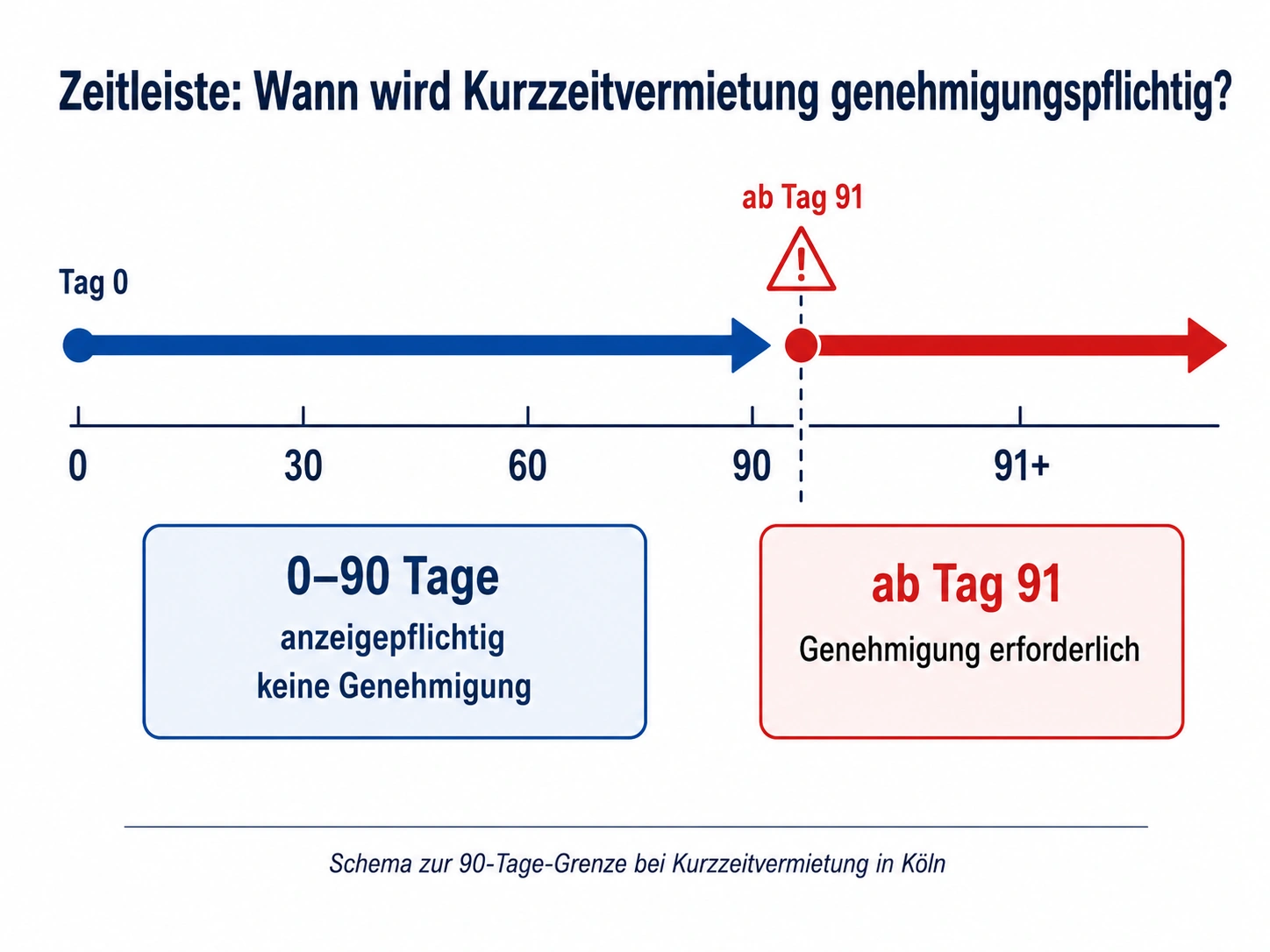
This is the crux of the matter for many landlords. Short-term rentals are not generally prohibited in Cologne – but they are always subject to notification and, after a certain period of time, also subject to authorisation.
Here’s how the scheme works:
| Duration of the short-term rental | Duties |
|---|---|
| Up to 90 days per calendar year | Subject to notification (residential property identification number required); no separate permit required |
| More than 90 days per calendar year | Subject to notification AND subject to authorisation – authorisation must be applied for before work commences |
| Vacancies from 3 months | Reportable to the Housing Office |
| Not a residential property (e.g. a holiday home) | The articles of association do not apply – but a change of use under planning law may be required (see below) |
Since the 1 July 2022 There is also a registration requirement: anyone wishing to let out accommodation in Cologne on a short-term basis must first obtain a Property ID (Housing ID), which must be applied for from the City of Cologne’s Housing Office. Without this number, any short-term let – even those lasting less than 90 days – is not permitted. Platforms such as Airbnb require this number to be included in every listing.
The process for applying for a housing ID is handled via a nationwide online portal. A separate number is required for each individual flat.
Go to the website of the Office for Housing Department of the City of Cologne
Which flats are protected under the articles of association?
The Housing Protection Ordinance does not apply to every building. Under section 4(1) of the Ordinance, protection is afforded to residential properties that are objectively and subjectively suitable and intended for residential use – and that were being used as residential accommodation at the time the Ordinance came into force or thereafter.
The following are not covered by the Articles of Association:
- Housing that had been used continuously for other purposes prior to the entry into force of the Housing Protection Ordinance (Section 5(6) of the Housing Protection Ordinance) – in such cases, the constitutional protection of existing rights under Article 14 of the Basic Law applies.
- Flats occupied by the owner.
- Granny flats (self-contained residential units within an owner-occupied building).
- Commercial accommodation establishments that were not approved as residential accommodation from the outset.
Whether grandfathering can be invoked in a particular case depends on the specific circumstances – in particular, on when the change of use actually took place and whether it has continued uninterrupted. There is no one-size-fits-all answer to this question.
Approval: When is it granted?
Anyone wishing to rent out more than 90 days per year must apply for a permit from the housing authority. A permit can be granted after Section 8 of the Housing Protection Ordinance shall be granted if:
- there are overriding public interests that justify the change of use, or
- the applicant’s private interests that are particularly worthy of protection take precedence – for example, financial or professional necessities that are clearly demonstrated, or
- sufficient alternative accommodation is provided on market terms (based on the local comparative rent).
Approval is the exception, not the rule. The office assesses each case on its own merits. Anyone submitting an application should provide a detailed and precise justification – incomplete applications significantly prolong the process.
Fines and regulatory enforcement
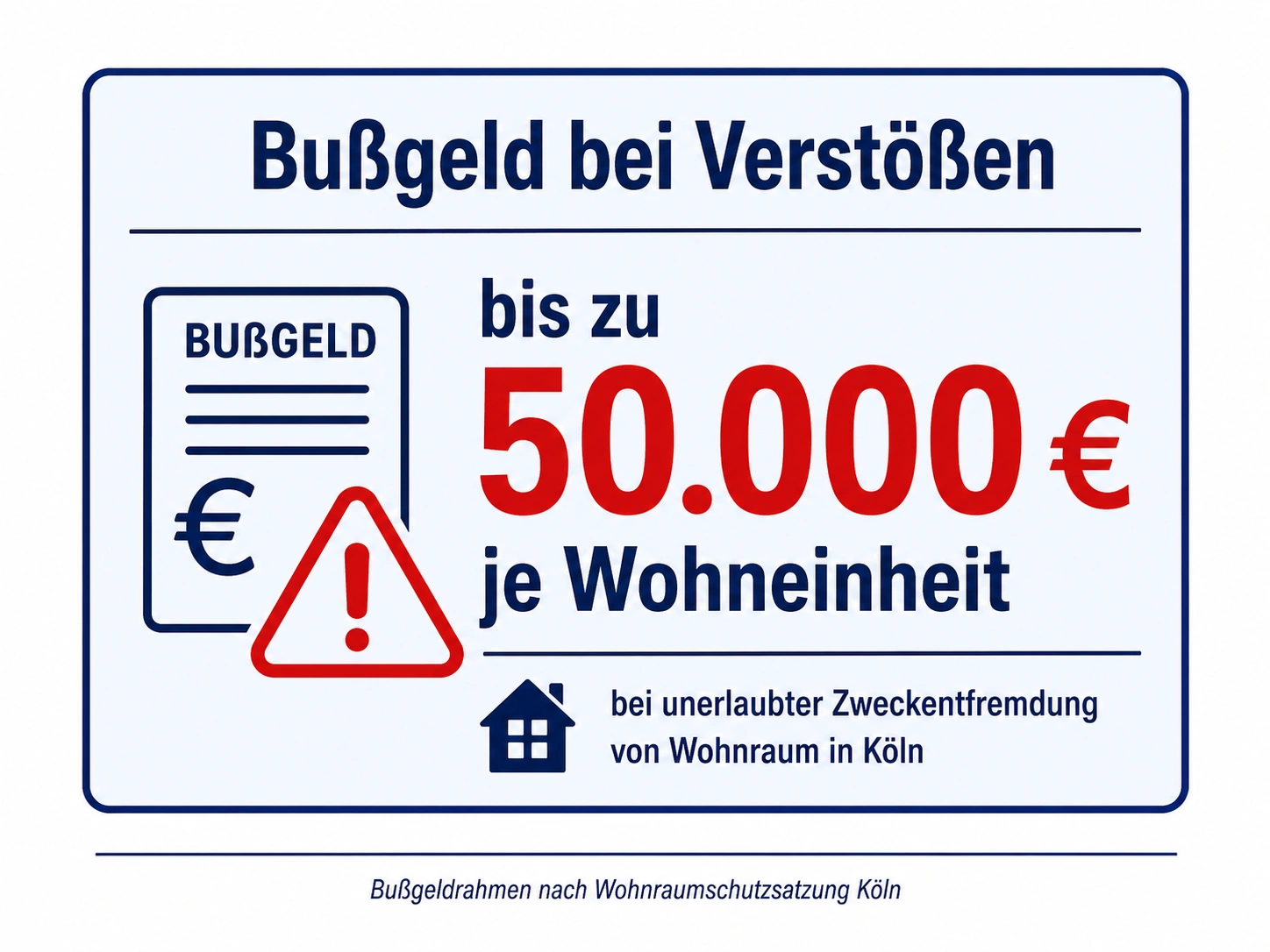
Breaches of the Housing Protection By-laws may result in a A fine of up to 50,000 euros be fined per residential unit. In addition, the authorities may issue an official order requiring the property to be returned to residential use.
The City of Cologne has significantly stepped up enforcement in recent years. In the second half of 2022, the Housing Authority initiated recovery proceedings for 441 residential units – 306 of these were due to short-term lettings alone, with a further 115 due to the properties standing vacant. The number of unreported cases is likely to be considerably higher.
In a ruling dated 13 June 2024, the Cologne Administrative Court upheld the legality of a municipal administrative order: two flats in Cologne’s old town, which had been regularly let out via Airbnb and Booking.com, were required to be returned to permanent residential use. The court deemed this to constitute an unlawful change of use in practice – regardless of the operator’s personal circumstances.
Tenancy law: Eviction proceedings – When is it permitted?
Non-competition clauses and the obligation to maintain business operations in commercial tenancy law
Change of use under planning law: a frequently overlooked issue
In addition to the Housing Protection Ordinance, there is another area of law that many landlords overlook: building law.
Anyone who operates a flat as tourist accommodation on a permanent basis is, under building regulations, changing from a Residential use into a Accommodation use. This usually requires planning permission for a change of use.
Residential use and accommodation differ legally in several respects:
| Criterion | Residential use | Accommodation |
|---|---|---|
| Length of stay | Long-term | Short intervals, temporary |
| Privacy | Full control over the budget | Less privacy, as is typical in hotels |
| Room size/amenities | Fully equipped, suitable for residential use | Often a smaller, simplified standard |
| Payment methods | Monthly rent | Per night/week, often platform |
| approval | Originally applied for and approved | A separate planning application is required |
If accommodation is being provided even though only residential use was authorised, a Application for a change of use submitted to the relevant building authority. Otherwise, the building control authority may issue an administrative order and prohibit its use.
The distinction is not always clear-cut. The overall circumstances are key: how many days a year is the property let out? Is the flat primarily furnished as private accommodation or specifically equipped for tourist use? Is a cleaning service provided? The more tourist-oriented the establishment, the more likely it is to be classified as accommodation under planning law.
What should you do if you are accused of misappropriation?
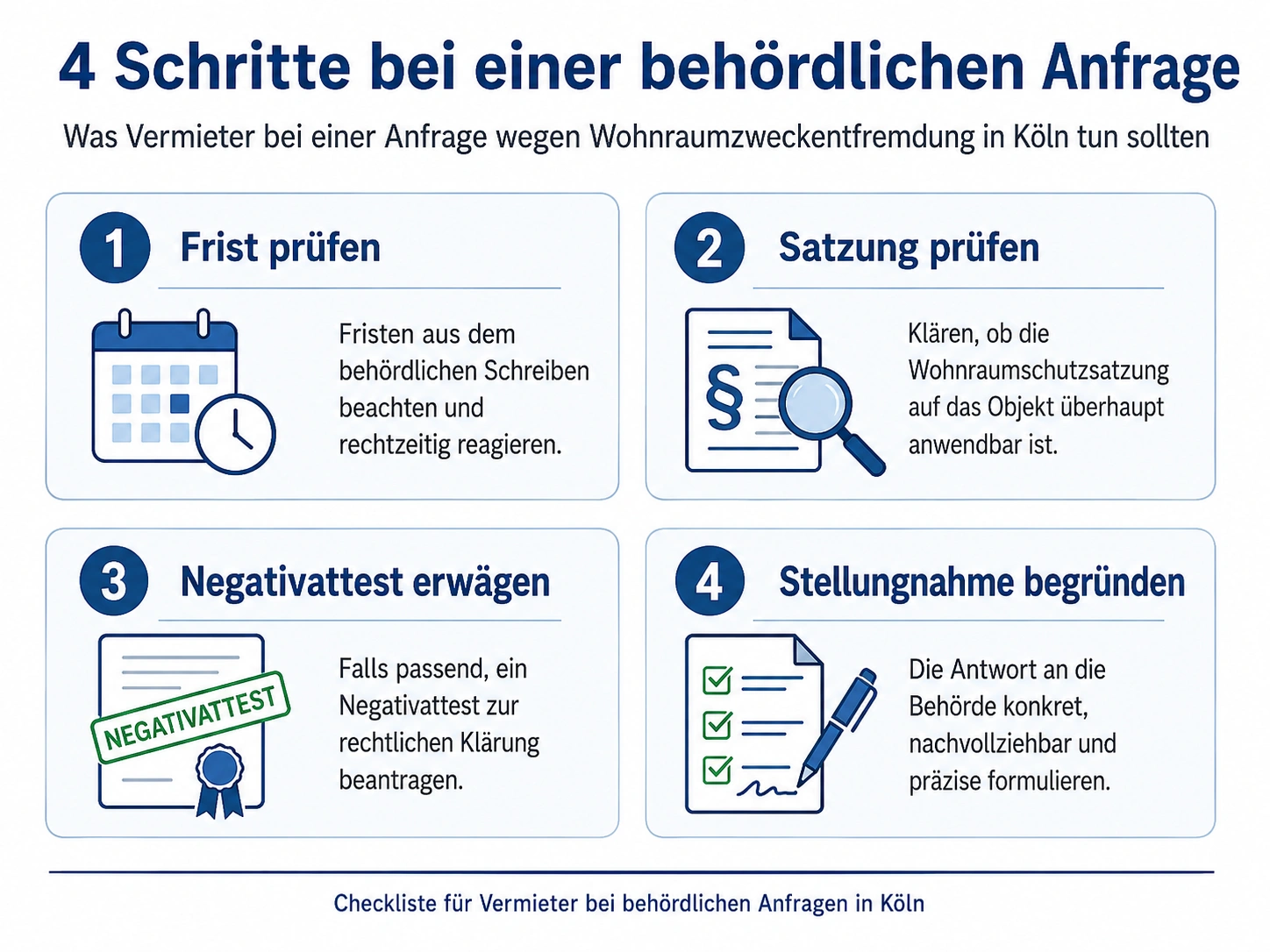
If you have received a request, a hearing notice or an administrative order from the City of Cologne regarding misuse of premises, you must respond – and do so in good time.
These steps are usually a good idea:
- Check and observe the deadline. Official correspondence usually sets deadlines for submitting comments. Anyone who misses these deadlines often forfeits important procedural rights.
- Check the applicability of the Articles of Association. Not every flat is covered by the Housing Protection Ordinance. Was the property used for a different purpose continuously before the Ordinance came into force? Does Section 5(6) of the Housing Protection Ordinance (grandfathering clause) apply?
- Apply for a negative test certificate. Anyone requiring planning certainty can apply to the City of Cologne for a negative certificate under Section 12 of the Housing Protection Ordinance. This certifies that no permission is required for the change of use of the property in question.
- Provide a clear justification for your position. General letters do not convince the authorities. Explain specifically why your situation is exempt from the regulations – or why special circumstances justify granting permission.
In many cases, it is advisable to seek legal advice at an early stage. Anyone who responds on their own without understanding the legal situation may inadvertently make statements that complicate the proceedings.
Solicitor Helmer Tieben advises and represents landlords and property owners in Cologne on matters relating to the Housing Protection Ordinance and tenancy law. Please feel free to give us a call: 0221 – 80187670.
Furniture left behind: When does partial eviction constitute an unlawful act??
Frequently asked questions (FAQ)
Am I actually allowed to rent out my flat in Cologne via Airbnb?
Yes – but only under certain conditions. Short-term lettings of up to 90 days per calendar year do not require a licence, but must always be reported. Since 1 July 2022, you have also needed a property identification number, which you can apply for from the Housing Authority. Without this number, any short-term letting is prohibited, even if it is under the 90-day limit.
What happens if I exceed the 90-day limit?
In that case, the letting will require a licence. This means that you must apply in advance for a licence to change the use of the property. If you let the property without a licence, you will be committing an administrative offence. The fine is up to 50,000 euros per residential unit.
My flat had already been vacant before 2014 – do the rules still apply?
Not automatically. If your residential property was already being used continuously for other purposes before the by-law came into force, the grandfathering provision under Section 5(6) of the Residential Property Protection By-law, in conjunction with Article 14 of the German Basic Law, applies. Whether this applies to your specific case depends on the exact circumstances – you should seek legal advice on this.
What is a negative test result, and when do I need one?
A negative certificate under Section 12 of the Housing Protection Ordinance confirms that no permission is required for the change of use of your property. It provides you with planning certainty – for example, if you wish to use the property permanently for tourist or commercial purposes and want to ensure that this is legally permissible.
Do I need to take building regulations into account as well as the Housing Protection Ordinance?
Yes. Anyone who runs a flat as a long-term tourist accommodation changes its use from residential to accommodation under planning law. This usually requires planning permission for a change of use. Without this, the planning authority may prohibit such use.
Legal notice
The content of this article has been compiled to the best of our knowledge and belief. However, given the complexity and constant evolution of tenancy law and local by-law legislation, we are obliged to exclude any liability or warranty. This article is not a substitute for individual legal advice. If you have specific questions regarding your situation, please contact us.
If you need legal advice, please feel free to call us on 0221 - 80187670 or send us an email at info@mth-partner.de.
Lawyer Helmer Tieben advises and represents you in Tenancy law in Cologne