
Note: This article is for general information only and does not replace individual legal advice. The complexity and constant change of the subject matter require the exclusion of liability and warranty. For your specific situation, please consult a lawyer.
The tenancy agreement has ended, the keys have been handed over – and yet there is still post for the former tenant in the letterbox. What now? Is the landlord allowed to simply ignore the letters, put them in the nearest public postbox, or even throw them away?
The answer is clear: No. The landlord also, after the termination of the tenancy, has so-called Post-contractual duties of care from § 242 of the German Civil Code (BGB) (good faith). These obligations include, among other things, the storage and forwarding of postal items intended for the former tenant.
In this article, we explain what this means in concrete terms: What are the landlord's obligations? What must they absolutely not do? And what rights does the tenant have if the landlord withholds or destroys their mail?
Legal basis: Post-contractual obligations under § 242 of the German Civil Code (BGB)
Even when a rental agreement ends, not all mutual obligations disappear overnight. German law knows the principle of the so-called fault after the contract is finished – liability for breach of duty after the end of the contract. The legal basis for this is provided by § 242 BGB, the principle of good faith.
Specifically, this means that certain ancillary contractual obligations continue to apply after the end of the tenancy. It is recognised in case law and legal literature that the landlord has ancillary contractual obligations that continue to apply, particularly duties of care and storage (cf. BGH, judgment of 27.04.1971, ref.: VI ZR 191/69; Schmidt-Futterer/Streyl, Mietrecht, § 546 para. 59).
These obligations do not only apply to items left behind by the tenant in the flat upon moving out. They also extend to postal items received in the landlord's letterbox after the tenant has moved out.
What does the duty of care mean for the landlord in concrete terms?
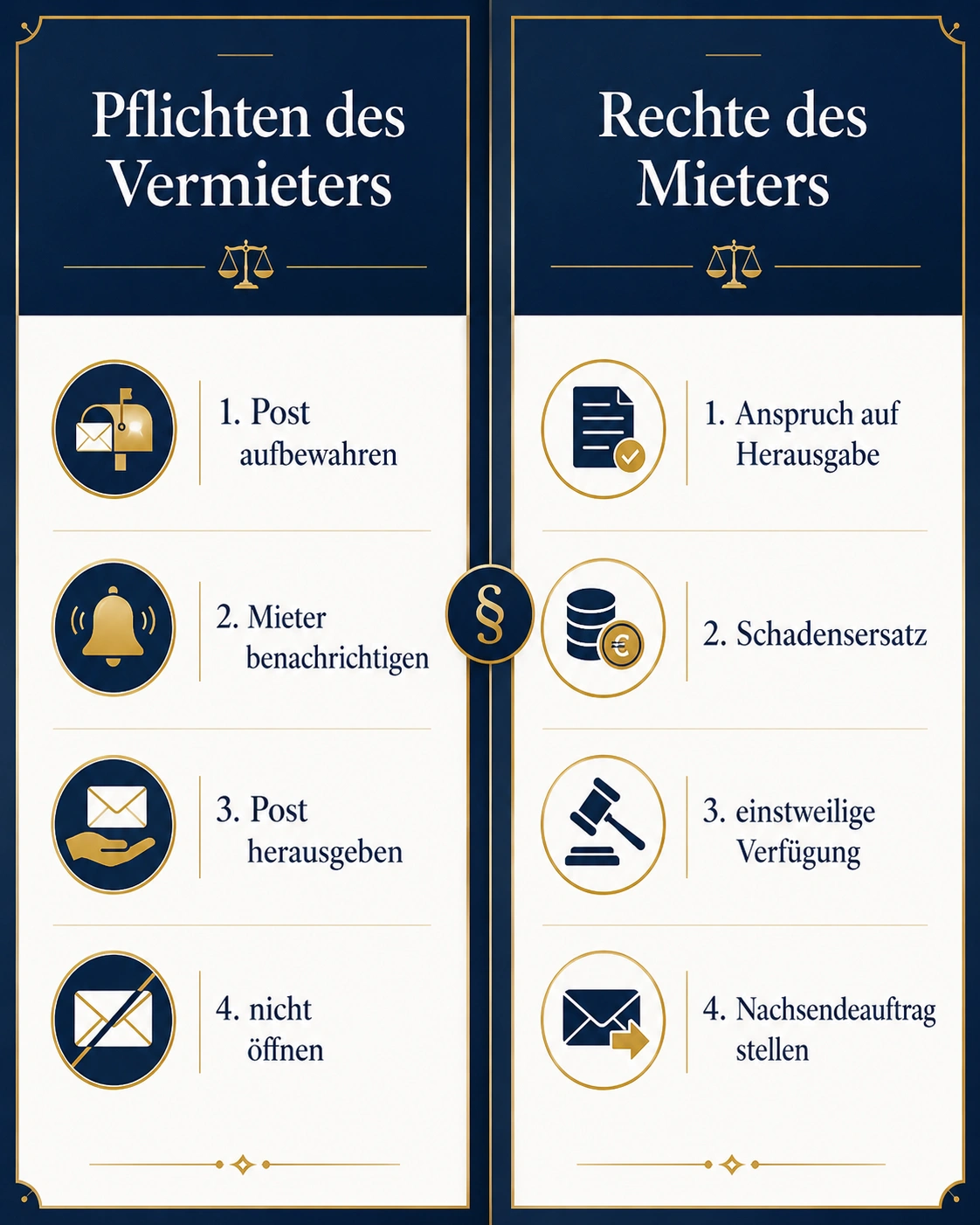
The post-contractual duty of care obliges the landlord to do the following:
- Storage: Mail that is clearly intended for the former tenant and is not obviously advertising must be carefully kept.
- Notification: The landlord must inform the former tenant promptly that mail has been received. An email, a phone call, or a letter to the new address is sufficient.
- Publication The landlord must hand over the mail to the former tenant or allow them to collect it, upon request.
- No unauthorised disposal: The landlord may not open, discard, or post the mail in a public mailbox.
What the landlord absolutely must not do
The landlord is not entitled, to simply dispose of the former tenant's mail or to throw it into a public letterbox. The Darmstadt Regional Court expressly clarified this in a widely cited decision (LG Darmstadt, Order of 30.12.2013, Case No.: 25 T 138/13).
The reason: If a letter is posted in a public letterbox, Deutsche Post will not automatically forward it to the new address. Without a redirection order and without noting the new address, the letter will simply be returned to the sender – if at all. Important deadlines can therefore be missed, court documents can be lost, and the former tenant faces significant damage.
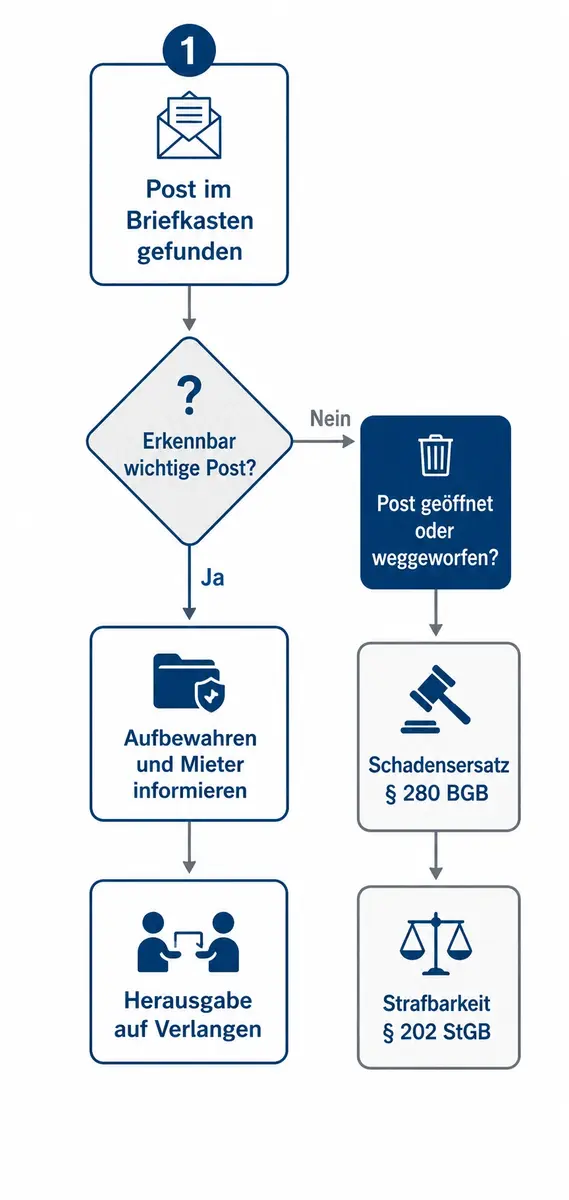
Secrecy of correspondence: Opening other people's mail is punishable by law
A particularly important point that many landlords are not aware of: Opening other people’s mail is punishable by law under Section 202 of the German Criminal Code (Violation of Postal Secrecy). This also applies if the letter is delivered to the landlord’s address – what matters is that it addressed to another person is.
Landlords who open mail belonging to a former tenant risk not only civil claims for damages but also criminal prosecution. The penalty: a fine or imprisonment for up to one year.
Damages for breach of post-contractual obligations
The landlord infringes their post-contractual duty of care – for example, by destroying, failing to forward, or withholding mail for months – this can result in a Tenant's claim for damages under Section 280(1) of the German Civil Code (BGB) result.
The damage can be considerable. Some examples:
- Missed court deadlines (e.g. for lawsuits, payment orders or enforcement orders)
- Lost contract offers or business correspondence
- Unattended official appointments or missed objection deadlines
- Financial disadvantages due to late delivery of invoices or reminders
The landlord is liable for the damage caused if they are responsible for the breach of duty (§ 276 BGB). As the duty of care is a recognised subsidiary obligation, culpability is presumed under § 280 (1) sentence 2 BGB – meaning the landlord must prove that they were not at fault.
Does the obligation apply equally to residential and commercial spaces?
The landmark ruling by the Darmstadt Regional Court concerned a commercial lease agreement – specifically for a law and notary firm. The court emphasised that the duty of care applies in any case to obviously important business mail.
However, the duty is limited not for commercial leases. The principle of § 242 BGB applies to all types of contracts. Landlords also have post-contractual duties of care in residential leases. However, the nature of mail can influence the extent of this duty:
| Criterion | Residential rent | Commercial rent |
| Basic duty | Yes – according to § 242 BGB | Yes – according to § 242 BGB |
| Scope | Recognisable important mail (e.g., official notices, invoices) | Comprehensive for business correspondence as economic damage is threatened |
| Advertising broadcasts | No retention requirement | No retention requirement |
| Damage risk | Moderate (e.g. missed deadline) | High (e.g. lost orders, missed deadlines) |
| Urgency | Normal | Increased – interim injunction possible |
How long does the obligation to retain postal items last?
There is no legally defined period for how long a landlord must keep a former tenant's post. Case law has not yet established a clear upper limit for this.
The following principles apply as a guide:
- Act promptly: The landlord should inform the former tenant as soon as possible that the post has been received. It is reasonable to expect notification within a few days.
- Reasonable retention period: As long as the landlord does not know the tenant’s new address and the post cannot be delivered, they must keep it. A few weeks is generally considered a reasonable period.
- Mail forwarding request: Both parties can help to resolve the issue. The tenant should arrange a mail forwarding service with Deutsche Post in good time. The landlord can submit a request for the new address to the Residents’ Registration Office (Hanover Regional Court, ruling of 3 May 2007, ref.: 13 S 21/07).
Practical tip: The landlord should document the receipt of the post in writing (date, sender, type of post) and ensure that the tenant is notified in a verifiable manner – for example, by email with a confirmation or by registered post.
Landmark decision: Darmstadt Regional Court, order of 30 December 2013 (Case No. 25 T 138/13)
The most well-known ruling on this matter was handed down by the Darmstadt Regional Court. The case serves as a striking illustration of just how quickly a dispute over post can escalate – and how costly this can be for the landlord.
The facts of the case
A law firm was a commercial tenant of business premises until 31st March 2013. Upon vacating, they handed all keys, including the letterbox keys, to the landlady. Their new office was located only about 400 metres away.
It was not until 21 September 2013 – almost six months later – that the landlord informed the former tenant by email that, when handing the premises over to new tenants, she had found business post dated April 2013 in the letterbox. The email contained the remarkable sentence:
„For reasons you are well aware of, I really have no reason whatsoever to be of any assistance to you. Nevertheless, I am informing you of my „discovery“.“
When staff from the law firm went to collect the post, the landlady refused to hand it over. In response to a written request, she replied that they should „stop bothering her“.
The court decision
The former tenant then applied for an interim injunction in summary proceedings to have the post handed over. The Darmstadt Local Court issued the injunction on the very same day.
The landlady lodged an objection, stating that she had already posted the letter in a „public postbox“ on 23 September 2013. The Darmstadt Regional Court ruled:
- The landlady was obliged to keep and hand over the business mail.
- This obligation arises from Section 242 of the German Civil Code (BGB) as a continuing obligation from the terminated rental agreement.
- Putting post in a public postbox does not fulfil this obligation.
- The legal costs were awarded against the landlady.
Practical tips: What tenants and landlords should do
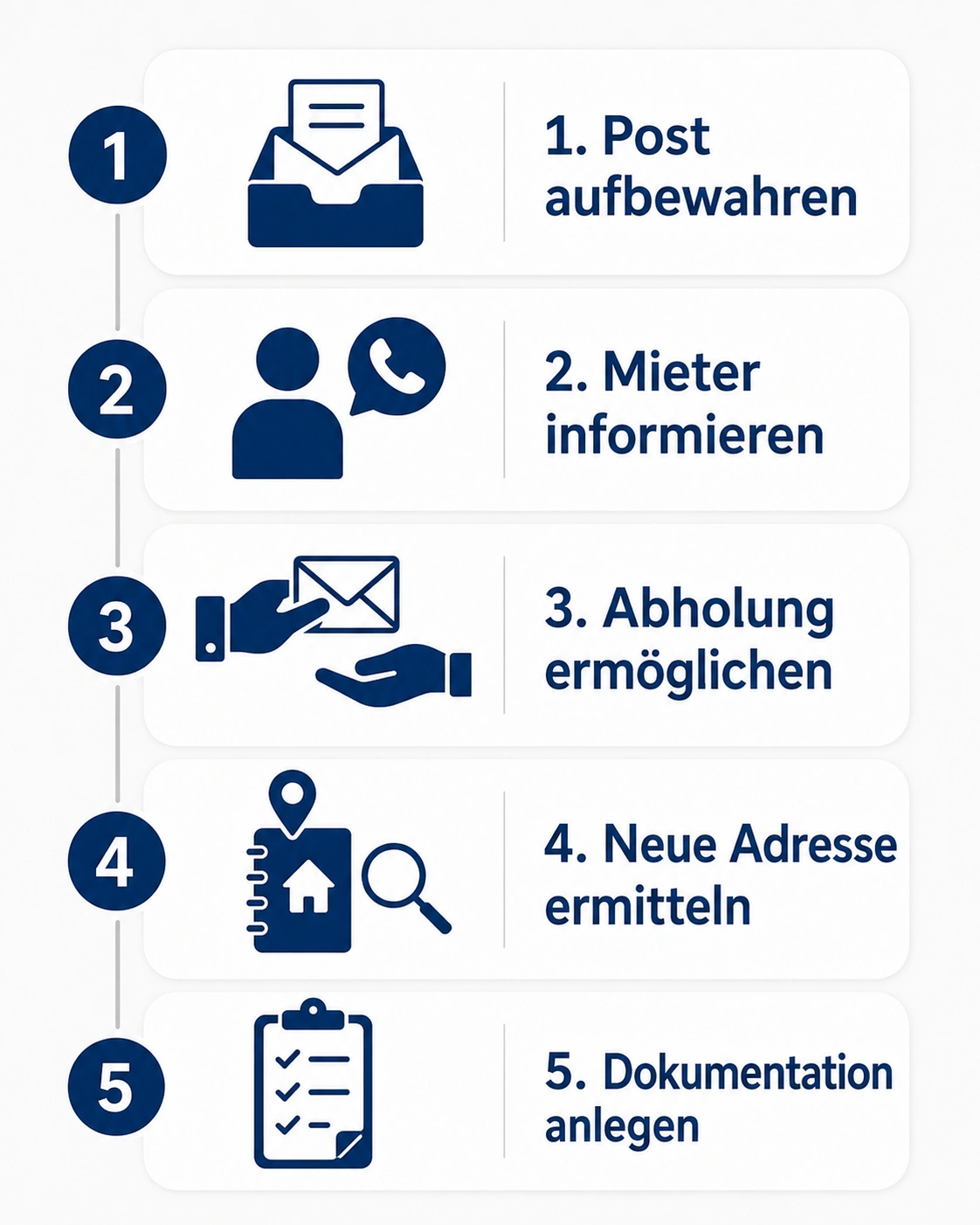
Landlord's Checklist
- Check mail forwarding order: Before the tenant moves out, ask them if they have set up a mail forwarding service with Deutsche Post.
- Keep the post: Please keep incoming post safe and undamaged. Do not open the letters under any circumstances.
- Inform tenants: Please notify the former tenant as soon as possible by email, text message or registered post.
- Enable collection: Please offer a collection date or redirect the post to the new address via registered mail.
- Document: Make a written record of when each item of post was received and when you notified the tenant. This documentation will protect you in the event of a dispute.
Checklist for tenants
- Set up a mail forwarding service: Arrange a mail forwarding service with Deutsche Post in good time (cost: approx. €28.90 for 12 months, as of 2025). Ideally, the service should start a few days before you move out.
- Notify the sender: Inform important correspondents (authorities, insurance companies, banks, employers) of your new address.
- Leave contact details: Provide the landlord with a phone number and email address where you can be reached after moving out.
- Knowing your rights If your landlord withholds or destroys your mail, you are entitled to its return and, if applicable, compensation for damages. In urgent cases, an injunction is possible.
Frequently asked questions about postal forwarding after tenancy ends (FAQ)
SEO Tip: Implement FAQPage Schema (JSON-LD) for this section.
Is the landlord obliged to forward mail from the former tenant?
Yes. Under Section 242 of the German Civil Code (BGB), the landlord has post-contractual duties of care, even after the termination of the tenancy. They must keep any mail clearly intended for the former tenant and allow them to collect it or forward it on. This duty applies to both residential and commercial tenancies.
Can the landlord open the post of the former tenant?
No. Opening other people's mail is punishable under § 202 of the German Criminal Code (violation of postal secrecy) and can be punished with a fine or imprisonment of up to one year. This also applies if the mail is delivered to the landlord's address – what matters is to whom the letter is addressed.
What happens if the landlord throws away mail?
If the landlord disposes of the former tenant’s post, they are in breach of their post-contractual duty of care under section 242 of the German Civil Code (BGB). The tenant may claim damages under section 280(1) of the German Civil Code (BGB). The extent of the damage depends on the specific disadvantages caused by the lost post – for example, missed deadlines, lost business opportunities or missed appointments with the authorities.
How long must the landlord keep the post?
There is no strict legal deadline. The landlord must keep the post for as long as is reasonable under the circumstances. The crucial factor is whether they have already informed the former tenant about incoming mail and given them an opportunity to collect it. As a general rule, a few weeks are considered a reasonable retention period.
Does the obligation also apply to advertising broadcasts?
No – at least not in full. The duty of care applies to post that is clearly important: official correspondence, court documents, invoices, contractual documents and business post. Obvious advertising material (flyers, catalogues, unaddressed advertising) is not subject to the retention obligation.
What can the tenant do if the landlord refuses to hand over the property?
The tenant may first send the landlord a written notice setting a deadline. If the landlord fails to respond, the tenant may take the matter to court. In urgent cases – such as court service of documents or time-sensitive business correspondence – an interim injunction may be applied for. In the case described above, Darmstadt Local Court granted the interim injunction on the very day the application was made.
Can the landlord simply put the post in a communal letterbox?
No. The Darmstadt Regional Court has expressly ruled that depositing a letter into a public mailbox does not fulfil the duty of care. Deutsche Post does not forward letters to the recipient without a redirection order and without specifying the new address. At best, the letter will be returned to the sender – at worst, it will be lost.
Should the tenant set up a mail forwarding service with the post office?
Absolutely. A redirection order with Deutsche Post is the simplest and safest measure to avoid postal delivery problems after a move. The order is valid for 6 or 12 months and ensures that mail is automatically forwarded to the new address. The cost is currently approx. €28.90 for 12 months (as of 2025). The order can be set up online at nachsendeauftrag.de.
Conclusion
The landlord's duty to keep and forward post after the tenancy ends is not a favour; it is a legal obligation under § 242 of the German Civil Code (BGB). Landlords who breach this risk claims for damages and, in the worst case, criminal proceedings for violation of postal secrecy.
Tenants should ensure they set up a mail forwarding service in good time and provide their landlord with their new contact details. This will help you avoid unnecessary complications.
If you as Tenant or landlord If you have any questions about post-contractual obligations or if you are being withheld post, solicitor Helmer Tieben will be happy to advise you personally. Please call us on 0221 - 80187670 or send us an email at info@mth-partner.de.
Further articles on tenancy law
- Furniture left in a rented flat: when does this constitute an impermissible partial clearance?
- If a landlord evicts a tenant without proper authorisation, this may give rise to claims for damages
- The rental deposit between tenant and landlord – prerequisites and claims
- Eviction lawsuit in Cologne – requirements and procedure