
You have cancelled – or your Your employer has terminated your employment. In both cases, sooner or later, a question arises that many employees only consider late on: What does my reference look like? And what can I do if it's incorrect?
In German employment law, the reference letter is far more than a formality. It is your professional business card – a document that is read with every application and helps decide your chances on the job market. Therefore, the legislator has laid down clear rules on who receives a reference letter, what must and must not be included in it.
This article explains the current legal situation as of 2026, including the possibility of electronic employment references since January 2025 and the latest case law of the Federal Labour Court concerning the closing formula.
Please note: This article is for general guidance only and does not constitute individual legal advice. Every case is different – you should consult a lawyer with experience in employment law for your specific situation.
Anyone who has a contract of employment is entitled to an employment reference. This applies to both full-time and part-time employees, as well as apprentices and trainees.
The central provision is § 109 of the Trade Regulation Act (Gewerbeordnung - GewO). It states unequivocally: Every employee is entitled to a written reference upon termination of the employment relationship. In addition, § 630 of the Civil Code (Bürgerliches Gesetzbuch - BGB) regulates the entitlement for persons engaged in service, and § 16 of the Vocational Training Act (Berufsbildungsgesetz - BBiG) regulates the entitlement for apprentices.
Not only classic full-time employees are entitled to this. Part-time workers, fixed-term employees, minijobbers, trainees, interns (provided it is not purely a taster internship), homeworkers, and persons similar to employees can also request a certificate. For temporary agency workers, the entitlement lies with the lending company – not the hiring company where they actually worked.
The claim arises upon termination of the employment relationship. However, you do not have to assert it on the last day. According to the consistent case law of the Federal Labour Court (BAG), you can request a provisional certificate as soon as the notice of termination has been issued – so that you are not left empty-handed for ongoing job applications.
Simple and qualified employment certificate – what's the difference?
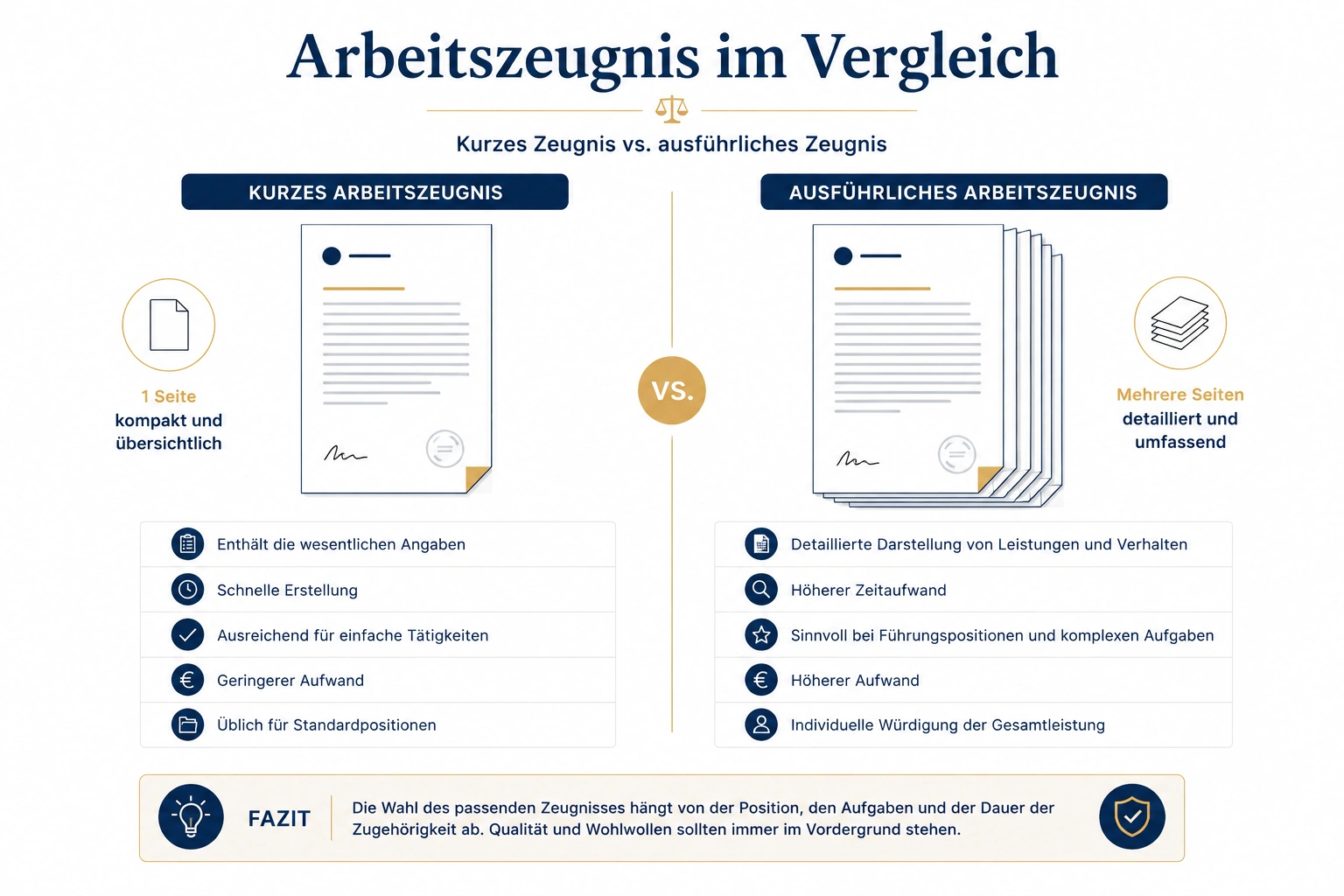
The law distinguishes between two types of certificates. You decide for yourself which one you receive – because § 109 of the Trade Regulation Act (GewO) gives the employee a right of choice.
| Simple testimonial | Qualified certificate | |
| Contents | Name, Occupation, Type and Duration of Employment | Simple testimonial, with additional performance and conduct assessment |
| When does it make sense? | For short employment periods or when an appraisal is not desired | Standard case – the more clearly meaningful option for each application. |
| Legal basis | § 109(1) of the Trade Regulations Act, sentence 2 | Section 109, Paragraph 1, Sentence 3 of the Trade Regulation Act |
In practice, the vast majority of employees request a qualified reference – and for good reason: Without a statement on performance and conduct, the next employer is missing precisely the information they pay most attention to when assessing applications.
Format of the employment reference: paper, signature – and from 2025 also digital
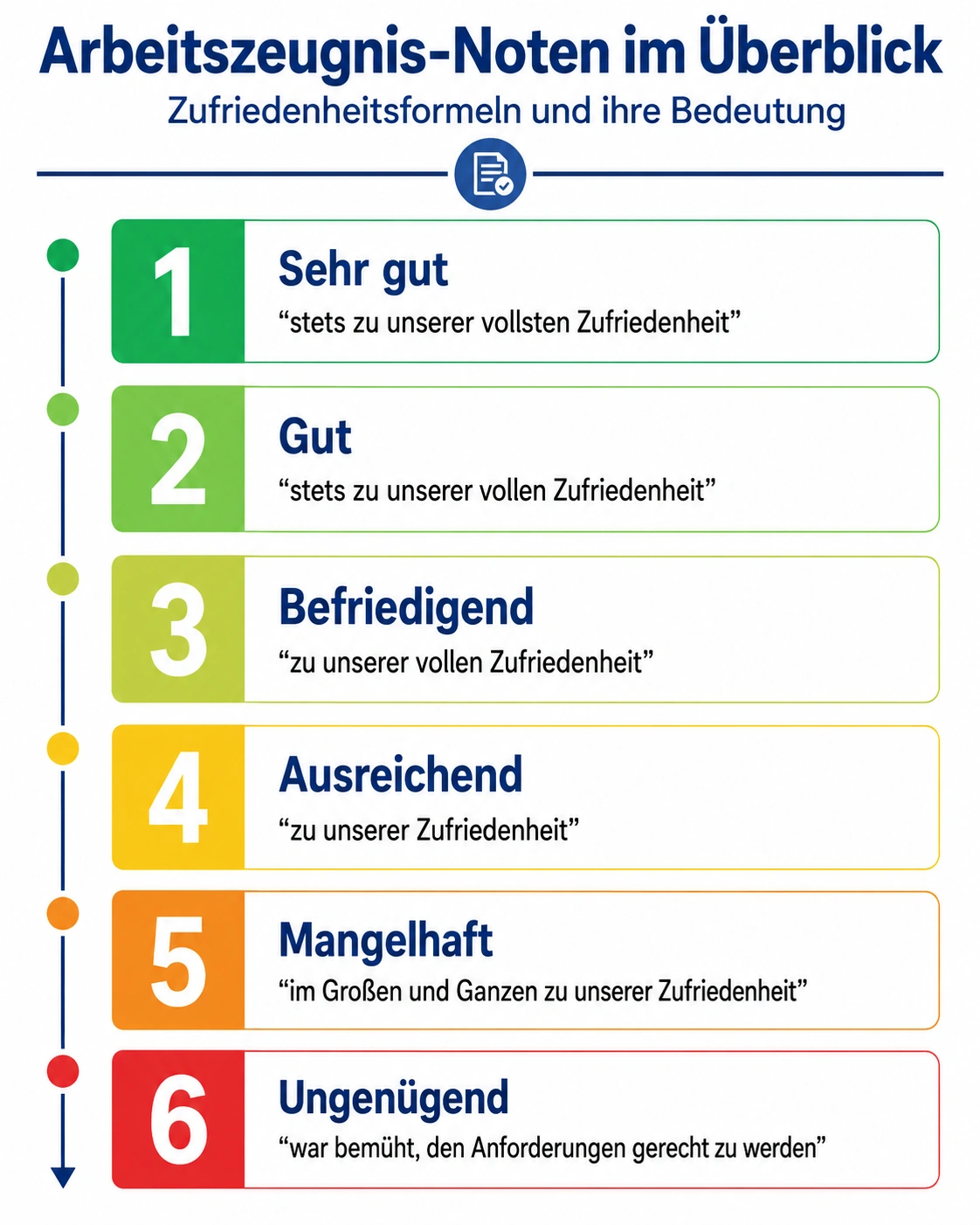
As a general rule, the employment reference must be issued in writing – on company headed paper, in uniform typewriting, clean and free of smudges, corrections, or handwritten additions. The reference is to be signed by hand by the employer or a person authorised to represent them. An email or a simple PDF has not been sufficient up to now.
New since 1 January 2025: With the Bureaucracy Relief Act IV, the legislator amended § 109 para. 3 of the GewO (Trade, Commerce and Industry Regulation Act). Since then, the employment reference can also be issued in electronic form – however, only under two conditions:
Firstly: The employee must expressly agree to the electronic form. Anyone who wants a paper certificate continues to have a full entitlement to it.
Secondly: The electronic certificate must be provided with a qualified electronic signature (QES) according to § 126a BGB. A simple email signature or a scanned PDF is not sufficient.
In practice, the paper form is likely to remain the rule for the time being – not least because the QES is not yet established in many companies and an electronically signed certificate cannot be backdated, which becomes a problem if the certificate is issued late.
Structure and Content of a Qualified Employment Reference
A qualified employment reference follows a fixed structure that has become established in practice over decades. Deviations from this structure are noticeable – and can be detrimental to the employee.
1. Heading and Introduction
The certificate begins with the heading and states the employee's full name, date of birth, and the start and end of the employment.
2. Description of activities
Here, the tasks assigned to the employee are described as completely and accurately as possible, so that expert third party can get an appropriate picture of the perceived scope of duties. The job description is purely descriptive – it does not evaluate, but rather presents.
3. Performance Review
This section assesses the employee's expertise and skills, their work approach (e.g., diligence, initiative, resilience), and their work success. It also contains the crucial satisfaction formula, from which the overall grade can be read.
4. Behavioural Assessment (Leadership)
The behaviour towards superiors, colleagues, employees and, where relevant, customers and business partners is described here. Pay attention to the SequenceIf superiors are not mentioned first, this can have a negative connotation in the language of testimonials.
5. Termination clause and closing remarks
At the end, the reason for leaving (at the employee's request) is stated, along with – often but not always – a thank you and good wishes. More on this shortly.
Report card language: What the phrasing really means
The employment reference is subject to two principles that are in a certain tension: the duty of truthfulness (principle of reference truthfulness) and the duty of benevolence (§ 109 (2) GewO). The employer must not place obstacles in the employee's professional path – but they are also not obliged to compose untruthful eulogies.
A unique language of testimonials has developed over decades from this area of tension: a system of standard phrases that can be assigned to school grading. The most important is the so-called satisfaction formula in performance appraisals:
| Note | Formulation | School report |
| 1 | ...always to our fullest satisfaction | Very good |
| 2 | ... to our fullest satisfaction / ... always to our fullest satisfaction | Gut |
| 3 | …to our full satisfaction | Satisfactory |
| 4 | …to our satisfaction | Sufficient |
| 5 | …all in all / on the whole to our satisfaction | Defective |
| 6 | …has endeavoured to complete the tasks to our satisfaction | Insufficient |
The difference between Full and Fullest Satisfaction may seem like a minor linguistic detail – but in report card language, it separates a grade of 3 from a grade of 1 or 2. Anyone checking their report card should read every single word in the satisfaction formula carefully.
Besides the satisfaction formula, there are numerous other coded formulations. Some examples to look out for are:
He always tried his best – sounds friendly, but means: The performance was poor. Striving without result is not a recommendation.
She completed all tasks properly – means: She did only what was strictly necessary, without showing any initiative of her own.
He was popular with colleagues – Without mentioning management, this could indicate that the relationship with the leadership was problematic.
She completed all tasks to her satisfaction – Attention: „their“ instead of „our“ is a hidden negative hint.
The concluding formula: No claim – but a strong signal
At the end of many employment references, there is a phrase in which the employer expresses regret at the employee's departure, thanks them for their work, and wishes them all the best for the future. If this concluding formula is missing, it is noticed by HR professionals – and raises questions.
Nevertheless, according to the constant case law of the Federal Labour Court, there is No legal entitlement to such a formula of thanks and good wishes. The BAG most recently affirmed this in its judgment of 25 January 2022 (Case No. 9 AZR 146/21). Reasoning: The closing formula expresses the personal sentiments of the employer and is protected by their freedom of expression (Article 5 of the Basic Law) and freedom of enterprise (Article 12 of the Basic Law).
But A closing remark once issued cannot be subsequently deleted simply because the employee has requested a certificate correction. This would constitute inadmissible retaliation under § 612a BGB – according to the BAG in its judgment of 6 June 2023 (file ref. 9 AZR 272/22). Anyone who legitimately disputes their certificate may not be punished for it.
In March 2026, the Stuttgart Labour Court clarified in another case that the exact wording of the concluding formula allows for a certain degree of leeway (ArbG Stuttgart, 3 March 2026, Ref. No. 3 Ca 7407/25).
The interim report: When you can request it – and why you should
In addition to the final certificate upon termination of employment, there is the interim certificate – a certificate issued during the ongoing employment relationship. A statutory entitlement to this only exists if there is a valid reason, for example:
Change of supervisor Your former boss, who knows and can assess your work, is leaving the company.
Transfer of undertaking or restructuring – the organisational structures are changing fundamentally.
Application for another position You require the certificate as part of your application.
Parental leave, sabbatical or extended leave – an interruption after which the basis for assessment might fade.
Strategically important: The interim report (mid-term review) unfolds a Binding effect. The Federal Labour Court has decided (judgment of 21 June 2005, ref. 9 AZR 352/04) that an employer may not deviate from the assessments in an interim reference in the final reference without a valid reason. Those who secure a positive interim reference during good times are in a strong position if a conflict arises later.
Burden of proof in employment disputes: Who has to prove what?
If you disagree with your testimonial and your employer refuses to correct it, your recourse is to the Employment Tribunal. The burden of proof plays a crucial role in this.
The Federal Labour Court has ruled that the grade Satisfactory (Note 3) is considered the average rating. This results in:
Does the employee claim a better grade (1 or 2): He must demonstrate above-average performance – for example, through a positive interim report, performance bonuses, documented assessments or witness statements.
Does the employer give a worse grade (4, 5 or 6): He must prove that the performance was below average. The employer bears the full burden of proof here.
This distribution has considerable practical significance: in many cases, the parties agree on a grade of 2 precisely because the employee would have difficulty proving a better grade, and the employer would have equal difficulty substantiating a worse one.
Statute of Limitations and Deadlines: When Does Your Claim Expire?
The entitlement to a reference is subject to the three-year ordinary limitation period pursuant to Section 195 of the German Civil Code (BGB). The period begins, in accordance with Section 199 of the BGB, at the end of the year in which the employment relationship ends.
Caution – Exclusion periods: Many employment contracts and collective bargaining agreements contain exclusion clauses that significantly shorten the claim – often to three to six months after the termination of the employment relationship. Check your employment contract carefully.
Furthermore, the claim can be lost even before the statute of limitations expires, according to the principles of forfeiture (§ 242 BGB). Therefore, act quickly. If approval is granted late, it may even be possible under certain circumstances to Claims for damages arise.
Common mistakes in employment references – and how to spot them
Not every mistake in a reference is obvious. Some hide in the details.
Missing activities If key areas of responsibility are not mentioned in the reference, it devalues your professional profile.
Gaps in behavioural assessment If superiors or clients are not mentioned, this can be interpreted as eloquent silence.
Passive formulations „He was assigned tasks“ versus „He took on tasks“ – the difference between initiative and passive completion.
Incorrect exhibition date: The certificate should be dated on the last day of employment – not on the day it was written.
Negation instead of affirmation: „His behaviour gave no cause for complaint“ sounds neutral, but in the language of references, it's a negative signal.
Es gibt Momente, in denen es Sinn macht, ein Zeugnis zu haben. Manchmal sind sie nicht so einfach zu bekommen, aber sie helfen trotzdem. Lawyer experienced in employment law to have checked.
What should not be included in a reference letter
- Section 109, Paragraph 2 of the Trade Regulation Act expressly prohibits formulations that are intended to convey a meaning about the employee other than that apparent from the wording. Furthermore, the following information must generally not appear in the certificate:
Works council activities – unless the employee expressly requests otherwise
Pregnancy, illnesses, disabilities – would be discriminatory under the AGG
Trade union membership, political opinion, religion
Cautions or suspicions
Details about private life – unless there is a direct link to the activity
If your certificate contains inadmissible content, you have a right to correction. Even contradictory statements an error in the report text may be a reason for a correction.
When is legal assistance worthwhile for an employment reference?
Not every wording that you don't like is legally contestable. But there are situations where legal support makes the difference:
If your report card contains a grade of 4 or worse and your employer refuses to make a correction, then the burden of proof lies with the employer, and a lawyer can enforce this position on your behalf.
If you are aiming for a better grade and have proof of above-average performance – such as a positive interim report, performance bonuses, or documented target agreements.
If the report contains hidden negative phrasing that you didn't notice at first glance.
If you have a Received termination notice and the certificate is part of an overall solution – in a Cancellation agreement or judicial settlement, the grade on the testimonial can often be negotiated.
If you suspect your employer Your personnel file used as a basis for an unjustifiably bad review.
If you have questions about your employment reference or would like a professional review, please contact us on the number 0221 - 80187670 or by e-mail to info@mth-partner.de. You can also directly a Book an appointment.
Frequently asked questions about the employment reference
Can my employment reference also be issued digitally from 2025?
Yes. As of January 1, 2025, employers can issue the employment reference electronically – provided you agree and the reference is affixed with a qualified electronic signature (QES) pursuant to Section 126a of the German Civil Code (BGB). Those who prefer a paper reference are still entitled to one.
Am I entitled to a closing formula with thanks and best wishes?
No – at least not as a legal entitlement. The Federal Labour Court (BAG) has repeatedly confirmed this (most recently 25.01.2022 – 9 AZR 146/21). However, an employer may not delete a closing formula once it has been issued simply because you have requested a correction – that would be an impermissible reprisal under Section 612a of the German Civil Code (BGB) (BAG, 06.06.2023 – 9 AZR 272/22).
What can I do if my reference is too bad?
First, you should ask the employer in writing to correct it, and specifically name which formulations you object to. If they refuse to correct it, you can assert a claim for correction of the testimonial in an employment tribunal. Remember the burden of proof: you must prove that it is better than satisfactory, and the employer must prove that it is worse than satisfactory.
When does my claim for a reference letter expire?
The statute of limitations is three years (§ 195 BGB), commencing at the end of the year in which the employment relationship terminates. However, be aware that exclusion periods stipulated in employment or collective bargaining agreements may shorten this period to three to six months.
Does the employer have to state the reason for dismissal in the reference?
No. The reason for termination can generally only be included at your request. Caution is advised in the case of a dismissal for misconduct by the employer – seek advice before agreeing.
Can I waive my work reference?
A waiver of a qualified employment reference before the termination of the employment relationship is invalid according to current Federal Labour Court (BAG) case law (2025) – otherwise, the employer could exert pressure during the ongoing employment. After termination, you can theoretically waive it, but there is no good reason to do so.


One Response
Hi.
I have a work reference. I've had a lot of penalties and have been through a lot. .